Greater Gulf State Fair Opens in Mobile With Petting Zoo Safety Focus
The Greater Gulf State Fair opened in Mobile on Oct. 19, 2007, with officials emphasizing health and safety measures, especially at the petting zoo.
Originally reported October 19, 2007.
The Greater Gulf State Fair opened in Mobile on Friday, Oct. 19, 2007, with organizers encouraging visitors to make health and safety a priority during the annual fall tradition. That focus was especially evident at the fair’s petting zoo, where the exhibit’s setup reflected lessons learned from a series of nationwide outbreaks that had linked animal-contact exhibits to serious illness in children.
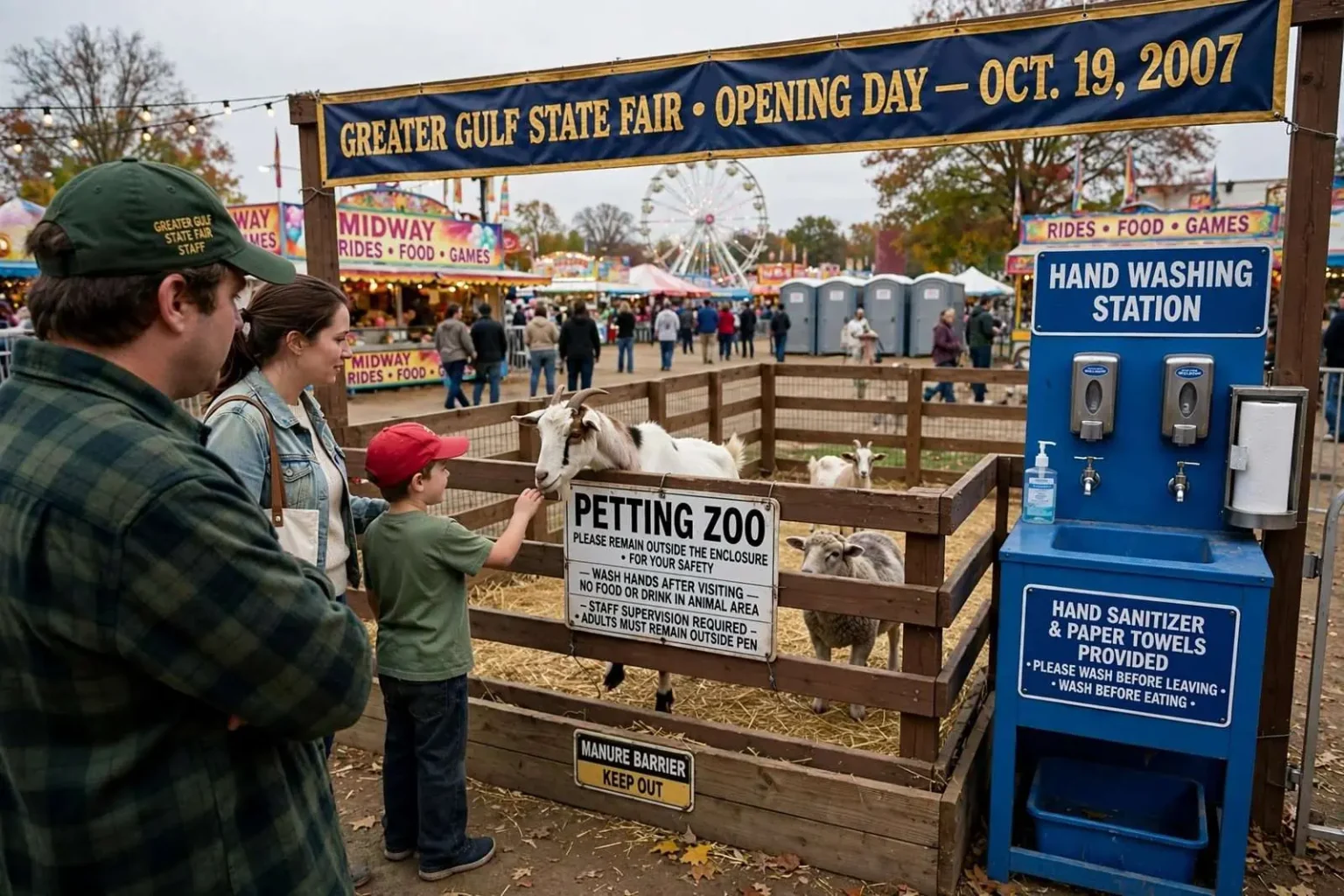
Vendor Dennis Cook said the exhibit had hand-washing dispensers and towels available to visitors, as well as a border around the animal enclosures intended to keep manure from reaching areas used by the public. Cook said adults were no longer allowed inside the animal pen with children — a practice that had been permitted years earlier — as part of the exhibit’s effort to reduce contact between fairgoers and contamination that could spread from animals to people.
The fair was scheduled to continue through Oct. 28, giving visitors more than a week to take in the rides, exhibits, food and animal attractions that made the event a fixture of Mobile’s fall calendar. The safety emphasis at the petting zoo mirrored guidance that state and county health officials had been promoting across the country in the mid-2000s.
Why petting zoos drew attention
By 2007, petting zoos had become a familiar subject of public-health warnings. The concern centered on E. coli O157:H7 and other pathogens carried harmlessly by livestock — cattle, goats, sheep and their pen mates — that can cause severe, sometimes life-threatening illness in humans, particularly small children. The most consequential outbreak had come in 2004 at the North Carolina State Fair, where more than 100 people, many of them children, were sickened after visiting an animal exhibit, and investigators traced the infections to a building whose drainage spread contaminated dust and water.
Federal and state health agencies responded with detailed guidance for animal-contact exhibits: barriers between animals and visitors, no food or drink in animal areas, hand-washing stations positioned at the exits, and signage telling visitors to wash before eating. The recommendations reshaped how county fairs, state fairs and traveling carnivals operated their animal exhibits, and the Greater Gulf State Fair’s setup — dispensers, towels, a manure barrier and limits on who could enter the pen — tracked that guidance closely.
The border Cook described serves a specific function. Livestock pens concentrate manure, and the bacteria in it can survive on surfaces, fencing and the ground for days. A physical boundary that keeps visitors from stepping into animal areas, combined with hand washing after touching animals, breaks the main transmission routes between the animals fairgoers come to see and the food they inevitably eat a few steps later on the midway.
The Greater Gulf State Fair’s place in Mobile
The Greater Gulf State Fair has been a Mobile institution for generations, staging its annual run each fall at the fairgrounds and drawing families from across the Gulf Coast for midway rides, agricultural exhibits, livestock shows, concerts and the fried food that defines the American fair experience. Operated under the Greater Gulf State Fair’s civic organization, the event carries forward the county-fair tradition of celebrating the region’s agricultural roots even as south Alabama’s economy has shifted toward industry, trade and tourism.
For many Mobilians, the fair marks the pivot from summer to fall — the point in the calendar when school routines have settled, high school football is in full swing and the first cool fronts begin to reach the Gulf Coast. The 2007 edition followed that familiar pattern, opening on a Friday and running through the following weekend to capture two full sets of weekend crowds.
Fairs and public health across the Gulf Coast
Animal exhibits are only one of the health issues fairs manage each season. Heat remains a factor on the Gulf Coast even in October, with fair days regularly reaching the 80s, and first-aid stations at fairs treat everything from dehydration to ride-related injuries. Food safety inspections cover the dozens of vendors on the midway, and ride inspections — state-regulated in Alabama — draw some of the closest scrutiny of all, particularly after high-profile accidents at traveling carnivals elsewhere in the country.
The petting zoo focus in 2007 fit into that broader safety picture. Organizers’ decision to spotlight health and safety at the opening reflected both the national guidance of the era and the practical reality that a fair’s reputation depends on families going home healthy. A single outbreak traced to an exhibit can undo years of goodwill, and fair operators across the country adopted the new standards not as red tape but as basic protection for their youngest visitors.
For the children who visited the exhibit in 2007, the rules changed an experience their parents may have remembered from earlier fairs. Where families once walked into the pen together — adults and children side by side among the goats and calves — the 2007 setup kept visitors outside the enclosure, petting and feeding across the barrier, then washing up on the way out. Cook, the exhibit’s vendor, framed the changes as improvements to the way the attraction was run rather than a diminishment of it: dispensers and towels instead of a lone sink, a border instead of a shared floor, and a rule that put adults on the same side of the fence as the children they brought.
The 2007 fair run
The Oct. 19 opening and Oct. 28 close gave the 2007 fair a standard eleven-day run, spanning two weekends and the weeknight crowds of students, church groups and community organizations that fill fairgrounds between the busy Friday and Saturday evenings. Fair weeks on the Gulf Coast also coincide with a busy stretch of the regional events calendar — high school playoffs, college football Saturdays and the first wave of holiday-season planning — and fair operators have long counted on the event’s familiarity to keep attendance steady year over year.
The 2007 edition arrived during a period of stability for Mobile’s fall traditions, before economic turbulence reshaped household spending in the years that followed. Attendance figures for the run were not preserved in the report, but the fair’s continuation through the decade that followed speaks to its standing in the city’s calendar — an event that generations of south Alabama families have attended in one form or another, and one where the details, right down to the hand-washing stations at the petting zoo exit, have gradually modernized around the rides and exhibits that stay the same.
What visitors can learn from it
The practices highlighted at the 2007 exhibit remain the standard advice for anyone visiting an animal exhibit today: wash hands thoroughly after touching animals or leaving the pen area, keep food and drink out of animal areas, keep small children’s hands away from their mouths until washed, and take extra care with children under five, adults over 65 and anyone with a weakened immune system, for whom E. coli infection carries the greatest risk of severe complications.
Those habits cost nothing and take less than a minute, and they were exactly what the Greater Gulf State Fair’s 2007 setup was designed to encourage. The report preserved here documents the fair’s opening day emphasis — health and safety as a priority — and the specific measures a traveling exhibit vendor put in place to deliver it: dispensers and towels, a border to keep manure away from visitors, and a new rule keeping adults outside the pen with their children, closing a practice from an earlier era of the fair.
How Alabama fairs are regulated
Alabama’s fairs operate under a mix of state and local oversight. The Alabama Department of Agriculture and Industries handles consumer protection matters, county health departments inspect food vendors under state sanitary rules, and amusement ride safety is regulated under state law, with operators required to maintain inspection records for the rides they move from town to town. Animal exhibits fall into a gray zone that health agencies address mainly through guidance and inspection during outbreaks, which is why the voluntary standards on display at the Greater Gulf State Fair in 2007 mattered — at fairs, the operator’s own commitment is often the first and most important layer of protection.
Mobile County’s health department, part of the Alabama Department of Public Health’s network of county offices, works with event organizers throughout the year on everything from vendor inspections to sanitation planning for large crowds. The fair’s mid-October timing places it after the peak heat of summer but before the colder fronts of late fall, a window when outdoor crowds are comfortable and the food-safety risks of heat-spoiled product are somewhat reduced.
A Gulf Coast tradition updated
The changes at the petting zoo in 2007 capture, in small scale, how long-running institutions update themselves. The fair itself — rides, exhibits, livestock, the midway’s lights and sounds — carries on largely as it did in earlier decades, while the details around the edges evolve with new knowledge about safety and health. Visitors who remembered walking into the pen with their own parents saw a different arrangement, one that reflected two decades of hard lessons from fairground outbreaks across the country.
The 2007 report preserved here documents those details precisely because they were newsworthy at the time: hand-washing dispensers and towels, a manure barrier around the enclosures, and adults kept outside the pen. Vendor Dennis Cook’s description of the exhibit stands as a record of how one Gulf Coast fair put national public-health guidance into practice — and of an opening day when Mobile’s oldest fall tradition asked its visitors, in the middle of all the fun, to make health and safety a priority too.