Grove Hill Municipal Pool Gets New Fence, Lighting Ahead of Labor Day
The Grove Hill Municipal Pool is getting a new fence, utility poles and night lighting as work continues at the facility, which will remain open through Labor Day.
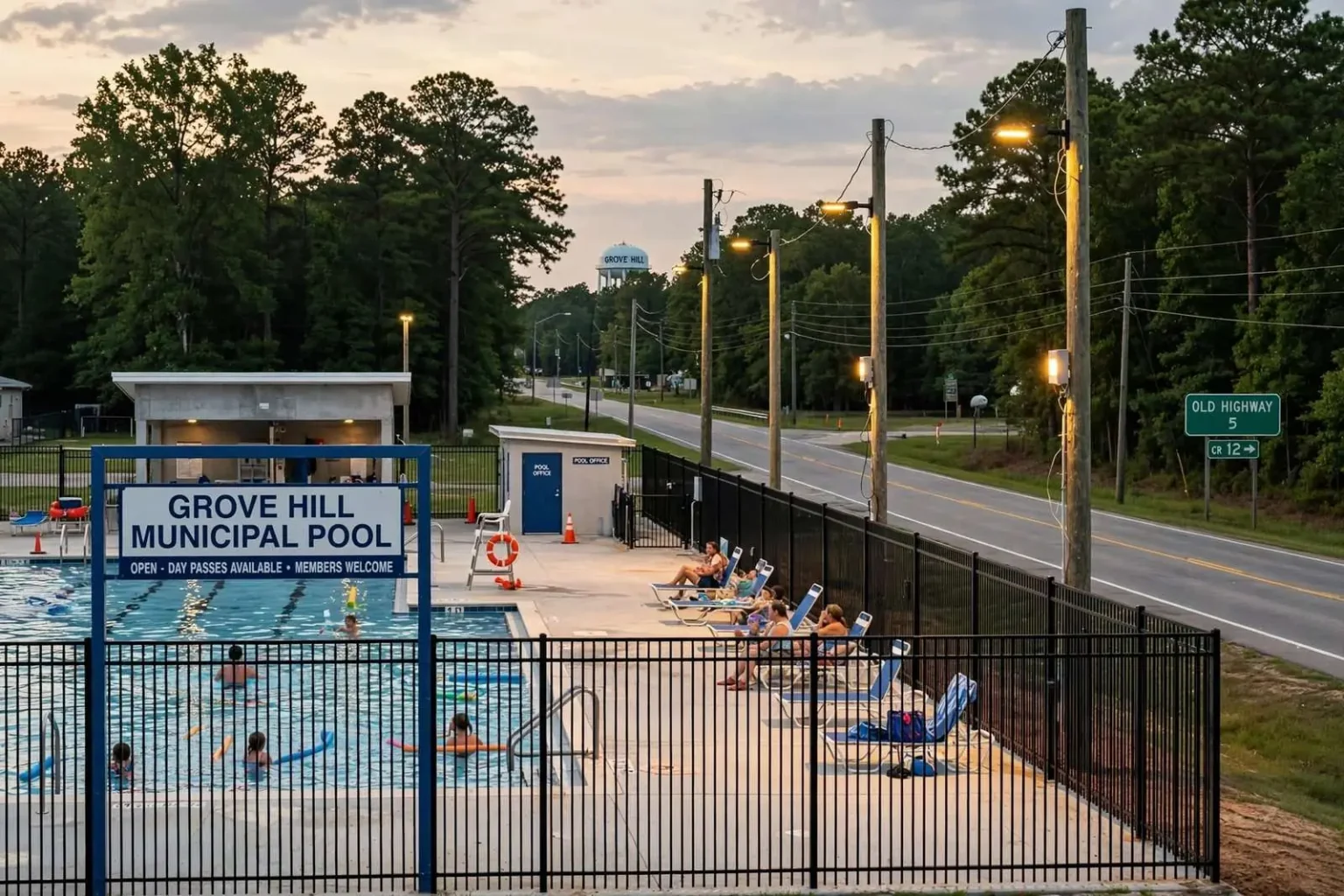
Improvements are underway at the Grove Hill Municipal Pool, where crews have installed a new fence along Old Highway 5 and added utility poles and night lighting in recent weeks. The upgrades come as the pool continues to operate for the remainder of the summer season.
The new fencing along the Old Highway 5 side of the property gives the municipal pool a clear boundary along one of the town’s main corridors, screening the facility from the roadway and controlling access to the deck. The poles and night lighting that followed change the site’s profile after dark, illuminating a facility that for years has gone dim at sundown. Both projects were completed while the pool remained open, with crews working around the daily schedule of swimmers.
City officials say the facility will remain open through Labor Day, giving residents several more weeks to use the pool before it closes for the year. The stretch between late summer and the holiday weekend is traditionally one of the pool’s busiest, as families squeeze in the last of their swimming before school-year routines take over and the season ends.
A Community Fixture in Clarke County
The Grove Hill Municipal Pool has long served as a gathering spot for families in Clarke County during the hot Alabama summer months. Improvements such as new fencing and lighting are typically aimed at both improving safety and extending the usability of a facility into the evening hours. The addition of night lighting could open the door to extended pool hours or evening programming in future seasons, though city officials have not announced any changes to the current operating schedule.
The pool’s place in Grove Hill life is hard to overstate. In a small town where options for recreation are limited by scale, a public pool functions as a summer commons — the place where children learn to swim, where teenagers meet up, and where families gather on hot afternoons that would otherwise be spent indoors. Generations of Clarke County residents have the same memory bank of summers measured in trips to the pool, and the facility’s upkeep is a matter of local pride as much as municipal service.
The pool is open to members, though the city also allows visitors to purchase day passes, making it accessible to residents who are not enrolled as annual memberships. That dual structure serves the town’s realities: local families who use the pool all summer buy in, while visitors — relatives in town for a week, families passing through, residents from elsewhere in the county — can swim for a day without a season commitment.
Why Lighting and Fencing Matter
Pool fencing is one of the most straightforward safety investments a community can make. A secure perimeter keeps unsupervised children from wandering onto an unguarded deck, satisfies the liability and code expectations that come with operating a public pool, and separates the water from a busy roadway like Old Highway 5. Many municipal pools across rural Alabama have faced pressure in recent years to upgrade aging enclosures, and Grove Hill’s new fence brings its facility in line with modern expectations.
The night lighting carries both safety and possibility. Lit grounds deter trespassing and vandalism after hours, make evening cleanup and maintenance easier, and — most intriguingly — create the option of programming the facility after dark. Communities that have lit their pools commonly use the capability for evening swim lessons, family swim nights, pool parties, and special events that a dark facility could never host. Grove Hill officials have not committed to any such schedule, but the infrastructure is now in place if they choose to.
Grove Hill, the county seat of Clarke County, has been pursuing a number of infrastructure projects this year, including grants for street resurfacing and the replacement of aging water lines, as the city continues to invest in its public facilities.
That broader agenda gives the pool work its context. Small municipalities across Alabama’s rural counties operate on tight budgets, and each improvement typically requires a blend of local funds and grant support. Street resurfacing addresses the roads residents drive daily; water line replacement modernizes utilities that in many small towns date back decades. Set alongside those projects, a new fence and lighting system at the pool shows a city attending to quality-of-life assets as well as basic infrastructure — a balance that residents of small towns notice and appreciate.
The Town Behind the Pool
Grove Hill serves as the governmental and commercial center of Clarke County, a heavily forested county in southwest Alabama between the Tombigbee and Alabama rivers. The town sits along the corridor between larger regional hubs, and its population hovers near 1,500 residents, with the surrounding county adding several thousand more who look to Grove Hill for services, schools, and shopping. For a community of that size, the municipal pool is one of the few public recreational facilities of its kind within easy reach, which explains both its popularity and the attention its maintenance receives.
Alabama’s summers make the case for the investment on their own. South Alabama’s heat and humidity settle in from May through September, and air conditioning is a poor substitute for water when children are out of school for the summer. Public pools in small towns also serve an equity function — they give every family, regardless of income, access to swimming that private clubs and backyard pools provide elsewhere. Day passes keep that door open even wider, and the city’s willingness to maintain the facility through Labor Day extends the value of the season for working families.
Labor Day’s traditional role as the unofficial end of summer will bring the season to its familiar close. Municipal pools across the region typically shut down after the holiday weekend, as schools settle into full swing, lifeguards return to school or college, and overnight temperatures begin their slow decline. The final weeks before closure are usually crowded ones, and this year’s closing will arrive with the facility looking better than it has in years.
What Comes Next
Whether the night lighting leads to expanded hours next season will be a decision for city officials as they plan next summer’s schedule. The possibility of evening programming — swim lessons after work hours, community swim nights, rented pool parties — is the kind of benefit that infrastructure creates quietly and pays off over years. Even without schedule changes, the lights and fence make the facility safer and more manageable from day to day.
The pool project also fits into a wider story of small Alabama towns reinvesting in themselves. Communities like Grove Hill compete for residents and businesses with larger towns that offer more amenities, and the quality of public facilities — parks, pools, streets, and utilities — weighs heavily in that competition. Each grant won and project completed signals a town that is maintaining rather than declining, a message that matters to young families deciding where to settle.
For now, the message to residents is simpler: the pool is open, the grounds are fenced and lit, and the season will run through Labor Day. After months of work visible along Old Highway 5, Grove Hill’s summer gathering place enters its final stretch looking like a facility the town can be proud of — and one positioned to serve the next generation of Clarke County swimmers for years to come.
The work at the pool also illustrates how small-town projects actually get done. Fencing, poles, and lighting each involve different contractors, utility coordination, and timing around the pool’s operating hours, and municipal staff manage all of it while keeping the facility open to the public. Completing such work mid-season rather than waiting for closure shows a deliberate effort to let residents enjoy the improvements while they can still use them — a small thing that residents of towns this size tend to notice.
The improvements’ timing relative to the summer season also maximizes their visibility. Old Highway 5 carries steady local traffic, and passersby have watched the fence line rise and the poles go in over recent weeks. In a small town, that kind of public progress builds goodwill for future projects — the street resurfacing and water line work among them — by demonstrating that the city follows through on facility upgrades.
Swimming Safety and Small Towns
Beyond recreation, municipal pools play a quiet role in water safety across rural Alabama. Drownings remain a leading cause of accidental death among young children nationally, and swim lessons at a community pool are often the only formal instruction available to children in small towns. A well-maintained, properly fenced, staffed facility is the foundation for that work, and upgrades like Grove Hill’s strengthen the case for families to make the pool their children’s summer home base.
The fence along the roadway side deserves particular emphasis in that regard. Pools that sit near busy roads face a specific hazard — an excited child chasing a ball or simply wandering from an adjacent yard — and a secure perimeter eliminates the most dangerous scenario. Combined with lighting that removes the cover of darkness, the upgrades address the two highest-risk periods for any public pool: unguarded daytime access and nighttime trespass.
As the Labor Day closing approaches, Grove Hill’s pool season will end the way it always does — with a final stretch of hot afternoons, crowded shallow ends, and the slow packing away of summer. But this year the town closes the season having done more than maintain its pool; it has invested in it, fenced it, lit it, and positioned it for whatever next summer brings. In the ledger of small-town progress, that is a season well spent.