Grove Hill Police Report Cutting, Car Chase Around Preseason Game
Grove Hill police and other law officers handled a cutting, a car chase and other disturbances around the Aug. 14 Clarke County-Jackson preseason football game.
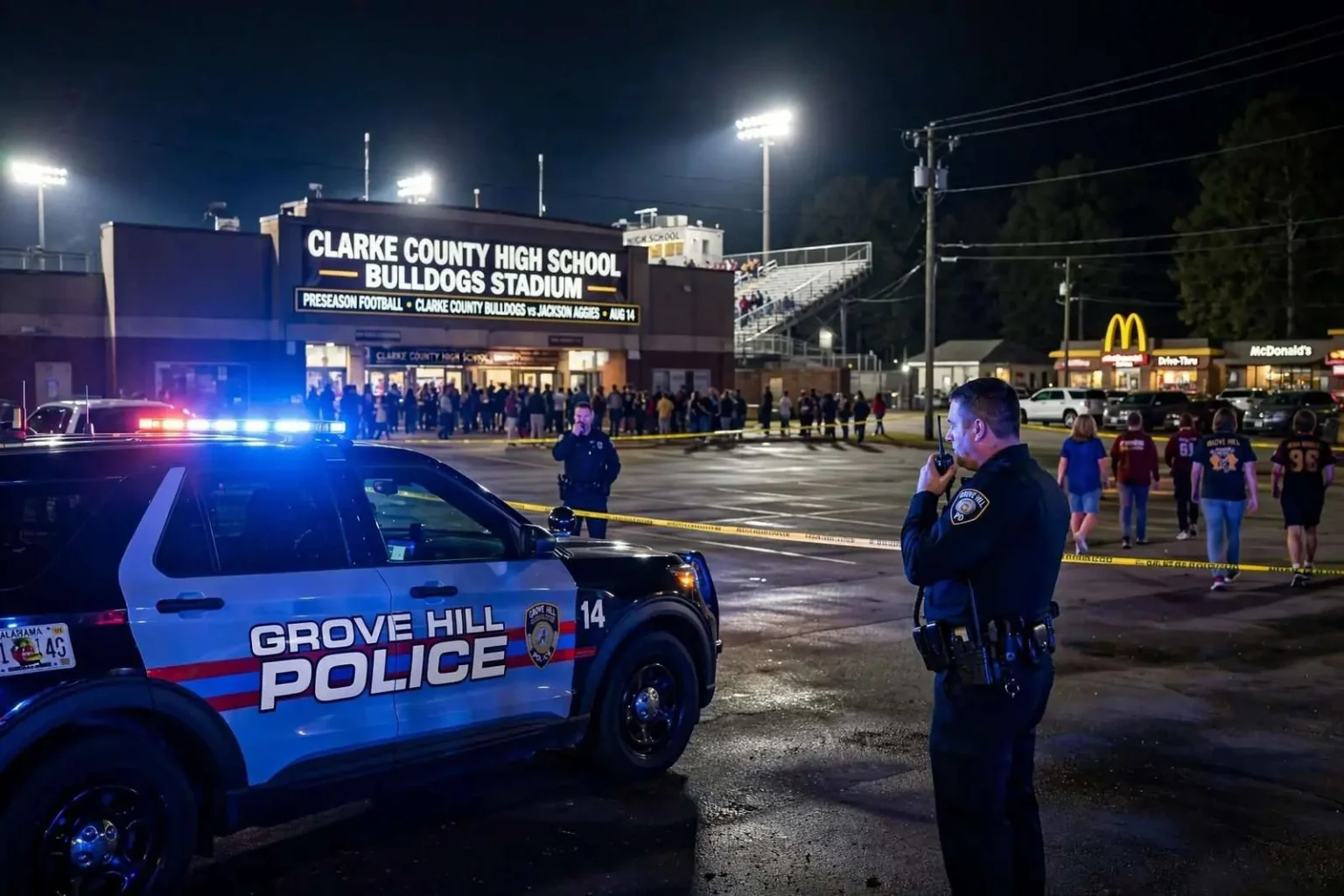
GROVE HILL, Ala. — Grove Hill police officers and other law enforcement handled a range of problems before, during and after the Aug. 14 preseason football game between Clarke County High and Jackson in Grove Hill, according to Police Chief Daniel Gibson. Among the incidents was a juvenile who was cut on the ankle. Chief Gibson said that cutting took place at the local McDonald’s. Officers also dealt with a car chase and other disturbances connected to the evening’s game.
The preseason matchup between the two Clarke County schools drew the crowds and energy typical of an early-season football night in a small Alabama county seat — and, along with them, a full slate of police calls that stretched from the school grounds to other corners of town. Chief Gibson’s account of the evening laid out the sequence: incidents before the game, disturbances during it, a cutting at the McDonald’s restaurant, and a car chase afterward.
The juvenile who was cut on the ankle was among the evening’s more serious calls. The chief did not release details about the circumstances beyond the location, the McDonald’s restaurant in Grove Hill, or about how seriously the juvenile was injured. No arrests in connection with the cutting were announced in the chief’s account.
A game night in the county seat
Grove Hill, the county seat of Clarke County, sits in southwest Alabama where U.S. Highway 84 meets Highway 43, a small town of roughly 1,500 residents that swells noticeably on football Fridays when the Clarke County High School Bulldogs play. The rivalry with the Jackson High School Aggies — the two schools separated by about 20 miles of highway in the same county — gives even preseason matchups the feel of a regionally significant event, with fans traveling from both communities and crowds gathering hours before kickoff.
Games of that scale bring predictable demands on a small police department. Parking and traffic control around the school consume officers’ attention before kickoff, and the department typically supplements its own staffing with help from the Clarke County Sheriff’s Office for larger games. Officers work the gates and the stands, watch for conflicts among spectators, and keep the flow of vehicles moving when the game ends and hundreds of cars try to leave the area at once.
What made Aug. 14 unusual was not the presence of problems but their variety and their spread across town. Disturbances connected to a game usually cluster around the stadium, but an incident at a restaurant several blocks away and a car chase in the aftermath of the evening stretched the department’s coverage across Grove Hill, requiring officers to triage calls and request assistance from neighboring agencies.
The cutting and the response
Cutting incidents at or near large public gatherings present particular challenges for small departments. The victim in this case was a juvenile, which limits the information police can release publicly — names of minors are protected, and details about injuries and the investigation are typically withheld both for the juvenile’s privacy and to preserve the integrity of any case that develops. Chief Gibson’s disclosure of the location and the fact of the injury was enough to alert the public without compromising the response.
The McDonald’s restaurant along the highway in Grove Hill is one of the busiest gathering spots in town on game nights, drawing families, students, and fans before and after events at the school. When a fight or a cutting occurs at a location like that, officers must move quickly to secure the scene, render aid, and separate the participants and witnesses before accounts of the incident blur together. Emergency medical response for an ankle laceration is typically handled by county EMS, with the severity of the injury determining whether hospital treatment is required.
Police across Alabama have dealt in recent years with a pattern in which conflicts that begin at school events spill over to other locations in town — parking lots, restaurants, and convenience stores — as crowds disperse. That pattern is why chiefs like Gibson brief the public on the full geography of a game night’s incidents: it shows where the department is concentrating its attention and reminds businesses and parents that supervision matters beyond the stadium gates.
The car chase that followed the evening’s other incidents added the most public danger to the night. Vehicle pursuits are among the riskiest activities police engage in, particularly in a small town where streets are narrow and pedestrians and other drivers share the road. Departments across Alabama follow pursuit policies that weigh the seriousness of the underlying offense against the danger the chase creates, and officers must constantly reassess whether to continue or break off.
Chief Gibson did not release details about who was pursued, why, or how the chase ended, but its connection to the game night — among the “other disturbances” the chief cited — indicated that the evening’s problems were not confined to the stadium grounds. Pursuits that begin after large events often involve drivers who left the scene of a disturbance or attempted traffic stops, and the responses can draw in sheriff’s deputies and state troopers as the vehicles move beyond city limits.
How small departments handle big-game demands
A town of Grove Hill’s size fields a small police department, and a busy game night can stretch its resources quickly. Mutual aid is the answer: the Clarke County Sheriff’s Office patrols the surrounding county and regularly assists inside the municipality, and state troopers and neighboring departments stand ready when a situation outgrows local staffing. The chief’s reference to “other law enforcement” handling the evening’s problems reflected that standing cooperation, which Alabama’s small departments rely on every week of the football season.
Dispatching also matters. Calls on a night like Aug. 14 flow through the county’s emergency communications system, where dispatchers must prioritize a cutting, a car chase, and ordinary crowd-control requests arriving simultaneously. The discipline of triage — sending the closest appropriate unit to the most serious call first — is what keeps a multi-incident evening from becoming chaotic, and it is practiced across rural Alabama every Friday night in the fall.
Preseason games like the Aug. 14 matchup serve as the season’s shakedown for more than the teams. They are the first full test of each department’s game-night routine, and problems that surface in August inform how agencies staff and position themselves for the regionally contested region games that follow. Chiefs in Clarke County and across south Alabama review each game night’s calls, adjust coverage, and coordinate with school resource officers and administrators on what worked and what did not.
The season ahead and public safety context
High school football in Clarke County is a community institution, and the Aug. 14 game between Clarke County High and Jackson was the opening act of a season that will bring the two rivals together again once region play begins. The vast majority of the thousands who attended the game — students, families, alumni, and fans — experienced a normal Friday-night event, and the incidents Chief Gibson described involved a small fraction of the crowd.
That balance — welcoming the crowds a game draws while managing the risks a few attendees create — defines public safety work in Alabama’s small towns each fall. Departments handle it with visibility before and after the game, firm management of disturbances, and the mutual aid relationships that let a small force scale up when the evening demands it.
For parents and students, game nights like this one carry a straightforward set of reminders that school administrators and police repeat each season: keep track of younger children in crowded areas, report conflicts to officers or school staff early rather than waiting for them to escalate, and leave the stadium and restaurant areas promptly after the event rather than lingering in large groups. Businesses along the highway that stay open late on game nights watch for the crowd spillover that Aug. 14 demonstrated, and many coordinate directly with police when disturbances begin to gather on their property.
Chief Gibson’s public accounting of the Aug. 14 incidents, including the juvenile’s cutting at the McDonald’s, the car chase, and the other disturbances, gave residents a clear picture of the night and of the department’s work handling it. The chief did not announce arrests in his account, and further details were not made available.
The Grove Hill Police Department, like departments its size across the state, also relies on its relationship with the schools themselves. School resource coverage, communication with coaches and administrators, and the presence of officers at games are all part of a year-round effort that pays off on nights like Aug. 14, when events move quickly and the difference between an isolated disturbance and a spreading problem is often the speed of the first response.
South Alabama News will update this story as additional information becomes available from the Grove Hill Police Department.