
Gulf Coast Challenge football weekend returns to Mobile, bringing millions in impact
Gulf Coast Challenge football weekend returns to Mobile, bringing millions in impact Reported by South Alabama News from local coverage of the Mobile and.
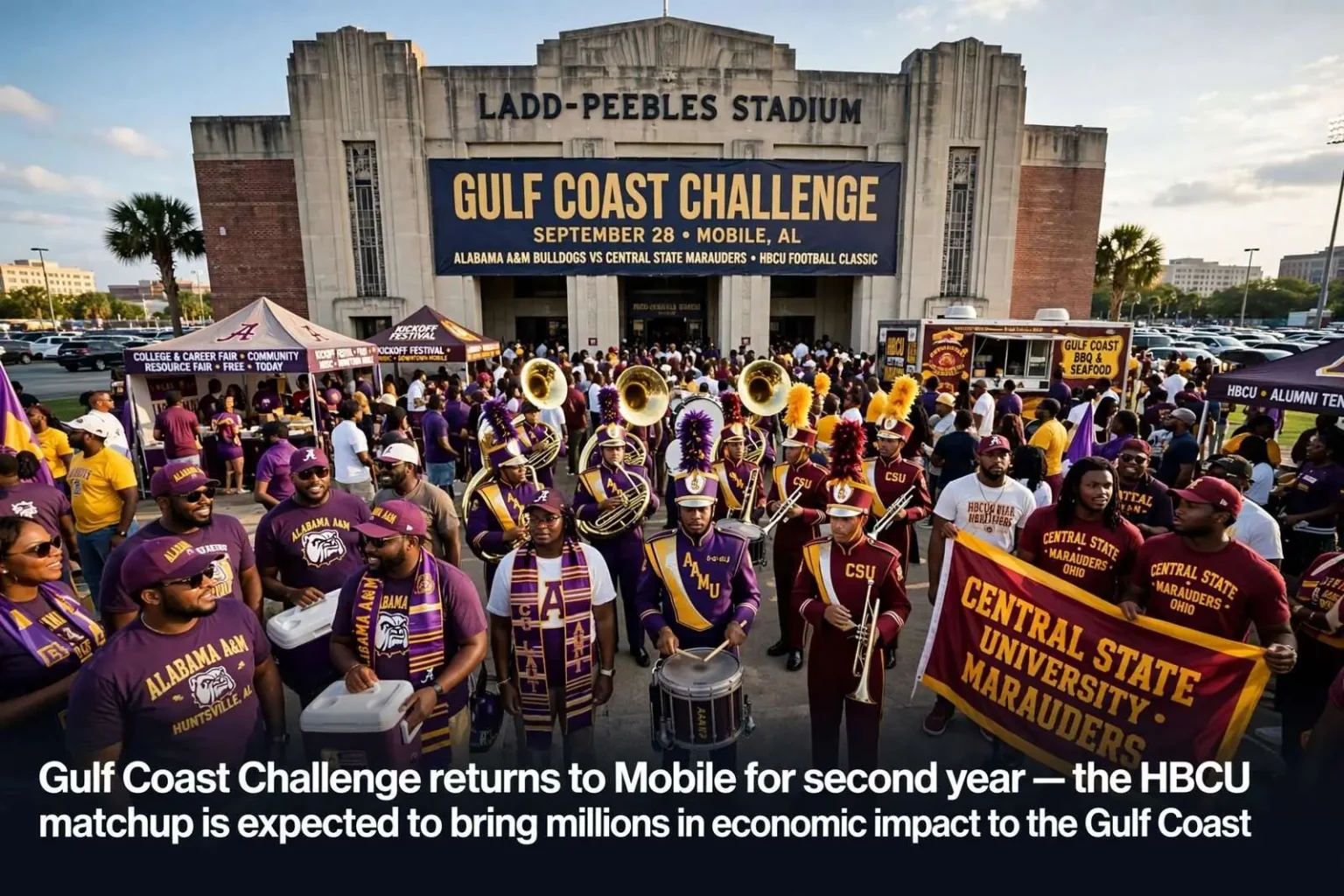
The Gulf Coast Challenge is coming back to Mobile, and local sports officials say the economic payoff is already proven. The second annual game is set for Sept. 28 and will match Alabama A&M against Central State University at Ladd-Peebles Stadium, the city’s longtime home for major college football events. The event positions Mobile once again at the center of the HBCU football calendar for a single Saturday, with fans expected from across Alabama, the Gulf Coast, and the colleges’ home regions.
The inaugural contest between Southern University and Alabama A&M drew 23,117 fans to Ladd-Peebles Stadium and generated an estimated $6.6 million in community impact, according to the Mobile Sports Authority. Those numbers came from hotels, restaurants, and businesses that saw a measurable surge over the game weekend, and they were strong enough to convince organizers that the challenge deserved a permanent place on the city’s events calendar. The event was even recognized by Sports Destination Management as a 2018 Champion of Economic Impact in Sports Tourism, a national award that put Mobile’s name in front of event planners across the country.
“Last year’s inaugural Gulf Coast Challenge was a big success and, once again, we anticipate football fans flocking to Mobile,” said Tim Hale, the event’s executive director. Hale’s confidence rests on the first-year experience: a packed stadium, a festive week of supporting events, and a visiting fan base that treated the trip as a destination weekend rather than a single game.
HBCU Football Finds a Home in Mobile
HBCU football has found a home in Mobile. The city’s own HBCU ties run deep through the Gulf Coast athletic community, and Ladd-Peebles Stadium has a long history of hosting historically black college matchups, bands, and pageantry that draw crowds a routine regular-season game cannot. The halftime show alone, with two full marching bands performing in succession, has become one of the event’s signature draws, and for many attendees the band battle is as anticipated as anything that happens between the tackles.
Alabama A&M head coach Connell Maynor said his players, alumni and fans enjoyed the experience, while Central State coach Cedric Pearl called it an honor to compete in his home state. Pearl’s connection to Alabama gives the Marauders’ trip an extra emotional layer, and both coaching staffs view the neutral-site game as a recruiting showcase, putting their programs in front of high school players and families in a major market they do not otherwise visit during the fall.
For Alabama A&M, the game offers a home-state stage in front of its large Alabama alumni network, and for Central State, the Ohio school’s visit brings one of the SIAC’s traditions-rich programs to the Gulf Coast. The matchup also continues a broader pattern in which neutral-site classics have become a fixture of HBCU football, with cities competing to host them because of the visitors and exposure they bring over a full weekend rather than a single afternoon.
The game is the centerpiece of a week of festivities that includes a kickoff party in the park, a college and career fair, a pep rally and a parade. The supporting schedule is designed to turn a football game into a civic occasion, and each element reaches a different audience: the kickoff party opens the week with music and community gathering space; the college and career fair connects students and job seekers with universities and employers; the pep rally brings the schools’ spirit organizations into the city ahead of the weekend; and the parade gives Mobile’s downtown and neighborhood communities a front-row seat to the pageantry leading into Saturday.
That weeklong footprint is precisely what makes the event valuable beyond the turnstiles. A single game fills a stadium for one night, but a week of events moves visitors through hotels and restaurants across multiple days, gives local students direct contact with college recruiters and employers, and generates the kind of community visibility that money cannot easily buy. Event planners in other host cities have found the same thing, which is why the classic-game model has spread so quickly across the HBCU landscape.
The Mobile Sports Authority’s Mission
The Mobile Sports Authority, a nonprofit formed in 2008 by the Mobile County Commission, said the event supports its mission to bring economic and public-relations benefits to the region. The authority exists to attract and support sporting events of all sizes across Mobile County, from youth tournaments that fill weekend hotel blocks to marquee events like the Gulf Coast Challenge that put the city in the regional and national spotlight. Its staff works with venues, hotels, and local organizers to bid for events and then to make sure they run smoothly once awarded.
Sports tourism has become a significant economic engine for Gulf Coast communities, and Mobile’s leaders have made deliberate investments to compete for it. Events like the challenge demonstrate the formula: pair a proven fan base with a venue and a hospitality community that can host it well, and the measurable impact follows. The $6.6 million estimate from the inaugural game is the kind of figure that gets repeated in board rooms and budget hearings when the next event is being recruited.
Organizers are counting on a similar showing for the Sept. 28 matchup, and the early signs, according to event staff, point toward another strong weekend of travel, tailgating, and packed bleachers at Ladd-Peebles. For Mobile, the second annual Gulf Coast Challenge is both a football game and a statement that the city intends to keep its seat at the table as HBCU classic events grow across the Southeast.
For the two universities, the game’s value extends past the weekend. Neutral-site games offer budget relief through guaranteed payouts, exposure in a new market, and a chance to recruit from a talent-rich region, and Mobile’s access to recruits across south Alabama and the panhandle makes it a strategic stop for both programs. Alumni offices and university foundations also treat the weekend as a reunion opportunity, scheduling meetings and gatherings around the game to bring graduates back into contact with their institutions.
Looking Ahead to Sept. 28
Ticket details, band performance times, and the full schedule of challenge-week events are being distributed through the event’s organizers and the participating universities, and fans planning travel are being encouraged to book early, since the inaugural edition filled hotel rooms across the city for the weekend. Ladd-Peebles Stadium’s familiar tailgating areas will open ahead of kickoff, and the traditional HBCU game-day atmosphere, vendors, alumni tents, Greek-letter organizations in full force, will surround the stadium throughout the afternoon and evening.
The Sept. 28 date gives the event a prime slot in the middle of the college football season, and organizers have structured the week so that the career fair and other programming reach students during the school week rather than competing with the weekend itself. That design reflects lessons from year one: the more ways a community can participate, from parade watching to career fair attendance to game tickets, the deeper the event’s footprint runs.
What began as a first-year experiment has, by every measure the Mobile Sports Authority tracks, earned its place on the calendar. A stadium full of fans, two marching bands, a week of civic events, and a multimillion-dollar impact have turned the Gulf Coast Challenge into one of the city’s signature fall events, and Mobile’s sports leadership is betting that year two will only strengthen the case for years three, four, and beyond.
The matchup history between the two programs adds another layer of interest. Alabama A&M and Central State have met on the field in past seasons, and neutral-site rematches give both staffs a chance to renew a series on a bigger stage than either campus can offer on its own. For the Bulldogs, the trip across the state line to the coast is a short one by classic-game standards, which should keep the home-state fan base traveling in large numbers, and for the Marauders, a game within driving distance of an airport hub simplifies the logistics of bringing a full traveling party, band included, several hundred strong.
Local businesses, meanwhile, have learned to plan for the weekend. Restaurants near the stadium and downtown extend hours for the influx, and hotels along the I-10 and Airport Boulevard corridors report the kind of occupancy bump that sports tourism events bring. City officials view that activity as evidence the challenge has moved from novelty to fixture, and each year the supporting events draw a wider slice of the community into what began as strictly a football weekend.
The bands deserve their own note in any accounting of the event’s pull. HBCU marching bands are cultural institutions in their own right, and fans routinely buy tickets to classics partly for the halftime experience. Mobile’s music-loving audiences, from the Thrive Mardi Gras calendar to the city’s festivals, have taken to that tradition quickly, and the band showcase at the inaugural game was among the weekend’s most talked-about moments. Expect the same again when both full band programs take the field in September.


