Gulf Coast Ethnic and Heritage Jazz Fest Poetry Slam Draws Crowd to Museum of Mobile
Fairhope poet Georgia Pearle won the 2011 Gulf Coast Ethnic and Heritage Jazz Fest poetry slam at the Museum of Mobile, hosted by spoken word artist Huggy.
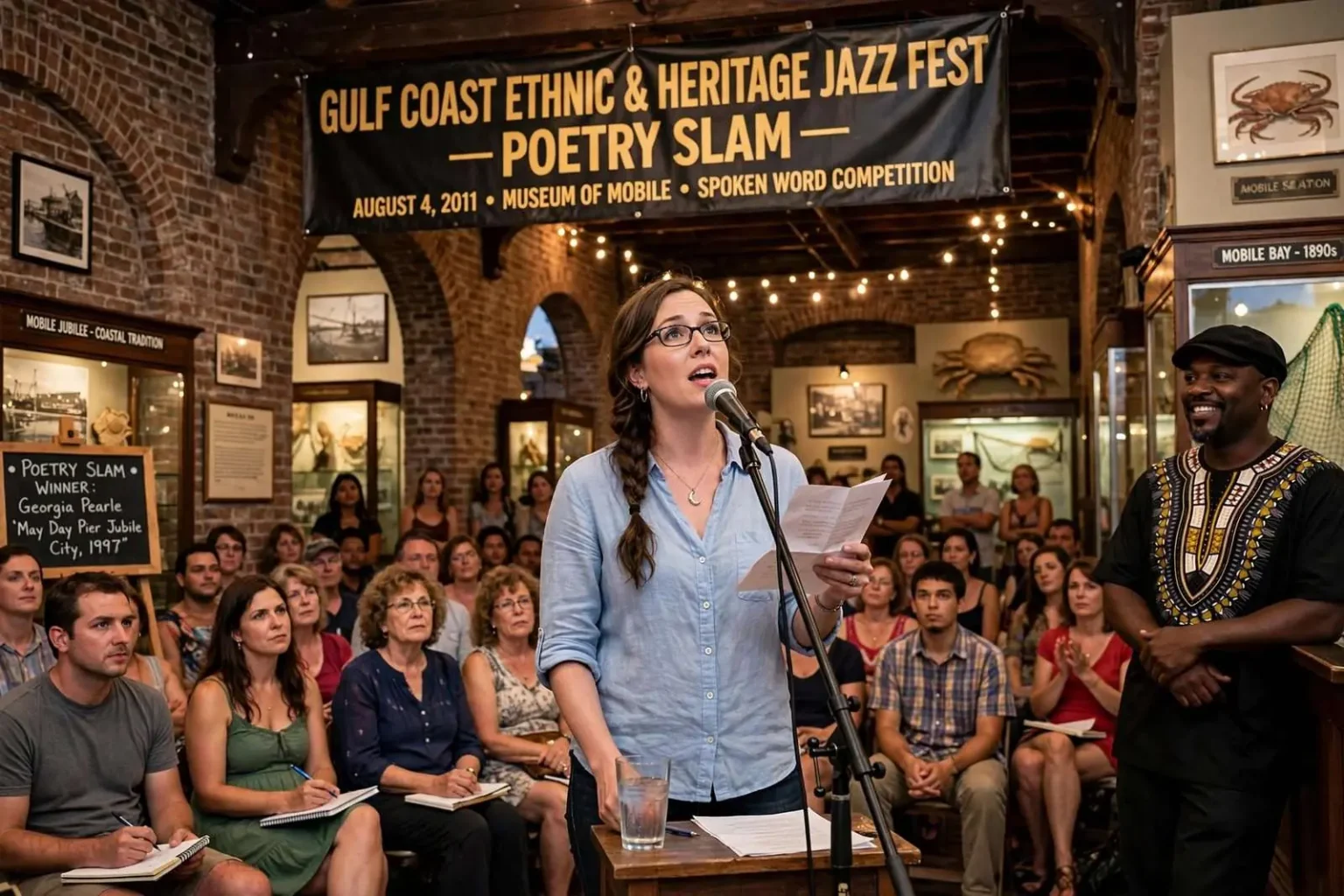
The Museum of Mobile was alive with the rhythm and power of spoken word on the evening of August 4, 2011, as poets gathered for the poetry slam competition held during the Gulf Coast Ethnic and Heritage Jazz Festival.
Slam competition turns poetry from a page-bound art into a public event. Poets perform original work before an audience and a panel of judges, typically within a strict time limit, and scores reward the combination of writing craft and stage presence that makes a poem land in a live room. The format — born in Chicago in the 1980s and spread nationwide — has become one of the most accessible entry points into poetry for young writers, and Mobile’s festival audience got a full demonstration of why.
Georgia Pearle takes top honors
Fairhope poet Georgia Pearle earned the winning title with her evocative poem “May Day Pier Jubilee City, 1997,” a vivid recollection of a jubilee night along Mobile Bay. Her piece wove together images of summer heat, loose clothing, and the natural phenomenon of blue crabs pushed close to shore by low oxygen levels in the water, all set against the backdrop of an intimate personal moment on a concrete pier.
The poem captured the unique coastal experience of a jubilee — a natural event particular to Mobile Bay in which marine life swarms toward shore — and layered it with deeply personal imagery that resonated with the audience.
Jubilees are among the strangest and most beloved phenomena on the Gulf Coast. On certain warm summer nights, oxygen-poor water rises in the bay, driving flounder, crabs, rays and shrimp toward the shoreline in quantities that can turn a stretch of beach into a harvest. Locals who catch word of a jubilee in the small hours sometimes head for the water with buckets and flashlights, and the event has entered the region’s folklore as something that can happen only here — a fitting subject, festival-goers agreed, for a winning poem in a Mobile competition.
Pearle’s title knits the phenomenon to memory. A pier on a jubilee night in 1997, the sultry air, the crowd of sea creatures at the waterline — the poem builds its emotional power from a scene that any Mobile Bay resident can picture immediately, then turns it toward the personal. Judges and audience alike responded to that fusion of the natural and the intimate, which is the combination slams are designed to surface.
Huggy Bear hosts the evening
Mobile native Huggy Bear Da Poet served as the evening’s host. A spoken word artist who grew up in Mobile, Huggy Bear has performed at prominent venues across the country, including the Nuyorican Cafe in New York City, Apache Cafe in Atlanta, and GreenCourt in Los Angeles. His stage credits include appearances alongside notable figures such as poet Nikki Giovanni and civil rights leader Jesse Jackson.
The host’s role in a slam is substantial. Between poems, the host manages the energy of the room, softens the sting of low scores with humor, and keeps the competition moving — skills that draw on a performer’s own stage experience. Huggy Bear’s national resume gave the local event a sense of connection to the wider spoken word world, where venues like the Nuyorican Poets Cafe on Manhattan’s Lower East Side have served as proving grounds for generations of slam poets.
His presence also underscored the festival’s blend of local roots and broader reach. A Mobile artist who has shared stages with a legendary poet like Nikki Giovanni — a figure central to African American literature — and civil rights leader Jesse Jackson returns home to emcee a hometown competition, modeling for young writers in the audience what a spoken word career can look like.
The festival and its setting
The poetry slam was one of several events held as part of the Gulf Coast Ethnic and Heritage Jazz Festival, an annual celebration of the diverse cultural traditions of the Gulf Coast region. The festival brings together music, poetry, visual arts, and cultural programming to highlight the rich heritage of Mobile and the surrounding area.
The festival’s summer schedule typically spreads its programming across venues in the city, with jazz performances at the center and supporting events — poetry, art, youth workshops — filling out the calendar. Placing a poetry slam inside a jazz festival is a natural pairing: the two art forms share deep roots, from the spoken rhythms of the blues to the improvisational interplay between a soloist and a crowd, and spoken word artists have long drawn on jazz in both subject and technique.
The Museum of Mobile provided a fitting venue. Housed in the historic Southern Market building on South Royal Street downtown, the museum’s exhibits trace the city’s history across three centuries — from its colonial foundations through the port economy that shaped it and the communities that built their lives here. An evening of spoken word inside those walls layered one more voice onto the city’s long story, told by the people who live it.
Downtown Mobile in early August gives any festival a distinctive backdrop. The live oak streets of the historic district, the offices and restaurants around Royal Street, and the proximity of the waterfront put visitors within walking distance of the city’s cultural core, and festival audiences that night moved from the museum’s exhibit halls to the competition itself in a single setting.
Slam culture on the Gulf Coast
The Gulf Coast has developed a lively spoken word scene over the past two decades, with regular open mics, slams and youth poetry programs in Mobile, along the Eastern Shore and across the bay in Baldwin County. Competitions like the festival’s give writers a stage and, just as importantly, an audience trained to listen — the element that separates a thriving scene from a series of open mics that come and go.
Poets from the region’s small towns have made names for themselves at national slams and festivals, and Mobile’s own Huggy Bear stands as the most visible example of a Gulf Coast spoken word artist carrying local audiences’ sensibility to stages across the country. For the younger poets who competed at the museum, that path was on display from the host’s chair.
The competitive format also draws out the community dimension of poetry. Scores are tallied, winners are crowned, but the evening’s real function is the exchange among writers — the way one poem about a Mobile Bay jubilee can put an image into another poet’s notebook for years to come.
Why the festival matters to Mobile
Festivals of this kind do cultural and economic work at once. They give regional artists a paid, prominent stage; they bring audiences downtown on a summer evening, where they patronize nearby restaurants and shops; and they preserve traditions — jazz, spoken word, the visual arts — that might otherwise remain scattered across small venues and private gatherings.
The Gulf Coast Ethnic and Heritage Jazz Festival’s emphasis on heritage distinguishes it from the region’s larger music events. Its focus on the diverse cultural traditions of the Gulf Coast connects the festival to Mobile’s particular history: a port city whose African American, Caribbean, European and Creole influences produced everything from Mardi Gras — which began here before New Orleans celebrated it — to a musical and culinary culture that remains distinctive on the Gulf.
Against that backdrop, a poetry slam at the Museum of Mobile was more than a competition. It was the festival’s mission made concrete: local voices, rooted in local places — a pier, a jubilee, a summer night in 1997 — performing work that could only have been written here, for an audience that recognized every image on contact. Georgia Pearle’s winning poem gave the 2011 festival its centerpiece, and Huggy Bear’s hosting gave the evening its bridge between Mobile’s spoken word community and the wider world of American slam.
The winning poem’s craft
What lifted “May Day Pier Jubilee City, 1997” above the competition was the poem’s grounding in a scene every listener could verify from memory. Jubilee nights are legend along Mobile Bay’s eastern shore — Fairhope’s piers included — and a poet who conjures one accurately earns the audience’s trust before turning to whatever personal story the scene carries. The imagery of heat, loose clothing and crabs crowding the shallows works because it is precisely true to the phenomenon; the emotion layered on top then lands as testimony rather than invention.
Slam judges reward that specificity. In a competition format, generic poems blur together over the course of an evening, while a poem built from unmistakably local material — a concrete pier, a jubilee, a particular summer — stands apart from the first lines. Pearle’s win also reflected the poem’s dual structure: a natural event observed and a private moment remembered, braided so that each gives the other weight.
For the other competitors and the audience at the museum, the winning performance offered a lesson in what the Gulf Coast gives its writers. The region’s landscape — bays, piers, storms, seasons of unbearable heat — supplies imagery found nowhere else in American poetry, and the slam’s result suggested that the surest route to a winning poem is the material closest to home.
An evening that keeps echoing
Evenings like the August 4 slam tend to outlast the competition itself. Writers who meet at festival events form the open mics and writing circles that keep a city’s spoken word scene alive between festivals, and audiences introduced to slam at a museum event often follow the art form to smaller venues afterward.
The museum’s role deserves note as well. By hosting the competition, the institution positioned poetry as part of the historical record it keeps — a living contribution to the story of Mobile rather than only a preserved one. Museums that open their halls to performance find that the audience for history and the audience for art overlap more than either expects.
The Gulf Coast Ethnic and Heritage Jazz Festival’s combination of jazz, poetry and community programming has made it a fixture of Mobile’s summer, and the 2011 slam — Georgia Pearle’s jubilee poem, Huggy Bear’s hosting, a full house at the Museum of Mobile — stands as a representative night of what the festival does: gathering the Gulf Coast’s traditions on a stage, handing them to the next generation, and letting the audience hear where they came from.