Gulf Coast Veterans Share Their Stories in Special Veterans Voices Broadcast
Gulf Coast veterans share their personal stories of military service in a special Veterans Voices broadcast featuring local heroes from Mobile.
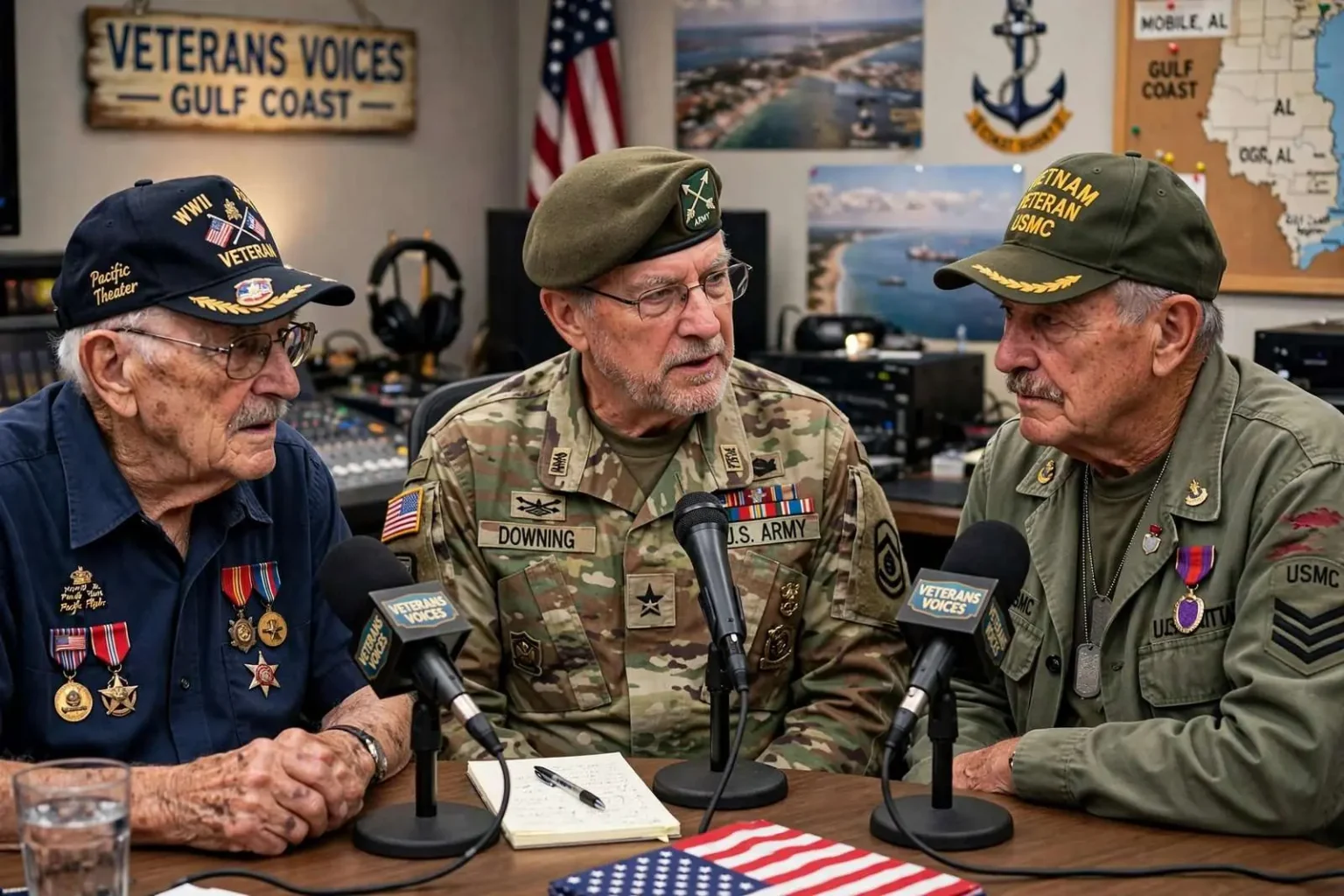
Gulf Coast veterans shared their personal stories of service and sacrifice in a special Veterans Voices broadcast on Monday evening, giving listeners an unfiltered look at the experiences that shaped the men and women who wore the nation’s uniform. The program brought together veterans of different generations and conflicts, weaving their accounts into a portrait of military service rooted deeply in the communities along the Gulf Coast.
The region’s connection to the military runs long and deep. From the Navy and Coast Guard presence at Mobile’s port to the Army airfields and training grounds scattered across the Panhandle and south Alabama, the Gulf Coast has sent generations of its sons and daughters into uniform. Programs like Veterans Voices exist to make sure that when those service members come home, their stories are preserved rather than lost — a mission that grows more urgent every year as the ranks of older veterans thin.
Among those featured was retired U.S. Army Special Forces Colonel Pat Downing, who grew up in Mobile and spoke about what inspired him to serve. His answer reached back to his childhood, to the veterans he watched and admired in his own neighborhood long before he ever considered a military career of his own.
“Growing up in Mobile, my heroes were World War II veterans,” Downing said. “My dad was a Marine in the Pacific in World War II. I had an uncle that was an ambulance driver in the China, Burma, India theater.” The accounts he heard around the dinner table and the community — from his father’s service in the island campaigns of the Pacific to his uncle’s harrowing work evacuating the wounded along the brutal supply route through China, Burma and India — formed the foundation of his own desire to serve.
For many veterans of Downing’s generation, that pattern repeats across families. The children and grandchildren of World War II veterans grew up in households where service was not an abstraction but a lived family history, told in fragments and understated anecdotes. Mobilian families in particular were steeped in that legacy, in a city that had turned out sailors, soldiers, airmen and Marines through World War II, Korea and Vietnam.
Honor Flight and the Full-Circle Moment
Downing said he jumped at the chance to volunteer with Honor Flight after Dr. Barry Booth returned from Prattville seeking volunteers to accompany World War II veterans. Honor Flight is a national program that flies aging veterans, free of charge, to Washington, D.C., to visit the memorials built in their honor — most famously the World War II Memorial, which was not completed until 2004, nearly six decades after the war ended. For many of the veterans who make the trip, it is their first opportunity to see the nation’s formal expression of gratitude for their service.
The Gulf Coast’s Honor Flight network has been driven largely by volunteers like Downing, who accompany the veterans on their journeys and serve as guardians throughout the trip. Dr. Barry Booth, a longtime organizer of the effort in the region, has championed the program across south Alabama, and the call for volunteers that Downing answered grew out of that work. The veteran-to-veteran connection is at the heart of the program: guardians often say they get back as much as they give.
“I wanted to be with those great World War II veterans again,” he said. The words reflect a sentiment common among those who have served as Honor Flight guardians — the sense that spending a day with the men and women who fought and won the Second World War is a privilege that outlasts the trip itself. For Downing, whose earliest heroes were those very veterans, volunteering closed a circle that had opened in his childhood in Mobile.
The timing of such programs carries an obvious weight. The youngest surviving World War II veterans are now in their nineties, and every year the opportunity to honor them in person narrows. Honor Flight organizations across the country have raced against time to bring as many of these veterans to Washington as possible, and the volunteers who make the trips possible describe each flight as an experience that cannot be postponed.
A Story of Survival from Vietnam
The special also featured A.B. Grantham, an 18-year-old Marine who was sent to fight in Vietnam. His story stands among the most harrowing the program has shared. Grantham was shot in the chest during the Battle of Hue in 1968, one of the bloodiest engagements of the Tet Offensive, when North Vietnamese regulars and Viet Cong forces overran large parts of the old imperial capital and U.S. and South Vietnamese forces fought house by house to retake it.
The Battle of Hue lasted roughly a month and became one of the defining fights of the Vietnam War, with American Marines engaged in some of the fiercest urban combat of the entire conflict. An 18-year-old Marine shot through the chest in that battle faced grim odds, and Grantham’s survival owed everything to the medical personnel who reached him and the care that kept him alive in the hours and days that followed.
He is set to be reunited with the doctor who saved his life, a reunion decades in the making that underscores the lifelong bonds formed in combat. For veterans of Grantham’s generation, the medics, corpsmen and doctors who pulled the wounded back from the edge occupy a singular place in memory — the people who stood between them and death in the worst moments of their lives. A reunion between a wounded Marine and the physician who saved him is, in the truest sense, a meeting between two men who have shared the same moment of mortal risk.
The Veterans Voices special highlighted the experiences of local military veterans, giving them a platform to share their stories of service, sacrifice and resilience with the Gulf Coast community. Between Downing’s reflections on the World War II generation that raised him, the Honor Flight mission that let him serve those veterans in return, and Grantham’s account of survival at Hue, the program traced an arc across the conflicts that defined the American century — told through the voices of the Gulf Coast men who lived it.
Why Preserving These Stories Matters
Veterans’ stories are among the most perishable documents of American history. The Library of Congress’s Veterans History Project and organizations like it have spent years racing to record the firsthand accounts of veterans before those memories are lost, and local efforts along the Gulf Coast serve the same purpose at the community level. Every broadcast, every recorded interview, every written account adds to a record that future generations will have no other way to access.
The value of these accounts lies in their specificity. History books can describe the Battle of Hue, the Pacific campaigns or the logistics of the China, Burma, India theater, but only a veteran can describe what it felt like to be an 18-year-old Marine fighting through a city block by block, or what it meant to grow up in Mobile with the heroes of World War II living next door. Those personal dimensions are what programs like Veterans Voices capture, and they are what the community loses when veterans pass away without telling their stories.
For the families of the veterans featured, such broadcasts become heirlooms. Children and grandchildren of service members frequently know only fragments of what their relatives did in uniform — a medal in a drawer, a photo on a wall, a story told once and never repeated. A recorded account gives families a permanent record of the experiences that shaped the people who raised them.
Mobile’s Deep Military Roots
Mobile’s contribution to the nation’s wars stretches back more than two centuries, but the city’s role in modern conflicts is particularly notable. During World War II, the city’s shipyards built vessels at a staggering pace, and Brookley Field served as a major Army Air Forces supply and modification hub that employed tens of thousands of workers. The war transformed Mobile into an industrial and military boomtown, and the servicemen and women who passed through or settled there afterward left a permanent imprint on the community.
That wartime generation shaped the city Downing grew up in decades later. The veterans who came home to Mobile after 1945 became its teachers, coaches, businessmen and civic leaders, and their quiet authority defined neighborhood life across the city. It is that generation — the fathers, uncles and neighbors who served — that Downing described when he named his childhood heroes, and his path from listening to their stories into a career in the Army’s Special Forces followed a route many young Alabamians have taken.
The presence of Special Forces in that story adds another dimension. The Army’s Green Berets, as the Special Forces are widely known, select for maturity, language skills and the ability to operate with indigenous forces in hostile territory. A career that culminates in colonel’s rank in that branch represents decades of service across multiple assignments and deployments, the kind of life in uniform that begins, as Downing described, with the heroes of an earlier war.
Monday evening’s broadcast also served as a reminder of the continuing needs of the veteran community along the Gulf Coast. Thousands of veterans live in the counties surrounding Mobile Bay and across the Panhandle, and the network of services available to them — from VA healthcare to peer support programs like those that connect veterans across generations — depends on community awareness and volunteer involvement. Honor Flight’s continuing mission and programs like Veterans Voices both draw on that same spirit of service to those who served.
As long as Gulf Coast veterans are willing to tell their stories, programs like Veterans Voices will be there to record them. The broadcast on Monday evening preserved accounts spanning from the Pacific islands of World War II to the streets of Hue and into the years of Honor Flight missions that followed — stories of service, sacrifice and resilience that belong to the veterans who lived them, and now, to the community they called home.