Gulf Shores, 15 other south Alabama cities among state’s fastest-growing
Sixteen cities in Mobile and Baldwin counties rank among Alabama's fastest-growing by home price, with 15 Baldwin County communities on the list.
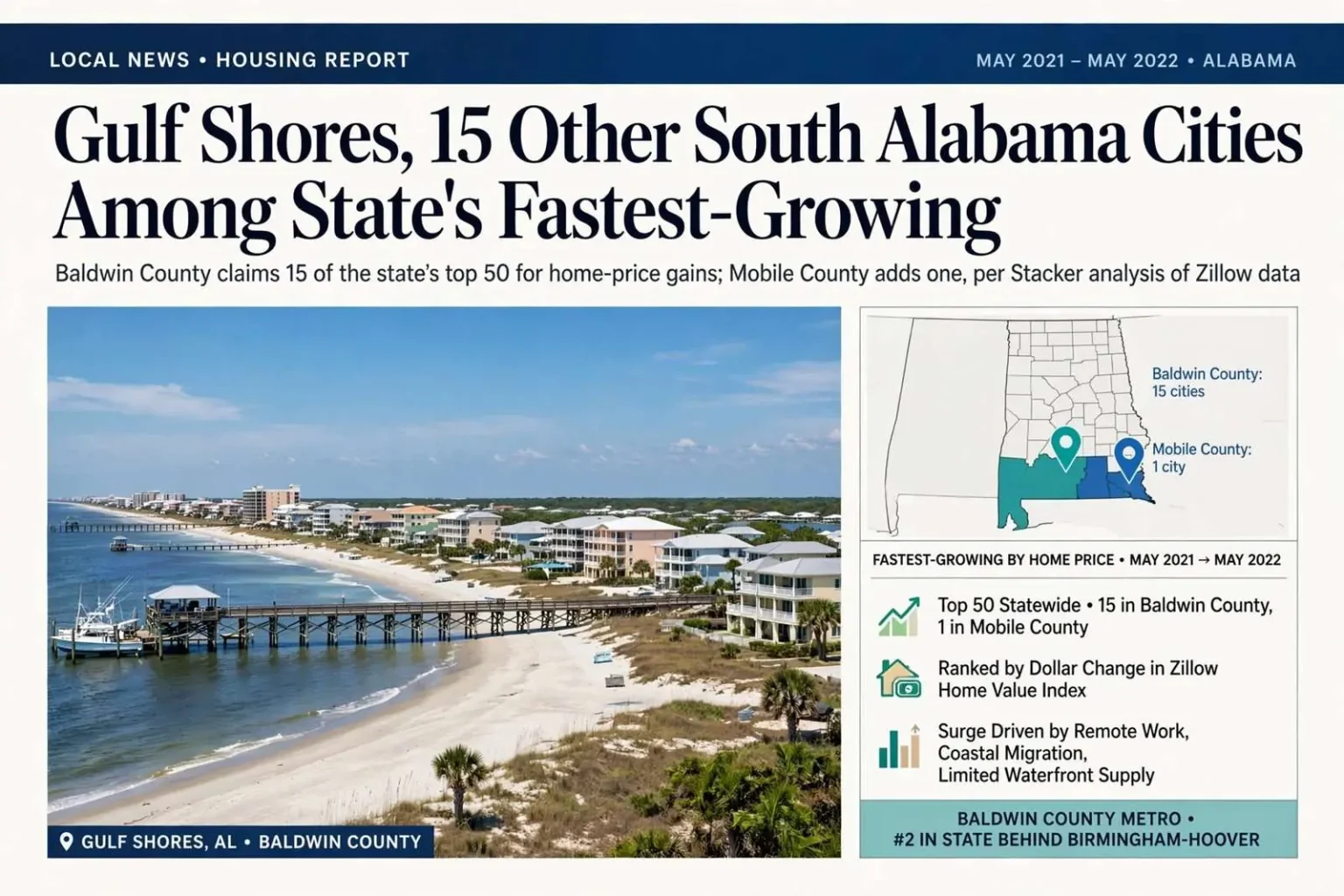
Sixteen cities in Mobile and Baldwin counties rank among Alabama’s fastest-growing by home price, according to a Stacker analysis of national housing data. The cities were ranked by the dollar change in the Zillow Home Value Index from May 2021 to May 2022, a one-year window that captured the surge in Gulf Coast housing demand that followed the pandemic migration and remote-work shifts of 2020 and 2021.
Of the top 50 fastest-growing home prices in the state, Baldwin County claimed 15 spots and Mobile County one, according to the analysis. The Baldwin County metro area was ranked second in the state, just behind Birmingham-Hoover. Gulf Shores, the Baldwin County beach city whose name headlines the findings, was among the south Alabama communities on the list, which drew from every corner of the state.
The results quantified what residents, realtors, and newcomers along the eastern shore of Mobile Bay had been experiencing for two years: a housing market moving faster than at any point in recent memory, with asking prices climbing month after month and homes in the most desirable communities selling in days rather than weeks.
What the Zillow Home Value Index measures
The Zillow Home Value Index is a widely used benchmark that tracks the typical home value in a given market, designed to smooth out the noise of individual sales and reflect the middle of the market rather than the extremes. Stacker’s analysis took the dollar change in that index between May 2021 and May 2022 for cities across Alabama and ranked them accordingly — a measurement that captures appreciation in real dollars rather than percentages, which tends to favor communities where baseline home prices are already substantial.
That dollar-change methodology matters for understanding why the list looked the way it did. A community like Gulf Shores, where waterfront and near-waterfront properties carry high baseline values, adds thousands of dollars to a typical home’s value with a percentage increase that would barely register in a town where the typical home sells for a fraction of that price. Ranking by raw dollar change highlights exactly the communities where the most money flowed into housing in a year’s time.
The May-to-May window also shaped the picture. By the spring of 2022, mortgage rates had begun climbing sharply from the historic lows of 2020 and 2021, and the frenzy of pandemic-era demand was beginning to cool nationally even as Alabama’s coastal markets continued to post strong gains. The period the analysis captured was, in retrospect, near the peak of one of the hottest housing markets in modern American history.
Baldwin County’s moment
Baldwin County’s dominance of the state’s top 50 — 15 of the spots — reflected a transformation that had been building for years before the pandemic accelerated it. The county, Alabama’s fourth-largest by population, stretches from the tidal communities of Mobile Bay across the farming belt of the county’s interior to the beach towns of the Gulf. Fairhope, Daphne, Spanish Fort, and the bay-side communities had long attracted new residents from Mobile and beyond, while Foley, Gulf Shores, and Orange Beach anchored the booming coastal end of the county.
The pandemic years supercharged that growth. Remote work freed buyers from commuting distance, and a wave of relocation from other states — drawn by Alabama’s absence of a state income tax on Social Security benefits, lower cost of living, and the appeal of coastal living — landed squarely on Baldwin County. Newcomers arriving from more expensive markets found Gulf Coast prices, even at their elevated levels, to be a relative bargain, and bidding pushed values upward from Fairhope’s Historic District to the subdivisions spreading along the Foley corridor.
Gulf Shores itself exemplified the shift. The city, once a seasonal beach town, had been evolving into a year-round community with growing schools, expanding infrastructure, and a housing stock increasingly sought by full-time residents rather than only vacation renters. Rising home values in the city reflected both the scarcity of land near the water and the demand from buyers who wanted to live where others only vacation.
The ripple effects of that appreciation reached well beyond the buyers and sellers directly involved. Property values drive property tax assessments, and rising assessments flow into the budgets of county commissions and school systems while raising the stakes for homeowners on fixed incomes. Renters felt the shift as well, with rental rates across Baldwin and Mobile counties climbing alongside sale prices, squeezing household budgets and making it harder for service-industry workers — the teachers, nurses, and first responders who keep coastal communities running — to live in the communities they serve.
Builders responded to the demand as best they could, with subdivisions expanding across Loxley, Robertsdale, Summerdale, and the unincorporated stretches of the county, but supply chains strained by the pandemic made it difficult to keep pace. Lot prices rose, construction timelines stretched, and the new inventory that reached the market often arrived at prices above the existing homes around it, feeding the appreciation rather than easing it.
Mobile County’s spot on the list
Mobile County’s single city among the state’s top 50 told a different but related story. The county had spent years growing more slowly than its neighbor across the bay, but the same forces — remote work, in-migration, and the regional spillover from Baldwin’s boom — lifted demand in Mobile’s own markets. Communities along the Mobile Bay side of the county and in its western suburbs drew buyers priced out of Baldwin or drawn by shorter commutes to the Port City’s employers — aerospace, shipbuilding, healthcare, and the expanding industrial corridor along the river.
The contrast between the two counties’ results also reflected the composition of their housing. Baldwin’s coastal municipalities, with their concentration of high-value waterfront and resort-adjacent properties, were positioned to post large dollar gains almost by default. Mobile County’s housing stock, with a broader range of mid-market homes, produced percentage gains that were meaningful but translated into smaller dollar changes on the analysis’s scale.
What followed the boom
The May 2022 endpoint of the analysis arrived just as the market’s trajectory was bending. Mortgage rates that had hovered near 3 percent for much of the pandemic era climbed through the spring of 2022 and kept rising into 2023, cooling demand nationally and slowing the pace of appreciation in even the hottest markets. Alabama’s coastal communities, however, retained advantages that kept their markets firmer than most: the continued migration into Baldwin County, the appeal of Gulf-front property to buyers paying cash, and the region’s growing reputation as a retirement and relocation destination.
For homeowners in the sixteen south Alabama cities on the list, the analysis documented a year in which the equity in their homes grew faster than at nearly any point in the state’s history — a windfall for those who owned and a barrier for those hoping to buy. Local officials continued to grapple with the consequences, balancing the tax revenue that rising values generate against affordability concerns and the infrastructure demands of growth that shows no sign of stopping.
The communities behind the numbers
The sixteen south Alabama cities on the list ranged from bayfront municipalities to inland towns feeling the pressure of the region’s expansion. Gulf Shores led the way in name recognition, but Baldwin’s smaller communities — the farm-belt towns along Highway 59 and the bay communities along the Eastern Shore — appeared alongside the better-known destinations, reflecting how broadly the demand spread. A buyer priced out of Gulf Shores or Fairhope looked inland to Foley, Summerdale, or Silverhill; a buyer priced out there looked to Robertsdale, Loxley, or the county’s northern tier, and each step of that search carried rising prices deeper into the county.
The same dynamic operated across Mobile Bay. The county’s single entry on the top-50 list underscored that the growth story of the period was concentrated across the bay, where the combination of coastal geography, limited developable waterfront land, and national attention on Gulf Coast living produced the steepest dollar gains. Local real estate professionals during that stretch described multiple-offer situations as routine and appraisal gaps as a recurring feature of sales in the most sought-after neighborhoods.
Economists watching the region during that period pointed to the underlying drivers that outlasted the rate spike: the Port of Mobile’s expansion, the growth of aerospace and manufacturing employment, and the county’s appeal to retirees that continued regardless of mortgage conditions. Home prices in markets with genuine in-migration, they noted, correct far more gently than markets driven purely by speculation — and Baldwin County’s growth was substantially a people story, not merely a price story.
The Stacker analysis stands as a snapshot of that extraordinary stretch: sixteen south Alabama cities among the fastest-growing in Alabama by home price, Baldwin County claiming 15 of the state’s top 50, and the Baldwin County metro ranked second in the state behind only Birmingham-Hoover — a one-year ledger of how dramatically the Gulf Coast market moved between May 2021 and May 2022.