Gulf Shores Approves $197 Million in Loans to Fund 10-Year Capital Improvement Plan
Gulf Shores approved two 20-year loans totaling $197 million for roads, parks, a justice center and a new pedestrian bridge over the Intracoastal.
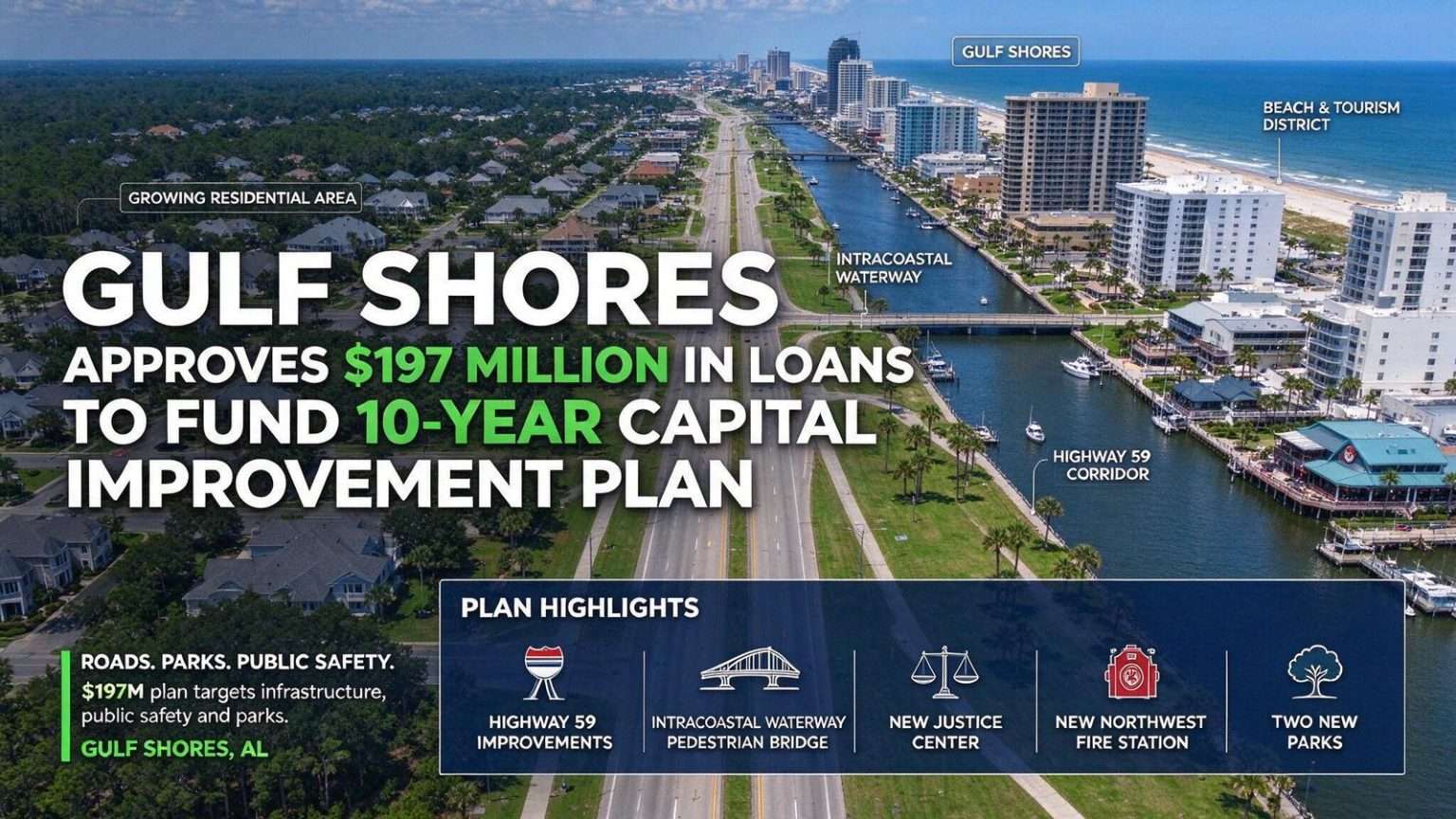
The Gulf Shores City Council signed off on two 20-year loans totaling $197 million, locking in financing for a sweeping 10-year capital improvement plan city leaders say is needed to catch up with the fastest population growth in Alabama.
Mayor Robert Craft said most of the city’s residential growth has pushed north of the Intracoastal Waterway, an area that still lacks fire stations, parks and recreation amenities. The 2020 Census counted roughly 5,000 new residents over the previous decade, a pace Craft said stunned even city officials. The growth has concentrated in the northern reaches of the city, where subdivisions have spread across former woodland while the infrastructure to serve daily life — public safety coverage, parks, connected roads — lagged behind.
The financing package is unusual in its size for a city of Gulf Shores’ population, and it commits the city to two decades of repayment. City officials have framed the borrowing as a way to fund a decade of projects at once, at historically low interest rates, rather than stretching improvements out piecemeal over many years as costs continue to rise.
Roads, bridges and a new pedestrian crossing
City administrator Steve Griffin outlined the transportation centerpiece: a third southbound lane on Alabama 59 from Coastal Gateway Boulevard to Fort Morgan Road, paired with plans for a new pedestrian bridge spanning the Intracoastal Canal near Lulu’s and connecting near Tacky Jack’s. The highway 59 corridor is the spine of Gulf Shores tourism and daily life, and its summer congestion has long been the city’s most visible infrastructure challenge. A third southbound lane targets one of the heaviest stretches of that corridor.
The pedestrian bridge across the Intracoastal Waterway addresses a safety problem that has grown with the waterfront’s popularity. The waterway separates the beachside districts from the restaurants and businesses along its northern bank, and boaters and pedestrians mix in a busy channel where crossings currently mean water. A dedicated span would link the destinations near Lulu’s and Tacky Jack’s without adding traffic to the highway bridges.
A $21.7 million RESTORE grant will help cover part of the roadwork. RESTORE funds, drawn from settlements related to the 2010 Deepwater Horizon oil spill, have been a major source of coastal infrastructure money across the Gulf, and Gulf Shores has been among Alabama’s most active recipients, directing the dollars toward projects that improve both resident life and the visitor economy.
Other projects include extending Waterway East Boulevard to link Alabama 59 south of the airport with Cotton Creek Drive and adding a new airport entrance, realigning East Canal Road to remove a dangerous 90-degree turn at Old Highway 59, widening Baldwin County 6 West with turn lanes, walkways and bike lanes, and rebuilding Waterway West Boulevard to eliminate a hairpin turn near Plash Island while raising the roadway against flooding.
Each of those projects answers a specific local problem. The airport entrance gives a growing general aviation facility a modern gateway off the highway. The East Canal Road curve is the kind of geometry that produces recurring crashes. Baldwin County 6 West carries commuter and school traffic that outgrew its two lanes. And Waterway West Boulevard’s hairpin, plus its low elevation, has made it both hazardous and vulnerable whenever storms push water into low-lying areas of the city.
A justice center, fire station and two new parks
The plan also funds a new justice center to replace the police station now 38 years old, a northwest fire station, and improvements to the Beach Walking District aimed at making the tourist core more walkable with additional on-street parking. The police facility’s age matters beyond aesthetics — decades-old buildings struggle to house modern dispatch, evidence storage and training needs, and the northwest fire station addresses response times on the north side of the waterway where the population has grown fastest.
Fire coverage is one of the most concrete quality-of-life issues created by the growth pattern Craft described. Response times are measured in minutes, and a fire station positioned north of the Intracoastal Waterway means homes and businesses in the new subdivisions are served by a station that is actually nearby rather than one a bridge away. Insurance rates for homeowners in those areas are also influenced by fire coverage, giving the station a financial dimension for residents as well as a safety one.
Parkland is on the way as well: a 120-acre Coastal Gateway Community Park and a 53-acre Laguna Cove Park on Little Lagoon that will add public beach access. In a city whose beach is its most famous asset, public access points to Little Lagoon and large-scale inland park space give residents — particularly families in the growing northern neighborhoods — recreation options that do not require crossing the waterway in summer traffic.
Coastal Gateway Community Park, at 120 acres, would rank among the larger municipal parks on the Alabama coast, with room for the fields, trails and facilities a growing population expects. Laguna Cove’s lagoon frontage adds a quieter complement: water access for paddling, fishing and swimming away from the Gulf beaches.
Paying for it
The financing consists of a $150 million Truist Bank loan at 2.34 percent and a $47 million SouthState Bank loan at 2.4 percent. Craft noted that the rates were low enough to make the sweeping plan financially workable, and that borrowing the full amount at once locks in the cost of projects that would only become more expensive if spread across a decade of separate decisions.
Twenty-year financing spreads repayment across the lifespan of the improvements themselves, the standard logic for long-term municipal debt: the residents and businesses using roads, parks and public safety facilities in their second decade help pay for them alongside those who benefit on day one. The interest rates secured by the city are well below what municipalities came to expect in earlier decades, a product of the low-rate environment that followed the pandemic.
City officials have pointed to Gulf Shores’ tourism economy as part of the repayment picture, since visitor spending generates lodging tax and sales tax revenue that supports city finances. The capital plan, in that framing, is partly an investment in the visitor economy itself — better beach access, a more walkable tourist core, and a highway corridor that moves summer traffic — paid for in part by the taxes that economy produces.
For residents, the immediate changes will come gradually as projects are designed and built over the plan’s 10-year span, but the financing vote commits the city to the full program. Council members voted to approve both loans, setting in motion work that will reshape how people move through Gulf Shores and what the city’s northern neighborhoods offer the families moving into them.
Growth that outpaced everything
Gulf Shores sits at the southern end of Baldwin County, which has ranked among the fastest-growing counties in Alabama and, by some measures, in the nation. The same forces pulling newcomers to the coast — jobs, schools, the climate, and the appeal of life near the water — have lifted Baldwin County communities from Fairhope to Foley, but Gulf Shores faces a version of the challenge shaped by its geography: a narrow barrier island economy at the south, expanding residential growth across the mainland to the north, and the Intracoastal Waterway running between them like a seam.
That geography explains much of the capital plan’s shape. Bridges and waterway crossings concentrate traffic; the highway 59 corridor carries both commuter and tourist loads; and neighborhoods platted on the north side over the past decade arrived ahead of the fire stations and parks that established parts of the city built out decades ago. Craft’s comment that the census numbers stunned even city officials reflects how quickly the northern districts filled once the development cycle started.
The census itself matters for the budget behind the plan. Federal and state funding formulas, grant eligibility and revenue projections all track population, and a city that adds 5,000 residents in a decade gains both the needs and the means to serve them. Gulf Shores’ tourism taxes add a second revenue stream most Alabama cities do not have, and the city has historically leaned on it for beach nourishment, public safety and visitor infrastructure.
Storm resilience built in
Raising Waterway West Boulevard against flooding reflects a broader shift in how coastal cities plan infrastructure. Gulf Shores has taken direct hits from hurricanes over the years, and every rebuild since has weighed how to make roads, utilities and public buildings more resilient to the next storm. Elevating a flood-prone roadway costs more upfront than repaving it, but it reduces both storm damage and the day-to-day street flooding that heavy rains already bring to low-lying blocks.
The pedestrian bridge over the waterway carries the same logic. A span designed for foot traffic can be built to modern standards and closed safely ahead of storms, and it removes some of the waterborne crossings that emergency responders and boaters manage today. Resilience projects like these have also strengthened the city’s applications for federal and RESTORE-related funding, since agencies increasingly prioritize projects that reduce future disaster costs.
City officials have not committed to a strict project-by-project schedule in the early announcements, but the financing vote establishes the sequence’s starting line. Engineering and design work typically precede construction by a year or more on projects of this scale, meaning residents will see design notices, right-of-way activity and public meetings before heavy equipment arrives on any given project.
What is settled is the scope: a widened highway 59, new waterway and roadway connections, safer geometry on the county road and canal corridors, a justice center and northwest fire station, two large parks, and a more walkable beach district — all funded by $197 million in 20-year loans and underwritten by a city betting that its growth, and the visitors who follow the sun to Gulf Shores, will keep paying dividends for decades to come.