Gulf Shores Council Work Session to Take Up Bridge Inspection Contract, C&D Franchise
Gulf Shores City Council's Feb. 6 work session takes up an ALDOT bridge inspection contract and a construction demolition franchise award.
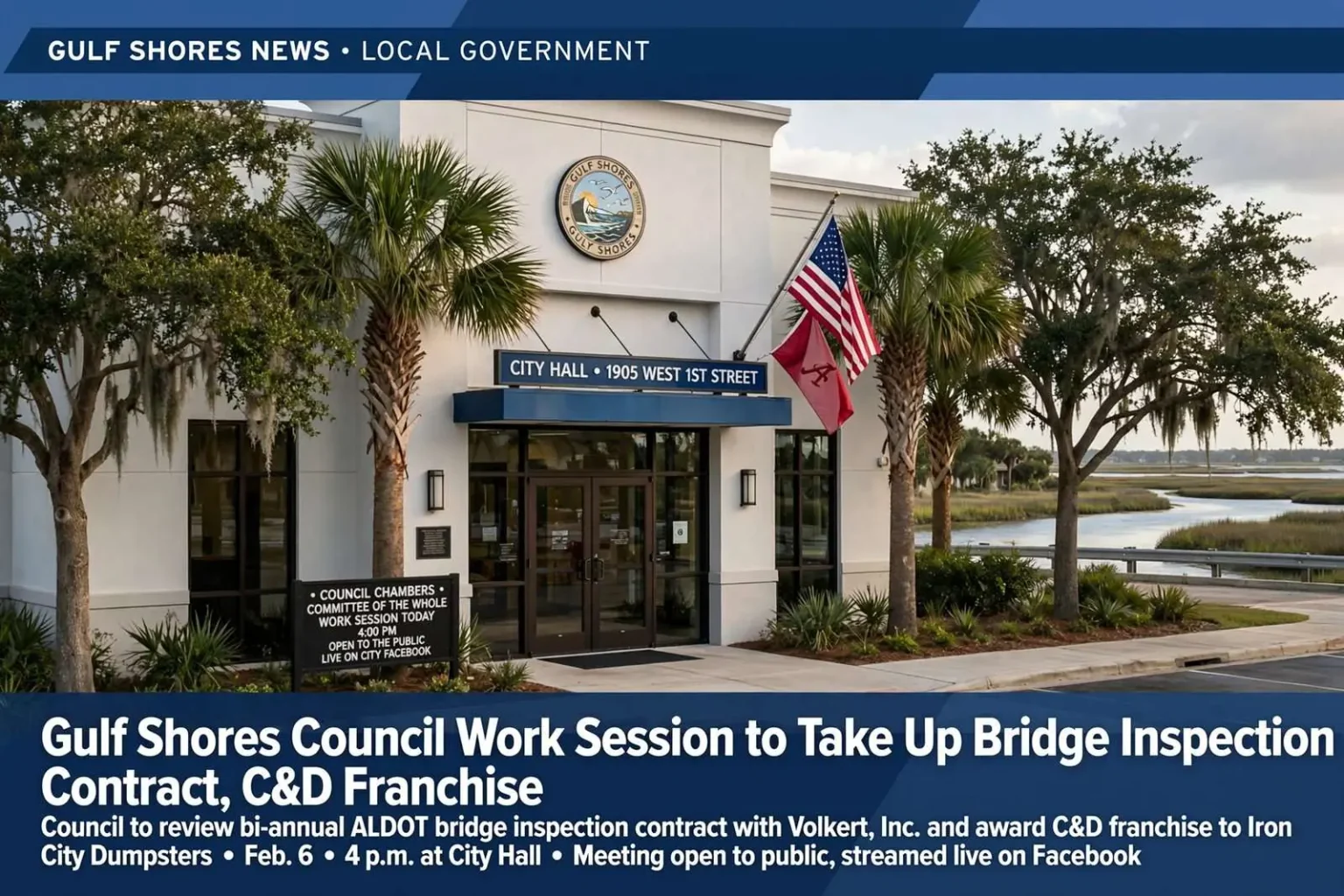
GULF SHORES, Ala. — The Gulf Shores City Council was scheduled to meet Monday, Feb. 6, at 4 p.m. for its work session — also known as a Committee of the Whole meeting — in the City Hall Council Chambers at 1905 West 1st Street. The session was open to the public, with questions and comments taken in person; the meeting was also streamed live on the city’s Facebook page for viewing only.
Work sessions occupy a distinctive place in Alabama municipal government. Unlike regular council meetings, where votes are taken and ordinances adopted, the Committee of the Whole format lets council members question staff, hear presentations and hash out details before anything comes to a formal vote. Items debated in a work session typically reappear on a later regular-meeting agenda, giving residents two chances to follow each decision — once in discussion and once at the vote.
Bridge inspection contract on the agenda
One noteworthy item stood out on the agenda: the bi-annual ALDOT bridge inspection. The council was asked to select Volkert, Inc. from ALDOT’s prequalified engineers list and accept the firm’s proposal to provide bridge inspection services at a cost not to exceed $12,892.32.
The arrangement reflects how bridge safety is handled across the state. Federal standards require public bridges to be inspected at least every two years, and the Alabama Department of Transportation maintains a list of prequalified engineering firms eligible to perform that work for cities — sparing small municipal staffs the trouble of vetting firms from scratch. Volkert, a Mobile-based engineering firm with a decades-long history of public infrastructure work across the Gulf Coast, is among the firms on that list.
For Gulf Shores, the inspections cover the city’s network of bridges, culverts and crossings that carry daily traffic over the waterways threading through the island city. With a system of canals, lagoons and bayous crossing its street grid, Gulf Shores depends on its small bridges more than most municipalities its size, and keeping inspection records current is a prerequisite for state and federal bridge funding programs.
C&D franchise bid up for award
The city was also set to award its construction and demolition (C&D) franchise bid. C&D franchises typically run five-year terms; the proposed franchise terms for Iron City Dumpsters were to begin upon full execution of the agreement and end December 31, 2025. City engineering staff reviewed the proposal and reported no known problems with the company’s service.
Construction and demolition franchises matter more to a growing coastal city than the dry term suggests. Alabama law requires that debris from building demolition and remodeling — concrete, lumber, roofing, brick and similar materials — go to licensed C&D landfills rather than ordinary municipal waste streams. A city the size of Gulf Shores, where constant construction, storm recovery and renovation generate heavy debris year-round, relies on franchised haulers to move that material legally and reliably. The franchise agreement governs which company may provide that service within city limits, on what terms and at what rates.
The franchise’s five-year span, running to the end of 2025, gives both the city and the company a long planning horizon. For the franchisee, the term provides a stable customer base; for the city, it provides a single accountable provider and a contract the city can enforce. Staff’s review — reporting no known problems with the company’s service — is the kind of routine diligence that precedes such awards, drawing on complaint records and performance during prior work.
How the evening was structured
Councilman Steve Jones was also slated to lead the councilman discussion period, the portion of a work session where members raise items of their own — constituent concerns, road conditions, upcoming events — that may not appear anywhere on the printed agenda. In a city like Gulf Shores, where tourism seasons shape municipal life, those discussions often touch on traffic, beach conditions and the perpetual balance between serving visitors and maintaining the quality of life residents expect.
The meeting’s accessibility arrangements reflected the city’s standard practice. Holding the session at City Hall on West 1st Street keeps it within walking distance of the stores and offices at the heart of town, while the live stream on the city’s Facebook page — offered for viewing only, with comments taken in person — extended access to residents who cannot attend in person. Cities across Baldwin County have adopted similar hybrid arrangements in recent years, streaming meetings while reserving public participation for the chamber itself.
Where to follow the decisions
A full agenda item summary with supporting detail for each item was available through the city’s agenda center, the online archive where Gulf Shores posts meeting agendas, minutes and supporting documents. Residents following either item — the bridge inspection contract or the C&D franchise — could review the same paperwork the council sees before the meeting, then watch the decisions move from work session to regular meeting in the weeks that followed.
Why routine items carry real weight
Neither agenda item was likely to draw a crowd, yet both represent the kind of municipal work that shapes daily life in a coastal city. Bridge inspection contracts sit at the junction of public safety and fiscal stewardship: a cost of less than $13,000 buys the documentation that keeps crossings certified, protects the city’s liability position and preserves eligibility for the state and federal bridge programs that fund repairs when inspections turn up deficiencies. Deferred inspections, by contrast, can turn small problems into closures — an outcome a barrier-island city can ill afford, where a closed bridge can reroute thousands of vehicles onto already burdened streets.
The C&D franchise, meanwhile, touches residents more directly than most realize. Every contractor tearing out an old roof, every pool excavation, every storm cleanup passes through the franchise system, and the rates and reliability of that system ripple into construction costs across the city. A franchise that performs poorly shows up in complaints about missed pickups, illegal dumping and debris lingering in alleys — issues city engineering staff track and weigh at renewal time.
The work session in Gulf Shores’ calendar
Early February falls in the quiet stretch of Gulf Shores’ municipal calendar, between the winter lull and the spring surge that brings the crowds, the beach rescues and the construction season. It is the time of year city governments along the Alabama coast use to catch up on contracts, inspections and capital planning before the busy months arrive. Scheduling the bridge inspection contract and the franchise award in this window is typical — locking in service providers and compliance work before tourist season makes every street, bridge and landfill run busier.
For residents, the practical takeaway of the meeting was continuity: the same inspection firm selected through the same state list, the same franchise system continuing under a familiar proposed term through 2025. Municipal government in Baldwin County’s beach cities runs on hundreds of such decisions a year — largely invisible, occasionally contentious, always consequential for the budget that funds police, fire, beach maintenance and the infrastructure that makes a coastal city work.
Following along from home
The council’s practice of streaming sessions and posting complete agenda documentation through the agenda center has made it easier than ever for residents to track these decisions without attending in person. The city’s Facebook live stream, though one-directional, captures the full discussion; the agenda center preserves the paperwork and the record. Between the two, a resident can reconstruct any decision the council makes — who bid, what it cost, what staff recommended and how each member voted. For a city that swells each year with visitors and new arrivals, that transparency is part of the infrastructure too, as essential in its way as the bridges the meeting was set to discuss.
Questions and comments on the items remained available in person at the work session, as the city noted in its meeting notice — the standing invitation that keeps a Committee of the Whole meeting, in the end, what its name promises: the public’s business, conducted in public.
The people behind the agenda
Gulf Shores’ council operates with a small professional staff typical of Baldwin County’s beach cities — a city engineer whose office reviews proposals like the C&D franchise bid, administrative staff who assemble the agenda center’s documentation, and elected officials who balance the city’s role as a resort destination with its obligations to a permanent residential community. The discussion period led by Councilman Steve Jones is where the residential side of that balance usually gets its voice, as members relay concerns about drainage, code enforcement, cut-through traffic and the other friction points of life in a town whose population multiplies each summer.
The Committee of the Whole format gives those conversations room. Without the formal constraints of a voting meeting, council members can ask staff to explain a contract line by line, probe the history behind a recommendation and flag items they want held for further study. Items that survive the work session generally move to the regular meeting with the council’s questions already answered, which shortens public meetings and keeps the decision record clean.
Bridges, storms and the island city
Gulf Shores’ dependence on its bridges is inseparable from its geography. The city spreads across the coastal strip and the barrier island south of it, connected by a network of bridges and causeways that funnel residents and visitors toward the public beaches that anchor the local economy. Storm seasons test that network regularly — tropical systems have battered Baldwin County’s coastline repeatedly over the decades — and the inspection program the council was asked to fund exists partly to find vulnerabilities before a storm finds them first.
Inspection contracts like the one proposed with Volkert feed directly into that preparedness. An inspection documents the condition of every structural element, ranks deficiencies and schedules follow-ups, giving the city an engineering basis for maintenance budgets and, when necessary, closure decisions. The bi-annual rhythm matches the federal minimum, but cities along the coast often find the inspections especially valuable in the aftermath of hurricanes, when rapid assessments determine which crossings can carry emergency traffic.
A quiet meeting, a working city
For all its routine character, the Feb. 6 work session illustrated the machinery of a city that runs on details: a state prequalified firm to inspect the bridges, a franchised hauler to carry the debris, a councilman to lead the discussion and an agenda center to keep the record straight. The council was scheduled to convene at 4 p.m. in the City Hall Council Chambers at 1905 West 1st Street, with the public invited in person and the live stream carrying the session to anyone at home. By the time the regular meeting followed, the questions raised that afternoon would have been answered, the contracts would have moved toward execution, and the city’s business — bridges, franchises and all — would have advanced another notch, largely unnoticed, as it does in Gulf Shores most weeks of the year.