Gulf Shores Couple Sues BrettRobinson Over Offer to Help With BP Oil Spill Claims
David and Theresa Gill sued BrettRobinson, alleging its offer to help with BP oil spill rental-loss claims amounted to unauthorized legal practice.
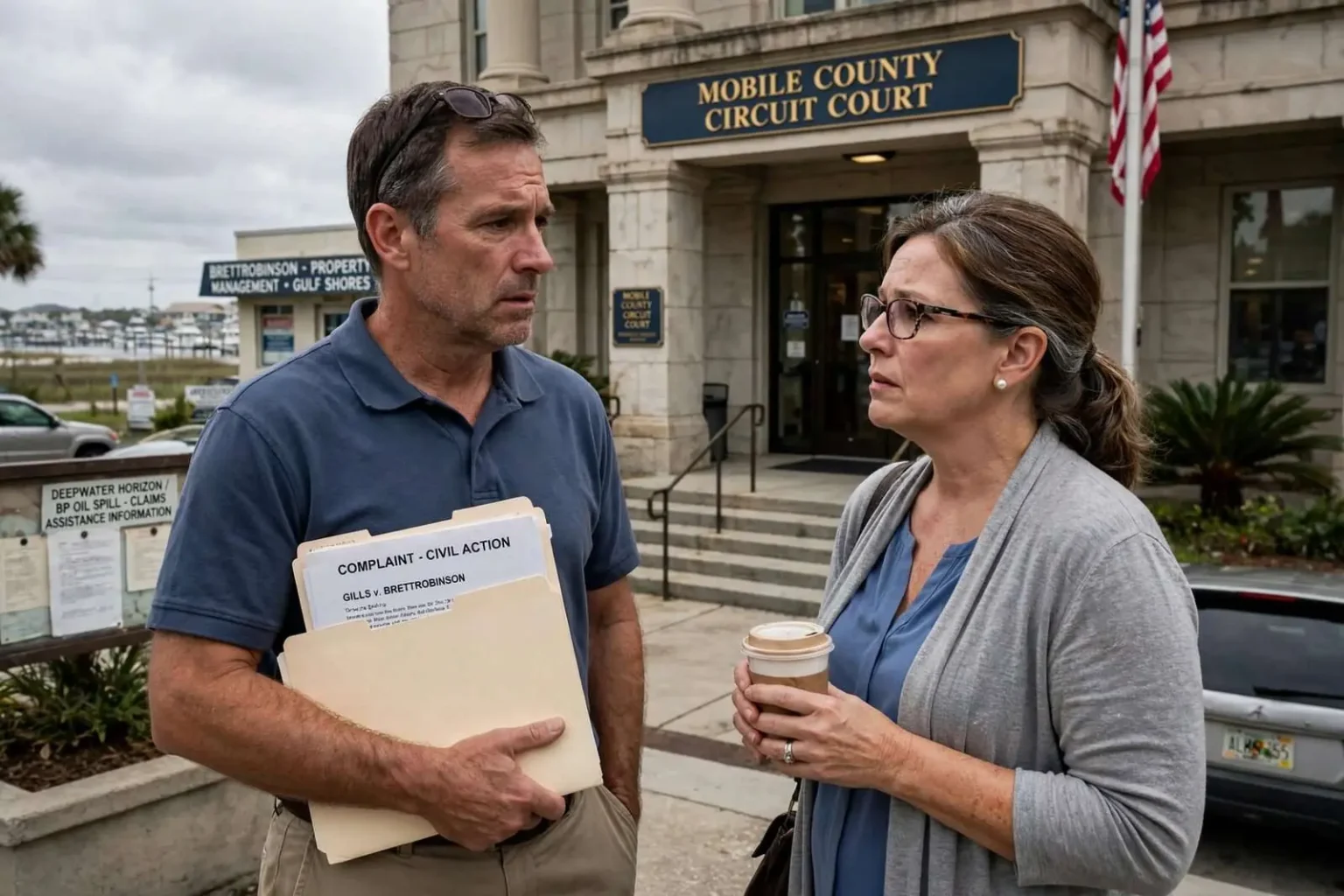
A Mobile County couple has filed a lawsuit against BrettRobinson, a Gulf Shores-based real estate company, over its offer to help rental property owners submit claims for lost income tied to the 2010 Deepwater Horizon oil spill. The case turned a routine-sounding business courtesy into a question of professional licensing: when a property manager helps its owners navigate a claims process, has it crossed into practicing law without a license?
David and Theresa Gill, the plaintiffs named in the suit, allege that BrettRobinson’s offer to assist owners in filing claims with BP crossed the line from routine business support into the unauthorized practice of law. The company had told owners it would help gather and submit documentation of lost rental income so BP could process claims more quickly.
The stakes were substantial for the parties involved. The spring and summer of 2010 is peak rental season along the Alabama beaches, and the spill’s arrival sent prospective vacationers elsewhere, leaving condo owners with empty units during the months their annual income depends on. For owners of BrettRobinson-managed properties, the company’s offer of help with claims paperwork arrived as a lifeline — and, the Gills’ suit contends, as something more legally significant than a simple administrative favor.
Unauthorized practice of law rules exist to protect the public from unqualified legal advice, and they are enforced unevenly — typically in disputes that arise after the advice goes wrong. The Gills’ lawsuit is a reminder that the line is not academic: businesses that help customers complete forms, calculate losses and frame claims are, in the view of some courts and bar authorities, edging into legal representation unless the activity is carefully confined to clerical assistance.
Company Says It Only Helped With Paperwork
BrettRobinson has said its role was limited to helping owners collect and deliver rental history and income records to BP, not to offer legal advice or representation on their behalf. The company maintains it never held itself out as providing legal services.
The distinction the company draws is the standard defense in these disputes: gathering documents that already exist — rental histories, bank records, tax forms — is clerical work, while interpreting the claims process, advising on what to ask for, or negotiating with the payer is legal work. Property management companies along the coast had decades of rental records in their systems, making them the natural source for the income documentation BP’s claims process demanded, and helping owners retrieve their own records is hard to characterize as representation.
The dispute reflects broader confusion in the months after the spill, as thousands of Gulf Coast property owners, business operators and workers scrambled to document losses and file claims through BP’s compensation process. Real estate management companies across coastal Alabama found themselves fielding requests from anxious owners for help navigating the paperwork.
The claims process itself was evolving as the filings rolled in. BP established emergency compensation funds and later a larger claims facility under the settlement framework, and the documentation requirements shifted as the process matured — first proving immediate losses, then building longer-term claims for the seasons the spill damaged. For owners whose livelihoods hung on the outcome, the shifting requirements created genuine anxiety, and for companies like BrettRobinson, every request for help raised the question of how far assistance could go.
Coastal Alabama’s rental market made the situation especially acute. The beach resort economy between Gulf Shores and Orange Beach runs on condominium rentals managed by a handful of large companies, and owners — many of them out-of-state investors — depend on those managers not only for bookings but for the financial records that prove what their properties normally earn. When the spill erased the season, the managers were simultaneously the victims’ landlords’ agents, the keepers of the evidence, and, in the Gills’ view, an actor whose help carried legal weight.
Restraining Order Issued
A Mobile County Circuit Court judge issued a temporary restraining order as the case proceeded, though the underlying legal question of where routine claims assistance ends and unauthorized legal practice begins remained unresolved as the suit moved forward.
A temporary restraining order in this context is an interim measure, not a judgment: it preserves the situation while the court considers the merits, preventing either side from acting in ways that would make the dispute moot. The Gills obtained the order as the litigation began, and its issuance signaled that the court saw a question worth restraining while the parties prepared their arguments. The order did not decide whether BrettRobinson’s conduct constituted legal practice — only that the question would be litigated.
The case adds to a wave of legal wrangling that followed the spill, as attorneys, claims consultants and business owners alike sought to define who could legally help Gulf Coast residents pursue compensation from BP.
The spill generated an entire ecosystem of claims assistance, and with it, disputes over its legitimacy. Attorneys advertised across the coast; out-of-state consultants set up offices near the beaches; accountants prepared loss calculations; and property managers, employers and bankers helped customers assemble documentation. Bar authorities in Alabama, Louisiana, Mississippi and Florida warned that unlicensed claims assistance could constitute unauthorized practice, while businesses countered that refusing to help customers through a confusing process would leave claimants worse off. The tension between consumer protection and consumer help defined the era, and lawsuits like the Gills’ tested where courts would draw the line.
For the real estate industry, the case’s outcome carried lessons regardless of who prevailed. Management companies responding to future disasters — and the Gulf Coast guarantees future disasters — now understood that claims assistance required careful boundary-setting: providing records, yes; advising on claims strategy, no. The safest course for most was to refer owners to licensed attorneys while supplying the underlying documentation, a division of labor that respected both the licensing rules and the practical need for help.
What the case means for the coast
Deepwater Horizon litigation sprawled across courts for years, encompassing everything from commercial fishermen’s losses to penalties under federal pollution law. Against that backdrop, the Gills’ suit was small but symbolically significant: it tested the duties of the property management industry, a pillar of Baldwin County’s economy, and asked a court to separate neighborly help from professional practice.
The litigation also illustrated how the spill’s costs cascaded in unexpected directions. Beyond the obvious losses — missed fishing trips, empty hotel rooms, closed oyster beds — the disaster produced disputes between neighbors, businesses and partners over the compensation process itself, adding legal fees to economic losses. A claims process meant to make victims whole became, in places, a source of conflict among the very people it was designed to help.
As the case moved through the Mobile County courts, both sides held to their positions: the Gills maintained that a company cannot practice law by another name, and BrettRobinson maintained that helping owners recover their own records was simply good service in a crisis. The restraining order kept the status quo while the courts worked — a reminder that even in a disaster’s aftermath, the ordinary machinery of civil litigation applies, one motion at a time.
The unauthorized practice of law, in plain terms
The doctrine at the center of the case exists in every state: only licensed attorneys may give legal advice, prepare legal documents for others, or represent people in legal matters. The rule protects the public from incorrect advice given by people without legal training or accountability, and courts enforce it through injunctions and, occasionally, prosecutions. But the boundary between legal work and ordinary business help is famously fuzzy. Real estate agents explain contract terms, accountants interpret tax law, banks help customers fill out loan documents — and all of it shades toward legal practice without anyone intending harm.
In the claims context, the line usually comes down to judgment and advocacy. Copying a client’s rental ledger and mailing it to BP is data transfer; advising an owner that his claim is worth more than BP’s offer, or drafting a letter arguing why the claim qualifies, is advocacy. Courts examining these questions look at what was actually said and done, which is why cases like this one turn on detailed records of the company’s communications with owners — the offer letters, the instructions, the extent of the help given.
Alabama’s enforcement of the rule runs through the Alabama State Bar, which investigates unauthorized practice complaints and can seek court orders. The bar’s posture after the spill followed the pattern of prior disasters: reminders to businesses about the limits of permissible help, alongside acknowledgment that claimants needed practical assistance and that plenty of it was legal. The Gills’ suit gave the issue a concrete courtroom test in Mobile County, where the parties and the judge could examine exactly what BrettRobinson’s offer involved.
BrettRobinson and the coastal rental economy
The company at the center of the suit is one of the largest property management firms on the Alabama coast, with a portfolio of beachfront condominiums in Gulf Shores and Orange Beach and a customer base of owners from across the country. Management companies of that scale handle bookings, housekeeping, maintenance and accounting for hundreds of units, and their owners — many of them absentees who visit a few weeks a year — rely on the companies’ records as the authoritative account of what their properties earn.
That reliance is what made the spill claims process so dependent on the management companies. A lost-rental claim requires proof of what the unit would have earned, and the only credible evidence lives in the manager’s booking and financial systems. Owners whose managers declined to help would have faced the claims process without the very documents that proved their losses. Against that backdrop, BrettRobinson’s offer of help was both practically necessary and, in the Gills’ view, legally loaded.
The case also unfolded as the coastal rental industry was absorbing the spill’s business damage. Bookings for the summer season had been cancelled or never made; owners were facing their first empty Julys; and management companies were trimming staff even as owners demanded help with claims. The lawsuit added a legal distraction to an operational crisis, and its resolution mattered not only to the parties but to every management company along the coast designing its own claims-assistance policy.
As the litigation proceeded in Mobile County Circuit Court, the temporary restraining order held the question open: whether help with paperwork, offered in good faith during a regional catastrophe, could be recast as the practice of law. The answer would shape how the Gulf Coast’s property managers respond the next time disaster closes the beaches.