Gulf Shores School Buses to Shuttle Visitors to National Shrimp Festival
Gulf Shores schools step in to run shuttles to the National Shrimp Festival after BRATS pulls out, with fees benefiting local school programs.
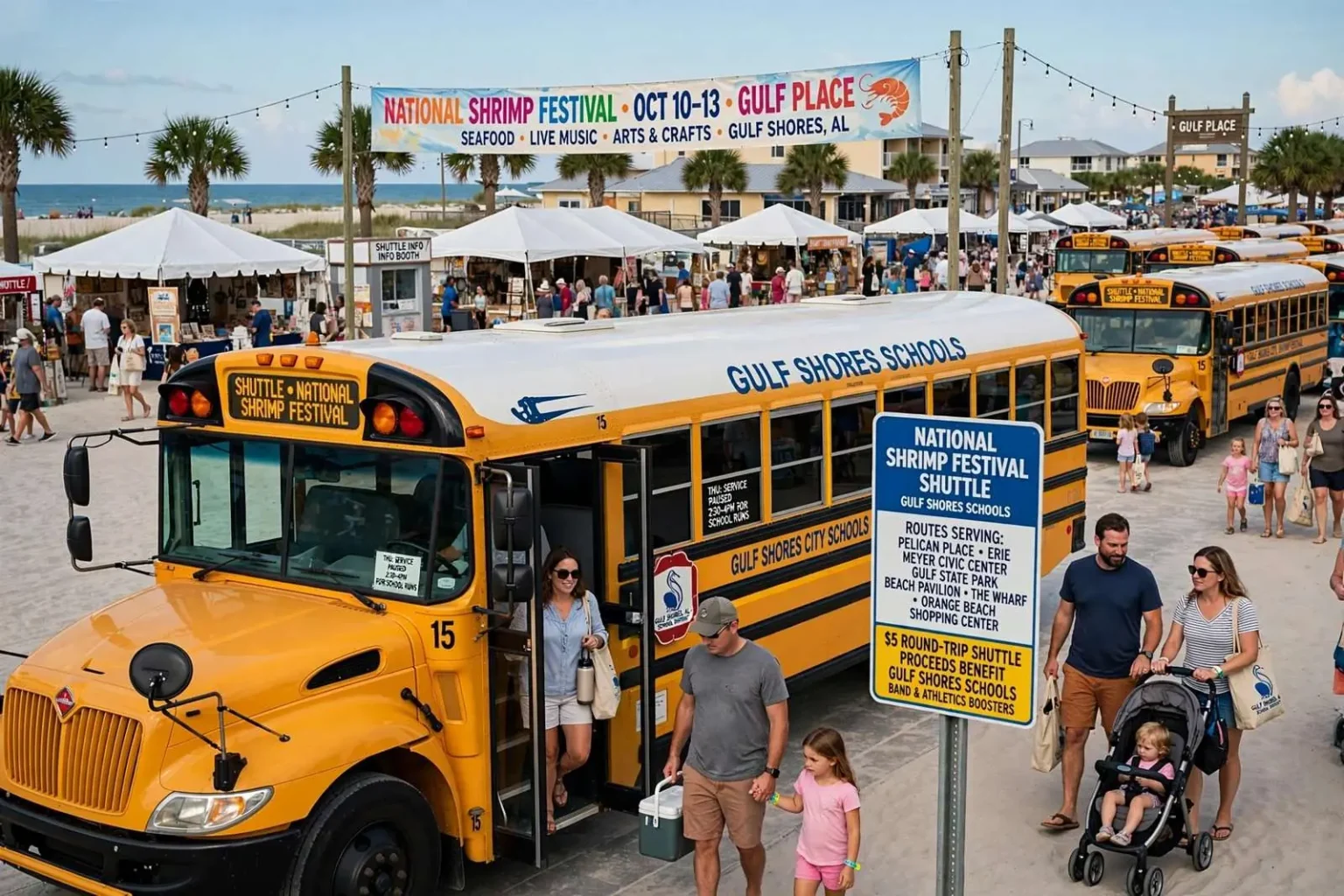
The National Shrimp Festival is returning to the Gulf Shores beachfront, and this year getting there will look a little different. With the Baldwin Regional Area Transit System stepping away from its usual shuttle role just before the event, the Gulf Shores school system has agreed to fill the gap, running buses that are expected to carry close to 20,000 visitors to and from the festival grounds.
The late change put one of the coast’s biggest annual events in the hands of a new set of drivers with only days to prepare, and it turned the yellow buses that normally serve Gulf Shores students into the main artery between the festival site and the parking areas strung along the coast on both sides of town.
Organizers said BRATS withdrew from the arrangement at the last minute because it did not have enough drivers available to cover the four-day event. The withdrawal came at the worst possible moment on the calendar, with the festival’s opening day approaching and tens of thousands of visitors expecting the shuttle service that has become part of how the event operates. For a public transit system that serves all of Baldwin County, driver availability has long been the binding constraint, and a four-day festival with extended hours every day is one of the most demanding assignments on its schedule.
The Gulf Shores Board of Education stepped in, supplying 15 buses and drivers across six routes from Thursday through Sunday. The arrangement essentially borrowed the school district’s existing fleet, its trained drivers and its daily route discipline, and redirected all of it toward moving festival traffic. Fifteen buses spread across six routes gave organizers enough capacity to keep waits short while still leaving room in the plan for the mechanical issues and delays that come with any large-scale shuttle operation.
Shuttle Fees Now Benefit Local Schools
The five-dollar shuttle fee remains in place, but the money collected this year will go to Gulf Shores schools rather than a transit agency. District leaders said band boosters plan to put their share toward new uniforms, while athletic booster groups expect to direct funds toward equipment for sports programs.
Booster organizations carry much of the financial weight behind high school band and athletics, and most raise the bulk of their money through small, labor-intensive fundraisers — concession stands, car washes, community suppers — spread across the year. A festival shuttle contract redirects a slice of the largest event on the Gulf Shores calendar straight into those accounts, in a matter of four days, at a scale that traditional fundraisers cannot approach. For the band, new uniforms are among the most expensive line items a program faces, often running thousands of dollars per set, and for athletic teams, equipment purchases arrive every season without fail.
Superintendent Matt Akin described the partnership as a long-term benefit both for the district and for the festival itself, noting that booster organizations supporting athletics and music programs stand to gain year after year as long as the arrangement continues. That framing matters: the district was not simply doing a favor for event organizers, it was being offered a recurring revenue stream that ties the school system’s fortunes to one of the region’s signature events.
The arrangement also reflects the close relationship between the city and its school system. Gulf Shores operates its own city school district, separate from the Baldwin County system, and the community’s identity is closely tied to both its schools and its tourism economy. A partnership that serves the festival, the schools and the visitors at once is the kind of arrangement small coastal cities are particularly well positioned to make, because the same leaders, businesses and families sit behind all three.
Where to Catch a Ride
Shuttle routes stretch along the coast on both sides of the festival site. On the western side of town, riders can board at Pelican Place or the Erie Meyer Civic Center, with an additional stop serving the Waves area. To the east, pickup points include the Gulf State Park Beach Pavilion, a shopping center location in Orange Beach, and The Wharf.
The route map reads like a tour of the coast’s major gathering points. Pelican Place serves the neighborhoods and shopping district on the western approach to town, while the Erie Meyer Civic Center sits on West 19th Avenue, a facility the city uses for events and recreation year-round. On the eastern end, the Gulf State Park Beach Pavilion anchors the park’s beachside day-use area, and The Wharf in Orange Beach gives visitors staying at the resort district’s hotels, condominiums and marinas a direct line to the festival without ever touching Highway 182 traffic.
For visitors, the economics are straightforward. Festival-area parking is limited and fills early, and the lots closest to Gulf Place command the most patience and the earliest arrival times. A five-dollar round-trip shuttle from a parking area miles away, with buses cycling continuously through the day and into the festival’s evening hours, trades a small fee for the ability to arrive when convenient rather than when a spot opens up. Families with children and visitors staying in condominiums along the route benefit most, since the shuttle eliminates the daily search for parking during a four-day event.
The volume involved explains why the driver shortage at BRATS was such a problem. Moving 20,000 riders over four days requires dozens of individual bus runs each day, each needing a qualified driver with a commercial license, and a transit system short on drivers simply cannot fabricate that capacity on short notice. The school district could, because it already employs the licensed drivers and already runs a fleet large enough to cover its own routes plus six festival loops at the same time.
One Wrinkle for Thursday Riders
One wrinkle for Thursday riders: buses will pause service between 2:30 p.m. and 4 p.m. so drivers can complete afternoon school runs before returning to their shuttle routes. The gap is the unavoidable arithmetic of borrowing a school fleet — the same buses and drivers that serve the festival have students waiting at the end of the school day, and those runs come first.
Festival organizers built the schedule around the pause, and riders planning a Thursday afternoon trip should simply expect the service to thin out during that window before resuming once the drivers finish their routes. The rest of the four-day run, Friday through Sunday, operates without the interruption since school buses and drivers are not needed for student transport on those days.
A Refined Festival Footprint
This marks the second year the festival has operated on its beachfront site at Gulf Place, and officials said feedback from the first year shaped the layout and operations for this fall’s event. Moving a long-running festival onto the sand is an undertaking that touches every part of the production — vendor placement, power, waste removal, security and the transportation network that brings visitors in — and a second year on a site is typically when an event smooths out the rough edges identified the first time through.
The National Shrimp Festival draws visitors from across the Gulf Coast and beyond for days of seafood, live music, arts and crafts, and children’s activities set against the Gulf of Mexico. Its footprint at Gulf Place puts hundreds of vendors and multiple music stages in a compact area that would be impossible to serve with individual parking, which is why the shuttle system is not a convenience but a structural part of how the event handles its crowds.
For the drivers making the switch from school routes to festival routes, the work is familiar in mechanics and different in rhythm. Festival shuttles run continuous loops for hours, loading and unloading at the same few stops, often with families carrying strollers, coolers and festival purchases that school routes never see. Experienced drivers and well-marked stops matter more than usual when passengers are visitors unfamiliar with the area, and the six-route structure was designed to keep the boarding process as simple as possible for someone who has never ridden a Gulf Shores bus before.
What Visitors Should Know
Visitors planning to use the shuttle should bring cash for the five-dollar fee, arrive at a marked route stop, and allow extra time during peak midday and evening hours when festival crowds are heaviest. The Thursday afternoon pause from 2:30 to 4 p.m. is the one scheduled gap in the service, and riders with flexibility can plan around it entirely by shifting their travel to earlier or later in the day.
For Gulf Shores, the arrangement turns a logistical scramble into something closer to a standing partnership: the city keeps its biggest festival moving, the schools gain a fundraising stream that grows with the event’s success, and visitors get the same ride to the sand they expected — just on buses painted yellow instead of white.