
Gulf State Park Pier Reopens After Extensive Hurricane Sally Repairs
The Gulf State Park Pier in Gulf Shores reopened Jan. 30 after crews repaired about 725 feet damaged by Hurricane Sally, with the southern section still.
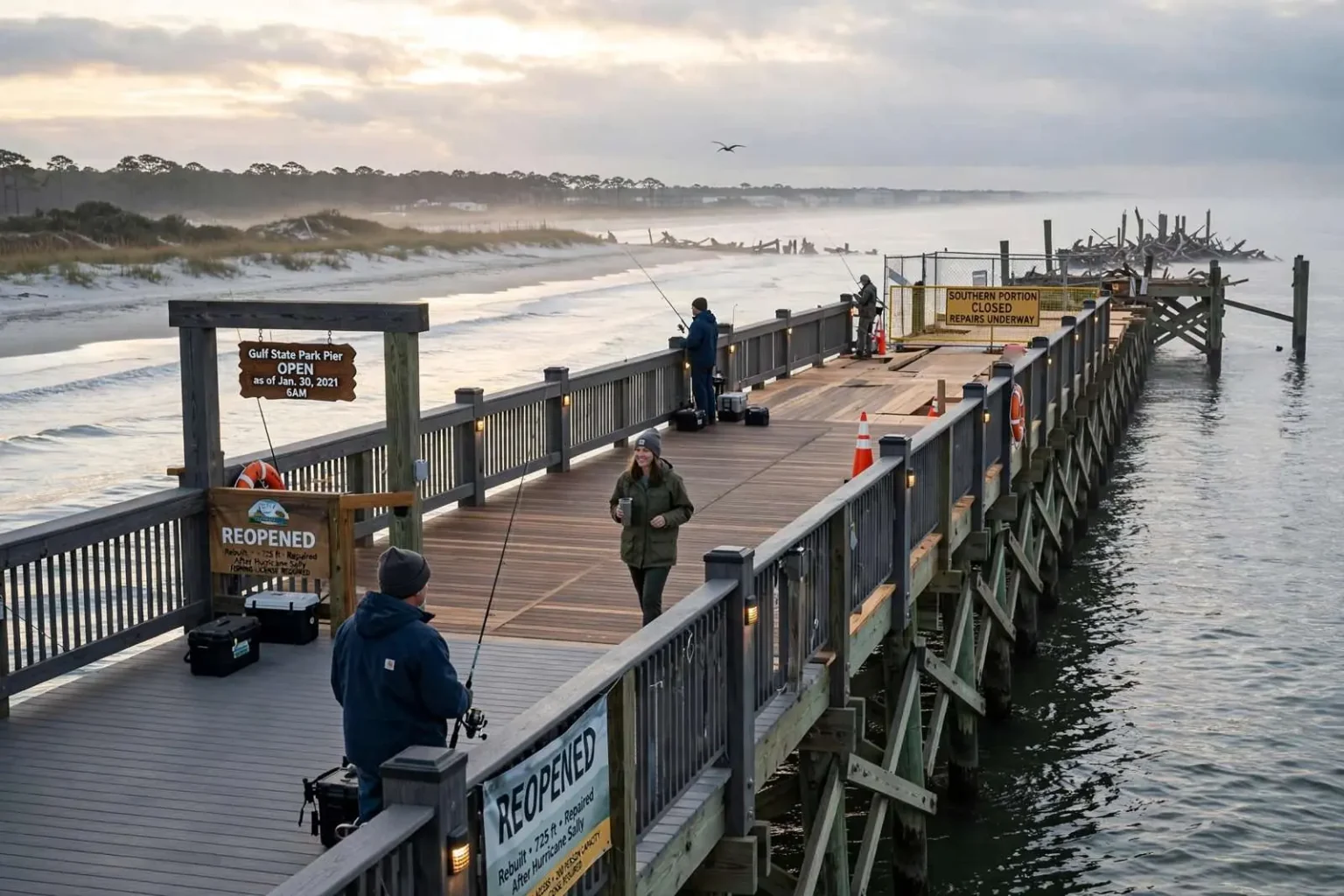
GULF SHORES, Ala. — The Gulf State Park Pier reopened to the public Saturday, Jan. 30, at 6 a.m., roughly four months after Hurricane Sally destroyed a section of the structure. The Sept. 16, 2020, storm wiped out an entire portion of the middle of the pier. Crews have since repaired about 725 feet of the span, which is now accessible to anglers on both sides. The southern portion, which took the heaviest damage, remains closed.
A Landmark Restored After Sally
The reopening of the Gulf State Park Pier marks a milestone in the Alabama Gulf Coast’s recovery from Hurricane Sally, the slow-moving Category 2 storm that came ashore near Gulf Shores on September 16, 2020, and punished the coast with days of flooding rain and a relentless storm surge. Sally’s damage across Baldwin County ran into the hundreds of millions of dollars, toppling trees, flooding neighborhoods and chewing through the coastline — and the pier, one of the region’s most recognizable landmarks, took a direct hit that split the structure and left a section of the span twisted and unusable.
The pier reopened to the public at 6 a.m. on Saturday, Jan. 30, roughly four and a half months after the storm, with crews having repaired about 725 feet of the span. Anglers can now walk the repaired stretch on both sides, restoring access to the deep-water reaches where the pier’s most prized catches — king mackerel, cobia, redfish and the seasonal runs of pompano and Spanish mackerel — are made. The southern portion, which took the heaviest damage, remains closed, and park officials have continued repairs on that section as a separate phase of the work. Weather windows, material sourcing and marine construction logistics all shaped the repair timeline, and finishing the middle span first made sense both structurally and for restoring the most usable fishing length.
For the fishing community, the reopening could not come soon enough. The Gulf State Park Pier is the longest pier on the Gulf of Mexico, stretching more than 1,500 feet into the Gulf, and it draws anglers from across the Southeast who target the species that gather around its pilings. Winter and early spring bring some of the pier’s most anticipated fishing, including the whiting and redfish bite and the buildup toward the famous cobia run, when sight-fishermen scan the green water for the migrating fish each March and April. The timing of the Jan. 30 reopening, ahead of the spring season, means pier regulars will be back in position for the year’s first big migration.
The pier’s role in Gulf Shores extends past fishing. Visitors who never wet a line walk the span for the view, the dolphin sightings and the sunset photographs, and the pier appears in a share of the area’s vacation photos matched by few structures on the coast. Its silhouette at the end of the beach road is part of how Gulf Shores pictures itself — a working fishing pier, open to everyone, running from the dunes into the open Gulf.
A Recently Renovated Showpiece
The reopening follows an extensive renovation completed in 2020, with upgraded ipe wood decking and railings, turtle-friendly lighting that meets U.S. Fish and Wildlife Service standards, a refreshed fish cleaning station and refurbished restrooms. That renovation, finished just months before Sally’s landfall, represented a major investment in the pier’s future — and the new construction proved its quality by surviving the parts of the structure that the storm did not destroy outright.
The turtle-friendly lighting deserves particular note. Sea turtle nesting along the Gulf Coast is a protected and closely managed phenomenon, and lights that shine white or bright disorient hatchlings trying to find the Gulf after emerging from their nests. The pier’s lighting system was redesigned to meet U.S. Fish and Wildlife Service standards, using fixtures and wavelengths that keep the deck usable for night anglers while minimizing the impact on nesting turtles on the beaches nearby. The standard reflects the growing partnership between coastal recreation and conservation that defines modern beach management along the Alabama coast, where nesting season closures and lighting ordinances are now routine parts of the summer calendar.
The ipe decking, a dense Brazilian hardwood prized for its durability in marine environments, replaced the pier’s previous walking surface as part of the renovation. Combined with new railings, the upgraded materials gave the pier a refreshed look that visitors had only months to enjoy before Sally interrupted — making the post-storm repairs a restoration of something newly renewed rather than a patch on an aging structure. The refreshed fish cleaning station and restrooms likewise returned with the pier, restoring the full amenity set that serious anglers plan a day around.
Visiting the Pier: Hours, Capacity and Cost
The pier is open 24 hours a day with staff on site from 6 a.m. to 9 p.m., and COVID-19 capacity limits keep occupancy at 200 people, split roughly between anglers and sightseers. The capacity restrictions, in place during the pandemic era, mean visitors may encounter wait periods during peak times — a small inconvenience compared with the alternative of losing access entirely, which was Sally’s legacy for four months. Staff on site during daylight hours handle admissions, answer questions and keep the platform operating smoothly for both the fishing trade and the sightseeing crowd.
The pier anchors Gulf State Park, the 6,150-acre park that stretches from the beaches of Gulf Shores and Orange Beach inland through lakes, dunes and maritime forest. The park’s trail system — more than 25 miles of paved paths — connects the pier area to the park’s campground, cabins, the Learning Campus and the fishing lakes inland of the dunes. For visitors, the pier is the park’s marquee attraction, but it functions as one piece of a recreation destination that includes the beach pavilion, nature center and one of the state’s most visited golf courses. The park’s reopening phases after Sally proceeded through the fall and winter, with the pier among the most anticipated pieces.
Anglers on the pier need a fishing license in most circumstances, available through the Alabama Department of Conservation and Natural Resources, and the pier’s staff handle the daily rhythm of a working fishing platform: bait sales, tackle advice, the fish cleaning station and the spectator trade that comes to watch the cranes, carts and big catches. The pier’s 24-hour schedule is a tradition — night fishing for bull reds, sharks and the summer flounder run draws its own devoted crowd after dark. Pier fishing culture runs deep on the Alabama coast, with regulars who keep carts, coolers and tackle boxes permanently rigged for a day on the planks.
Sally’s Long Shadow and the Recovery Ahead
“It is gratifying to be able to start 2021 with the reopening of one of our most significant amenities,” said Lamar Pendergrass, Alabama State Parks’ Southern Regional Operations Supervisor. His assessment reflected both pride in the recovery and realism about what remains: the southern portion of the pier — the end that reaches into the deepest water and some of the best fishing — was still under repair as the rest reopened, and the park as a whole continued piecing itself together from the storm’s damage.
Hurricane Sally was a reminder of the Gulf Coast’s vulnerability. The storm’s slow track parked it over the region for days, and its surge and sustained winds did structural damage that fast-moving hurricanes often spare. State parks along the coast, already budget-conscious operations funded substantially through their own revenues, measured the storm’s costs in closed amenities, lost visitation and repair backlogs that take years to clear. The pier’s rapid reopening — four months from destruction to public access — was among the faster recoveries, aided by the fact that the structure had just been renovated and its repair needs were localized.
The pier’s reopening also carries symbolic weight for the coastal towns around it. Gulf Shores and Orange Beach built their tourism economies on exactly the mix of beach, fishing and recreation the pier represents, and every recovered amenity is a signal to visitors that the coast is open for business. Condo towers, restaurants and charter fleets around the park all depend on the same visitor flow, and a functioning pier strengthens the draw of the entire eastern end of the Alabama beaches.
As 2021 began, with the pier’s gates swinging open at 6 a.m. on Jan. 30 and the repaired 725 feet back under the feet of anglers, the Alabama Gulf Coast could point to concrete evidence that Sally’s damage, however extensive, was temporary — and that the pier, like the coast around it, intends to be here for the long run. The southern section’s completion will close out the recovery, and until then the pier offers plenty: the view, the fish, the sunrise crowd and the deep-water platform that has defined Gulf Shores for generations.