Hands Across the Sand Events Planned for Fairhope, Gulf Shores and Dauphin Island
Hands Across the Sand events were planned for Fairhope, Gulf Shores and Dauphin Island as coastal Alabama joined the national clean energy movement.
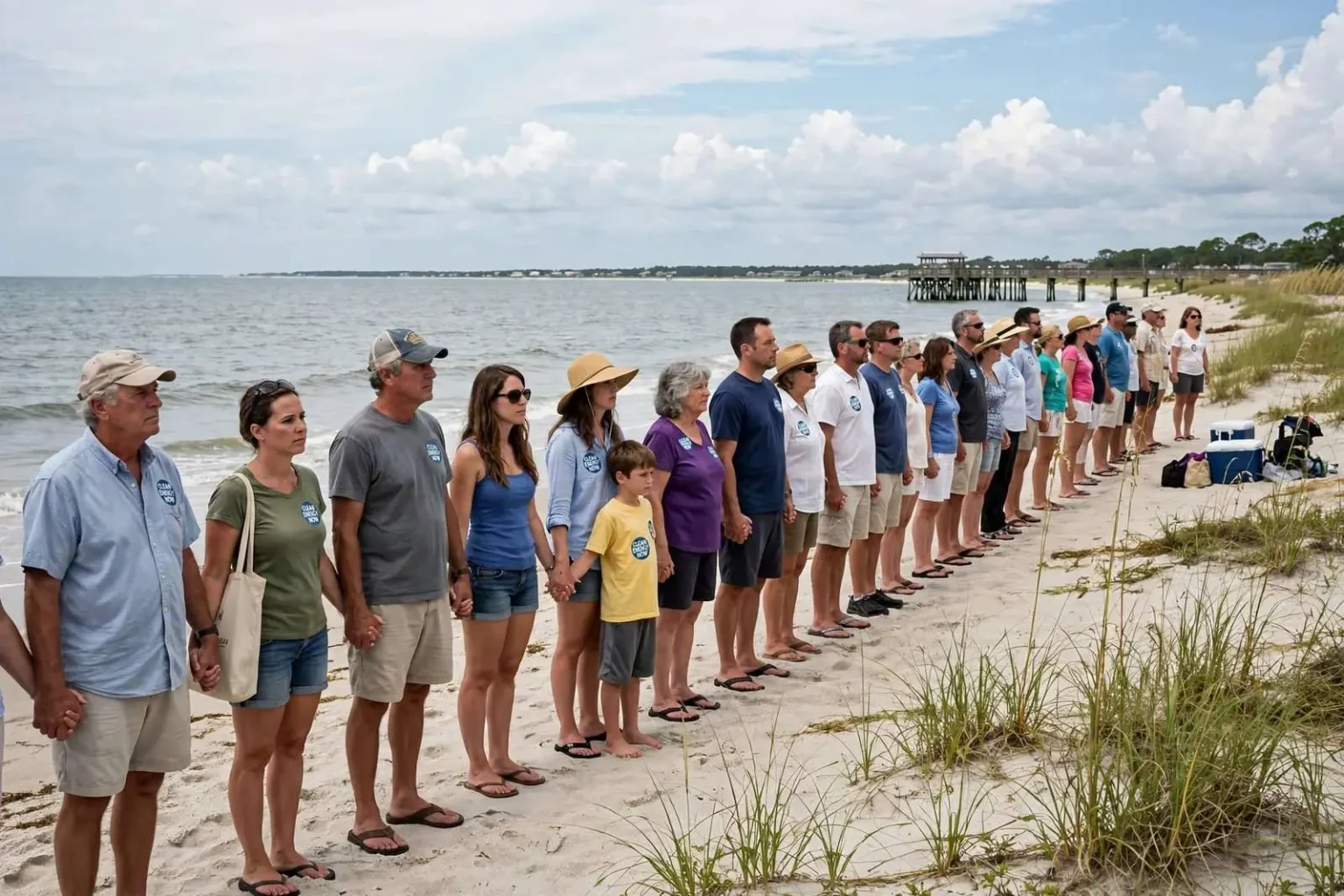
On a June Saturday one year after the worst offshore oil disaster in American history, Alabamians were asked to do something deceptively simple: show up at their local beach, hold a stranger’s hand, and stand in silence for fifteen minutes. The invitation came through the national Hands Across the Sand movement, which scheduled coordinated gatherings for Saturday, June 25, 2011, at three Gulf Coast locations — Dauphin Island, Fairhope and Gulf Shores — as part of a nationwide day of action.
The event’s choreography was the same at every site. Participants were asked to begin gathering at 11:00 a.m. At noon, everyone joined hands and stood in silence along the beach for 15 minutes, creating symbolic lines in the sand to represent their commitment to protecting beaches, oceans, marine wildlife and coastal economies. There were no speeches to sit through and no permits for amplification; the entire demonstration could be understood from a distance, which was the point.
Hands Across the Sand is a grassroots initiative that brings together people from all walks of life to form human chains along shorelines. The movement’s mission centers on expressing support for clean energy development while opposing the expansion of offshore oil drilling. The event is deliberately nonpartisan, focusing instead on shared values of environmental stewardship and coastal preservation — a posture that mattered along a Gulf Coast where energy jobs and beach economies coexist in the same towns.
For coastal Alabama, the 2011 edition carried a significance no other state could quite match. The Deepwater Horizon spill had begun in waters within sight of these very shores, and the year that followed had tested the region’s beaches, boats, restaurants, and patience. Standing hand in hand above the waterline was, for many who attended, the first structured chance to mark what the coast had been through.
From a Florida Beach to a Global Date
Hands Across the Sand was founded in October 2009 by Dave Rauschkolb, a Florida restaurateur whose oceanfront business gave him a front-row view of the drilling debate. The first events were organized as a protest against plans to open Florida’s waters to offshore drilling — a fight that seemed local until, months later, a rig 40 miles off Louisiana made the stakes unmistakable to everyone.
By 2011, the movement had expanded to include events in nearly every U.S. state and numerous international locations. The exponential growth reflected both the spill’s galvanizing effect and the format’s portability: any community with a shoreline could join by showing up at an appointed hour, and inland communities found their own ways to participate. What Rauschkolb started as a Florida protest had become, in under two years, a fixture of the international environmental calendar.
The initiative carried endorsements from major national environmental organizations, including the Sierra Club, the National Audubon Society, Oceana, Defenders of Wildlife, the Ocean Conservancy, Friends of the Earth, Environment America and the Center for Biological Diversity. The list spanned the spectrum of the conservation world, from grassroots giants to policy-focused groups, and gave local volunteers institutional backing without imposing on the events’ homemade feel.
For the Alabama organizers, those national connections supplied logistics and visibility, but the local turnout would supply the meaning. Movements of this kind live or die on whether people actually come to the beach — and on a June Saturday, with competition from the season’s ordinary pleasures, that was the open question.
Where Alabamians Stood
The three Alabama sites were scattered across two counties and two very different bodies of water. On Dauphin Island, the event took place at the beach near Fort Gaines, located on the island’s east side along Bienville Boulevard. The east-end beach sits beside a fortress that has watched over Mobile Bay since the Civil War era, and in 2011 it watched over something newer: the ongoing recovery of an island whose fishing fleet, restaurants, and rental houses had all absorbed the spill’s consequences.
In Fairhope, participants gathered at the public beach near the pavilion in the Duck Pond area at the foot of Fairhope Avenue on Mobile Bay. The Eastern Shore site brought the event to the bay itself, where the water is calmer and the crowd skews toward families and locals rather than tourists. Fairhope’s bluff-top downtown and its park system have long made the city a gathering place for causes of every kind, and its beach — small, popular, and directly on the bay — was a natural choice for the Baldwin County line.
The Gulf Shores event was held at Gulf Shores State Park Pier on State Highway 135. The pier is one of the Alabama coast’s most recognizable landmarks, and the state park around it anchors the public side of a beach economy built almost entirely on the promise of clean sand and swimmable water. If any single site embodied what the movement asked Alabamians to protect, it was this one — the beach that appears in the state’s tourism advertising, still rebuilding its reputation a year after tar balls washed ashore.
Together, the three gatherings traced the full outline of coastal Alabama: barrier island, protected bay, and open Gulf beach. Organizers hoped the geography itself would send a message — that the region’s risk is not confined to one shoreline, and that the people of all three places share the same stake in what happens in federal waters offshore.
The Message Beyond the Beach
Local organizers encouraged attendees to incorporate clean energy practices into their daily lives, including conserving energy, recycling and supporting efforts to reduce dependence on fossil fuels. The ask was deliberately practical. A movement that asks people only to protest can be dismissed as symbolic; one that also asks them to change habits gives every participant something to do on Monday morning, and builds the case that the clean energy transition begins at the household level.
The political target of the day was clear even if the tone was quiet. Hands Across the Sand’s founding purpose — opposing the expansion of offshore drilling — had been sharpened rather than softened by the spill, and the 2011 events aimed that argument at lawmakers considering how quickly drilling should resume and expand in Gulf waters. The silent line was the movement’s answer to lobbying: a constituent statement that required no words to be understood.
One Year After Deepwater Horizon
The 2011 events came roughly one year after the Deepwater Horizon oil spill, which devastated Gulf Coast communities and heightened public awareness of the risks associated with offshore drilling in the region. The disaster began with an explosion that killed eleven workers aboard the rig and unfolded into a months-long gusher that released millions of barrels of oil into the Gulf, closing fishing grounds, blackening beaches, and paralyzing the tourism season across the entire coast.
Alabama’s experience of the spill followed that arc in miniature. Early in the crisis, the state’s beaches seemed likely to escape the worst; then tar balls and oil mousse began arriving on the very sand the events of June 25 would occupy. Cleanup crews, boom lines, and hired boats became part of the summer landscape, and the images — workers in white suits raking oiled sand — did damage to the region’s reputation that outlasted the oil itself.
The economic aftershocks ran through every coastal industry. Charter fishing captains watched trips cancel by the week, seafood dealers worked to convince buyers their product was safe and tested, and hoteliers along the beach highway absorbed a lost season that no reimbursement fully replaced. It was against that backdrop — still raw, still unresolved in courtrooms and claims offices — that Alabamians were invited to the shoreline on the spill’s first anniversary summer.
The anniversary framing cut both ways for organizers. It guaranteed attention and emotional resonance, but it also meant the events would be measured against the recovery the coast was still living through. For participants, though, the calculation was simpler: a year after the water turned against them, they could stand on the sand and say, wordlessly, what the Gulf means to the people who live beside it.
What a Line in the Sand Leaves Behind
No single event reverses an energy policy, and no one involved in Hands Across the Sand pretended otherwise. What the movement promised was visibility and solidarity — a recurring, photogenic demonstration that the constituency for clean water and clean energy is broad, geographically dispersed, and willing to show up in the summer heat. The endorsements from the Sierra Club, Audubon, Oceana, Defenders of Wildlife, the Ocean Conservancy, Friends of the Earth, Environment America and the Center for Biological Diversity gave the effort institutional weight; the lines of hands gave it a human face.
By the time the fifteen minutes ended at the Dauphin Island, Fairhope and Gulf Shores sites on June 25, 2011, the photographs were already doing their work — local news carried the images inland, and national coverage collected them with hundreds of others from around the country and the world. For the participants, the memory served a different purpose: proof that the year after the spill, the coast’s people had not gone back to pretending the water would take care of itself.
The June 25 gatherings were part protest, part memorial, and part promise — a promise that the communities whose livelihoods, summers, and identities are built on the Gulf would keep a place at the table when decisions about offshore drilling and clean energy were made. A line in the sand, by design, washes away with the tide. The argument behind it was meant to stay.