Hatch Fairhope and Bessel Wrap Second Biotech Accelerator With Pitch Night Featuring 10 Startups
Ten biotech and medtech startups pitched investors at Hatch Fairhope and Bessel's second annual accelerator finale in Fairhope, Alabama.
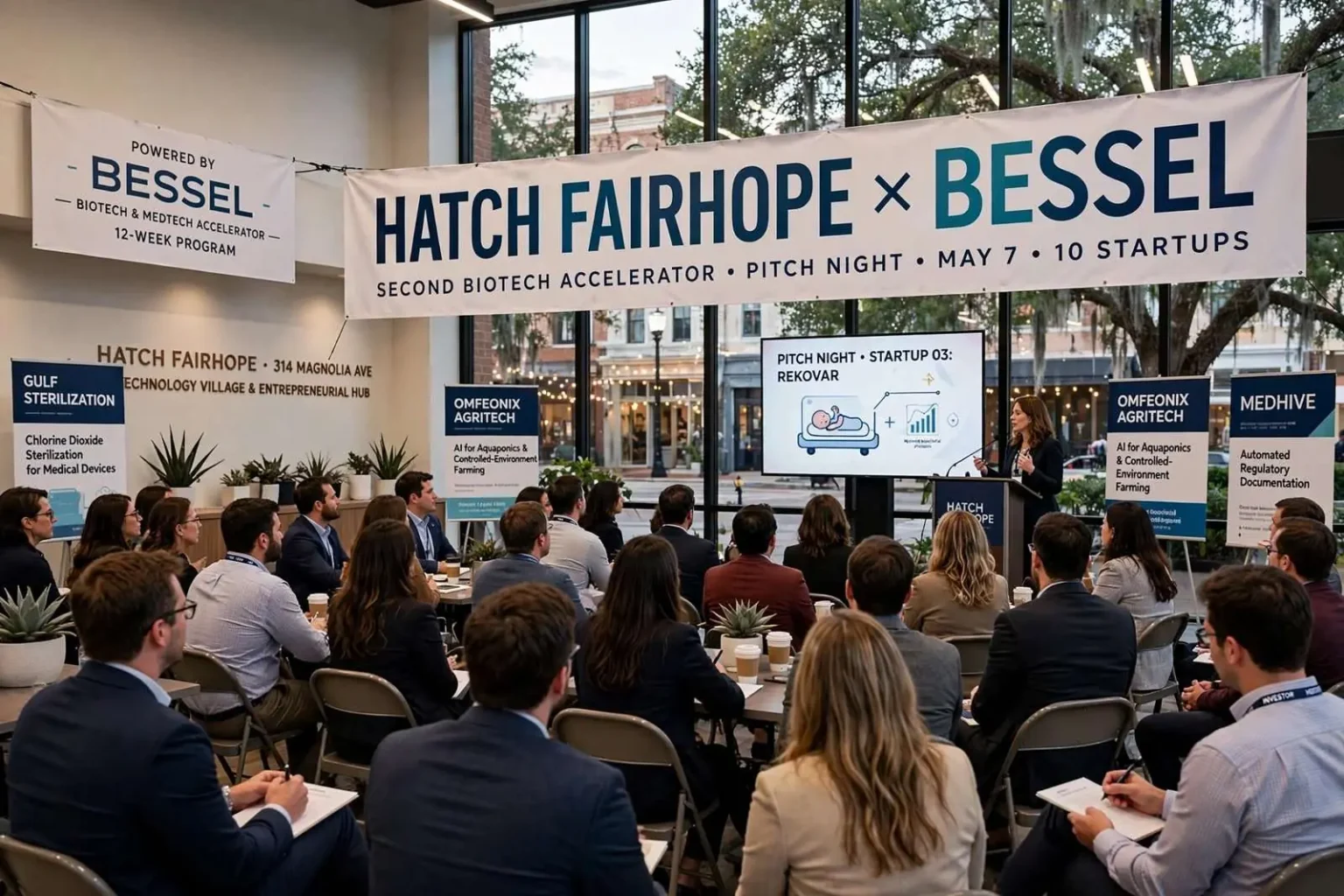
Fairhope’s growing reputation as a Gulf Coast innovation hub got another boost as Hatch Fairhope and Bessel hosted the finale of their second annual biotech and medtech accelerator, bringing 10 startup companies to town for investor pitches, demonstrations and networking. The May 7 event capped a 12-week accelerator cycle run through the Powered by Bessel program, which supports life sciences and deep tech founders in healthcare, agriculture and advanced technology.
The pitch night transformed downtown Fairhope into a showcase for science-driven entrepreneurship that is more commonly associated with university towns and coastal metros. Founders came before an audience of investors, institutional partners and community leaders to make their cases in a format designed to compress months of relationship-building into a single evening.
Across its first two years, the partnership says it has backed 18 companies with more than 430 hours of direct mentorship — 240 hours delivered to this year’s cohort alone. Those numbers describe a program that has moved beyond the launch party phase: mentorship hours of that scale mean recurring, one-on-one work between experienced operators and founders, the kind of engagement that determines whether a young company survives its first years.
Who Pitched
This year’s cohort spanned medical devices, agriculture, mental health and regulatory software, a spread that reflects how broadly the life sciences now reach into other industries on the Gulf Coast.
Gulf Sterilization is developing chlorine dioxide-based contract sterilization as a safer alternative to ethylene oxide for medical device makers. The distinction matters: ethylene oxide sterilization has faced growing regulatory scrutiny over emissions, and alternatives that can sterilize medical instruments effectively without the same environmental profile are drawing attention from manufacturers nationwide.
Rekovar is building an AI-driven neonatal monitoring platform aimed at improving outcomes for Neonatal Abstinence Syndrome, the condition affecting newborns exposed to opioids before birth. The company’s focus ties directly to a crisis that has hit Alabama and the Gulf Coast especially hard, making a monitoring technology with clinical precision a natural fit for regional hospitals.
Also pitching: VivoSphere with 3D tissue engineering for drug discovery; Spectratherm with microcirculation technology intended to improve surgical outcomes for peripheral artery disease; Psigryph’s nano-delivery platform spanning agriculture and pharmaceuticals; Omfeonix Agritech’s AI system for aquaponics and controlled-environment farming; MedHive’s automated regulatory documentation for medical device submissions; New Mindset Consulting’s preventative mental health literacy programs; OSAZ AI’s clinical intake and imaging platform; and early-stage life sciences venture Southern Rooted.
Pitch nights of this kind do more than present companies; they compress the Gulf Coast’s innovation ecosystem into a single room for an evening. Investors see all ten startups back to back, founders see which institutions show up for them, and the community sees, concretely, what a science-based economy could look like in Baldwin County. For a program in only its second year, that visibility is itself a kind of infrastructure.
Read together, the ten companies sketch a portrait of where biotech on the Gulf Coast is heading. Several — Gulf Sterilization, Spectratherm, Rekovar — target healthcare problems with device and platform solutions that hospitals can adopt. Others, like Omfeonix Agritech and Psigryph, carry the same scientific toolkit into agriculture, a natural direction for a region where farming and aquaculture remain economic anchors. The regulatory and clinical software plays, MedHive and OSAZ AI, address the administrative burden that slows medical innovation regardless of where a company is headquartered.
An Ecosystem of Support From Across Alabama
Founders pitched to representatives of the University of South Alabama, Auburn University, USA Health, Innovate Alabama, the Alabama Department of Commerce, Alabama Power, Pilot Capital, Coastal Alabama Community College, the University of Mobile and the City of Fairhope.
That roster is notable for how many different kinds of institutions were in the room. Research universities and health systems offer validation pathways and clinical partnerships. State-level organizations like Innovate Alabama and the Department of Commerce connect startups to grants, incentives and recruitment resources. Utilities, capital providers and community colleges each fill a different gap — infrastructure, funding, workforce. A startup founder able to work that room in one evening has, in effect, been introduced to the state’s entire innovation infrastructure.
Hatch director Keith Glines said the turnout shows world-class biotech can grow on the Gulf Coast rather than only in Boston or San Francisco. His framing gets at the central bet of the program: that the ingredients of a biotech cluster — scientific talent, clinical partners, capital and mentorship — can be assembled in a coastal Alabama town of modest size if the community commits to building them deliberately.
Fairhope Mayor Sherry Sullivan framed the program as part of positioning the city as a place where entrepreneurship thrives. For a city best known for its bayfront charm, arts community and quality of life, the accelerator represents a deliberate economic development strategy: attract founders who can build anywhere by offering them a community that supports them concretely.
The Powered by Bessel Model
The Powered by Bessel program supplies the accelerator’s structure — a defined 12-week cycle that takes founders through mentorship, refinement of their technology and business models, and a public pitch event as the capstone. Cohort-based accelerators of this kind concentrate resources on a small group of companies at a formative moment, when the right guidance and connections can change a company’s trajectory.
The breadth of the partner list also serves a practical function for the startups themselves. A company like MedHive, which automates the documentation that medical device makers must file with regulators, needs customers who understand that pain directly; a company like Spectratherm needs clinicians who can evaluate its microcirculation claims. Putting universities, health systems and agencies in the audience turns the pitch night into a matchmaking event as much as a competition.
Bessel’s focus on life sciences and deep tech distinguishes it from the general small-business accelerators more common in the region. Deep tech founders face longer development timelines, heavier regulatory pathways and harder fundraising questions than typical software startups, which makes structured mentorship and institutional introductions all the more valuable to them.
Hatch Fairhope’s Role in Baldwin County
Hatch Fairhope operates from 314 Magnolia Avenue as Baldwin County’s technology village and entrepreneurial hub. The space functions as a gathering point for the county’s startup community — coworking, programming, and a home base for events like the accelerator’s pitch night that bring outside investors and partners into downtown Fairhope.
Baldwin County is one of the fastest-growing counties in Alabama, with communities from Daphne and Spanish Fort to Gulf Shores and Foley adding residents and businesses at a rapid clip. Hatch’s positioning in Fairhope places the county’s entrepreneurial infrastructure at the center of that growth, giving the eastern shore a node for technology-driven economic development to complement the tourism and construction industries that have long driven the local economy.
The accelerator’s second year built on that foundation. With 18 companies backed across two cohorts and mentorship hours continuing to accumulate, the program has produced the beginnings of a network — founders who have been through the cycle, mentors who have given their time, and institutional partners who have seen the quality of the companies firsthand.
What Comes Next for the Cohort
For the ten founders who pitched on May 7, the evening is less an ending than a starting gun. Accelerator graduates typically leave with warmer investor relationships, clearer regulatory and technical roadmaps, and a cohort of peers facing the same challenges. Companies targeting healthcare will pursue clinical validation and partnerships with systems like USA Health; the agricultural plays will look toward pilot deployments in the region’s farms and greenhouses.
The broader hope, as Glines and Sullivan’s comments suggest, is that some of those companies put down permanent roots in Fairhope or elsewhere on the Gulf Coast, building the kind of high-wage science jobs that anchor innovation economies. Each cohort that completes the program makes that outcome a little more plausible, and each pitch night broadcasts the same message across the region: serious biotech is being built here, and Alabama’s institutions are showing up to see it.
The third year of the partnership will carry its own expectations — a new cohort, more mentorship hours, and a pitch night that has quickly become one of the signature events on Baldwin County’s business calendar. Applications, mentorship cycles and event details run through Hatch Fairhope at 314 Magnolia Avenue.
Programs like Powered by Bessel also change how young scientists and students in the region see their own options. When Coastal Alabama Community College, the University of Mobile, Auburn and South Alabama are all in the room watching local startups pitch real technologies, the message to students is that a science career does not require leaving the Gulf Coast behind. Retaining that talent is, in the long run, the hardest part of building any innovation ecosystem, and it is the part that begins with visibility rather than venture capital.