University of South Alabama Baldwin County
Hillary Clinton Raises $160,000 at an Eastern Shore Luncheon
The Democratic presidential candidate collected roughly $160,000 at a seated luncheon in the Baldwin County home of Pat and Bob Edington, drawing about 45 donors from five states to a deeply Republican county.
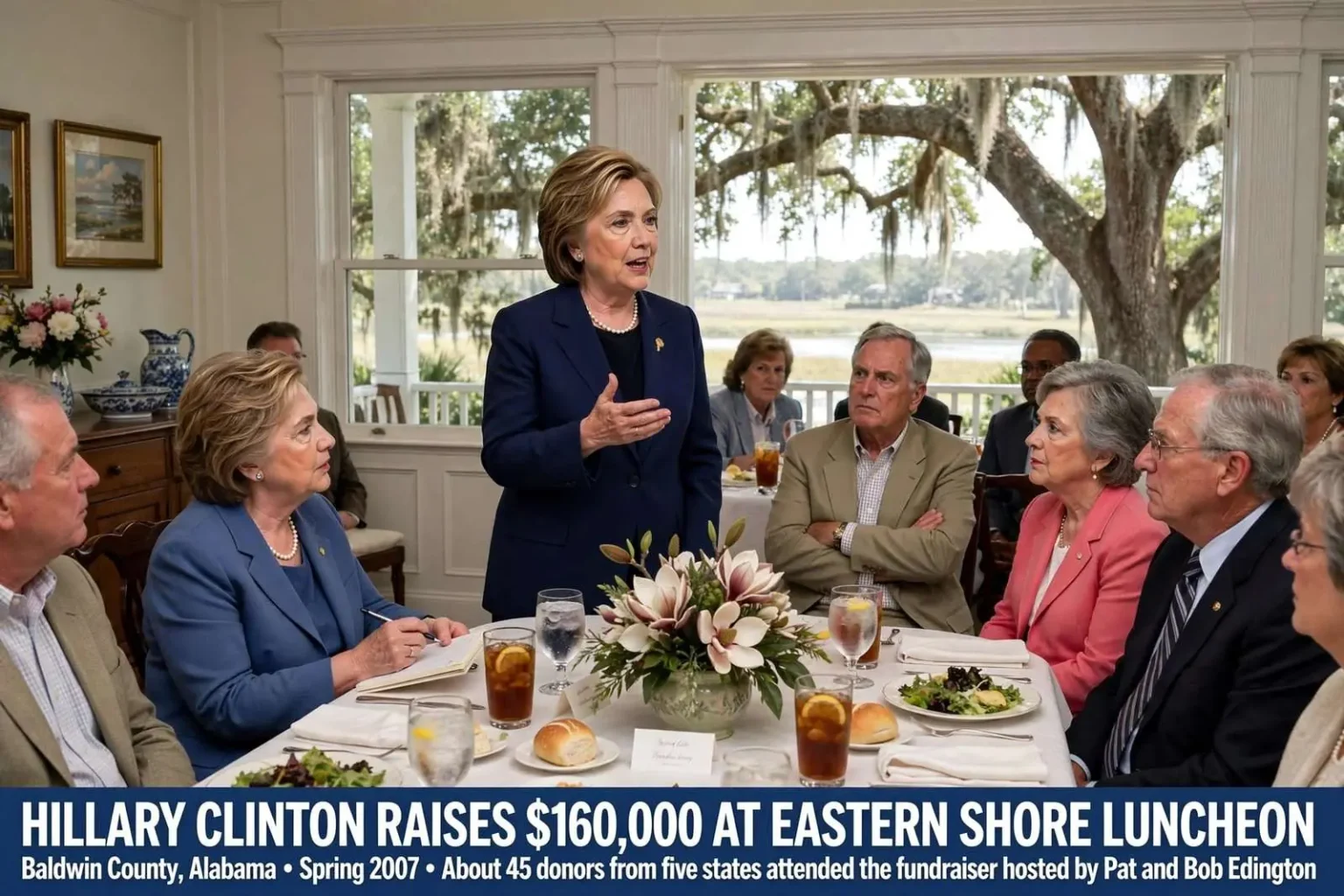
Baldwin County is not obvious terrain for a Democratic presidential candidate. It is among the most reliably Republican counties in Alabama, and Alabama is among the most reliably Republican states in the country. Sen. Hillary Clinton went anyway, and left the Mobile area with roughly $160,000 more than she arrived with.
The money was raised at a seated luncheon at the Eastern Shore home of Pat and Bob Edington, longtime Democratic stalwarts in a place where that identification takes a certain persistence. The event put one of the 2008 campaign’s leading candidates in the living room of one of south Alabama’s most committed Democratic households, in a county where such gatherings are rare enough to be remembered for years.
Pat Edington, who served on the Clinton campaign’s finance team, had been appointed by President Bill Clinton as a White House delegate to UNESCO in Paris in 1995 and 1997. Her history with the Clinton family stretched back to the administration years, and the luncheon leveraged relationships built across decades of Alabama Democratic politics.
About 45 donors representing five states attended, she said, along with 15 or so volunteers and staff. For a single fundraising luncheon in Baldwin County, the guest count and the fundraising total represented a substantial afternoon’s work, and the five-state reach showed how far donors would travel for a small-room event with the candidate herself.
Who Came
The guest list was a fair census of what remained of the Alabama Democratic establishment, and it reached well beyond the Mobile Bay area. State Democratic chairman Joe Turnham attended, as did former chairman and former U.S. Attorney Redding Pitt and former Alabama Supreme Court Justice Janie Shores.
Shores’ presence carried particular weight in Alabama legal circles. The first woman elected to the Alabama Supreme Court, she had served on the court for two decades, and her attendance signaled the luncheon’s reach into the state’s legal and judicial establishment, not merely its party machinery.
A state senator from Mississippi made the drive. From the local bar and civic ranks came a long list of Mobile and Baldwin attorneys, a former Mobile city councilwoman, a former Mobile County revenue commissioner, a University of South Alabama physician and a Fort Conde developer who came down from New York.
The mix illustrated the coalition a candidate assembles at events like this: elected officials, former officeholders, lawyers whose firms give and attend, medical and business leaders, and expatriates with Alabama ties who fly in for the chance at a living-room conversation with a candidate. In a state where Republicans hold most of the offices, the Democratic donor base skews toward exactly these professional ranks.
More Events to Come
Edington said more Alabama events were being scheduled, in Huntsville in July and Birmingham later, and that she was helping organize one in Jackson, Mississippi, that summer.
“She wants to come back here as often as possible,” Edington said.
The schedule reflected a campaign strategy for the South that treated the region as contestable territory even in red states. Democratic primaries allocate delegates proportionally, meaning a candidate who competes seriously in Alabama, Mississippi and the rest of the South can bank delegates even where a general election win is unlikely — and the primary calendar that year put Alabama’s vote early enough to matter.
Huntsville’s inclusion pointed at the Tennessee Valley’s demographic mix of engineers, federal contractors and transplants, a pocket where Democrats had remained competitive, while Birmingham anchored the state’s traditional Democratic strongholds. The Baldwin County luncheon, by contrast, was partly about proving the campaign would show up anywhere — and about the money that small rooms generate.
What She Said
By the account of one attendee, Clinton spoke for about half an hour and covered the platform she was then running on, in the conversational register that small-room events reward.
On Iraq: draw down American forces, but leave a presence to deal with whatever government emerged; protect the Kurds, with the recognition that Turkey posed a threat to them; ensure that Al Qaeda did not prosper in a failed state; bring the region’s major players in through diplomacy; and refocus American effort on fighting terrorism. The position threaded the needle of a Democratic primary electorate that had turned against the war while the candidate herself had voted to authorize it — a vote she would be pressed on for the rest of the campaign.
On domestic policy: health coverage for all; fixing No Child Left Behind; low fixed rates on student loans. The health care proposal, which became a central pillar of her candidacy, addressed a coverage gap that rural states like Alabama felt acutely, and the education and student loan planks spoke to the middle-class anxieties that defined the 2008 cycle.
On the middle class: she noted that chief executive pay had run about 20 times worker wages 40 years earlier and had reached roughly 200 times. The statistic — delivered with an economist’s precision rather than a stump speaker’s outrage — framed the wage stagnation and inequality themes that would dominate Democratic messaging for years to come.
On energy and climate: American energy independence, with new energy sources framed as economic opportunity, citing Brazil’s sugar cane program and job creation in Britain and the Netherlands. Global warming, she said, is real. The framing was deliberate: energy policy pitched not as sacrifice but as a jobs agenda, citing foreign examples of biofuel and clean energy economies as proof the transition could pay.
On America’s standing in the world: she recounted a visiting ambassador’s line that a world leader must be feared, revered or respected, and that the United States was none of the three. It was a pointed critique of the Bush years delivered through a third party’s words, and it drew the kind of knowing reaction from an audience of Democratic loyalists that such lines are built for.
She also told the room a story from third grade, when her teacher announced that the president wanted students to learn more math and science, and the young Hillary Rodham assumed the president had personally telephoned the school. Her point was that America needed that emphasis again. The anecdote — self-deprecating, nostalgic and pointed all at once — was the kind of story a candidate saves for small rooms, where the distance between the stage and the audience allows it to land as a conversation rather than a speech.
The Mood in the Room
Attendees described the event as upbeat. Clinton, they noted, said nothing disparaging about President Bush or about any of her opponents — a restraint that stood out in a campaign season defined by sharp elbows.
The private assessment among the Democrats present was more pointed. They believed the two apparent Republican front-runners, Rudy Giuliani and Mitt Romney, would not command the religious conservative support that had twice elected Bush, and that Sen. John McCain was, as one guest put it, “dead in the water” on Iraq.
The analysis, offered over dessert by some of the most experienced Democratic operatives in the state, would prove badly wrong in its particulars. McCain, written off at luncheons like this one in the spring of 2007, secured the Republican nomination by year’s end — and Alabama’s electoral votes went with him, as the guests no doubt expected even as they bet on his weakness.
The real issue for voters, they argued, would be competence. The argument reflected the campaign’s read of the electorate after years of frustration with government performance on multiple fronts: that voters wanted an administration that worked more than they wanted any particular ideology, a bet the Clinton campaign built its case on.
A Warm Impression
Freda Roberts, the former Mobile County revenue commissioner, found the candidate warm and approachable, noting that she spoke with each guest individually and posed for photographs with all of them.
For the donors, the individual attention was the point of the event. A luncheon with 45 guests allows a candidate to do what no stadium rally permits: learn names, ask about families, and leave each attendee with the sense of a personal encounter. Roberts’ account of the candidate working the room, photograph by photograph, described the retail political skill that small events exist to showcase.
After a little more than two hours, Clinton was gone, headed for the airport and on to Atlanta to do the same thing again. The Georgia event would repeat the formula — a few dozen donors, a half-hour of remarks, photographs all around — as the campaign worked through a fundraising schedule that hopscotched the country one living room at a time.
How It Turned Out
Alabama’s Democratic presidential primary the following February would ultimately go to Barack Obama, and the state’s electoral votes to McCain. The primary result reflected the Obama campaign’s organizational strength among the Black voters who form the backbone of the Alabama Democratic electorate, and it presaged the nominee who would carry the state’s primary contest on the way to its general election that November — though the general election itself was never in doubt in Alabama.
The luncheon’s own numbers, however, stand on their own. About 45 donors, five states, 15 volunteers and staff, and roughly $160,000 raised in a little more than two hours in one of the most Republican counties in one of the most Republican states in America.
That is the arithmetic that keeps presidential candidates calling on unfamiliar territory. A seated luncheon on the Eastern Shore — with the state party chairman, a former supreme court justice and a room’s worth of lawyers, physicians and developers — produced more money in an afternoon than many rallies produce in a month, and it came with the intangibles money can’t buy: organizers energized, relationships renewed, and a county’s Democrats reminded that their party’s leading candidate considered their corner of Alabama worth the trip.
Baldwin County would remain reliably Republican, as it has been for a generation. But in the spring of 2007, a Baldwin County living room was worth $160,000, and the money was the point.