
How Shirley’s Law Works: Alabama ADA Clears Up Elder Abuse Registry Confusion
An Alabama ADA explains Shirley's Law: those convicted of elder abuse are auto-added to a registry; there is no application process.
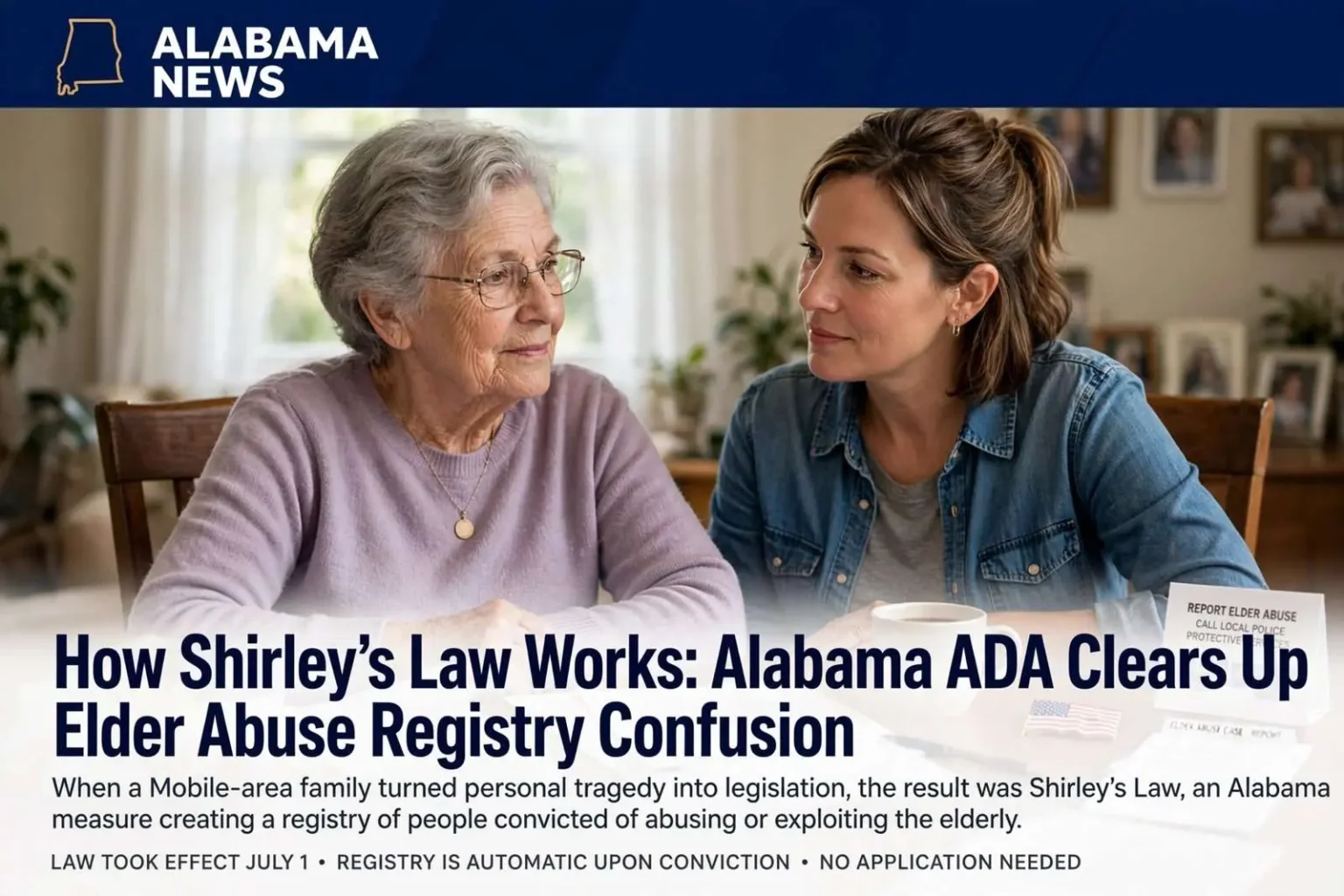
When a Mobile-area family turned personal tragedy into legislation, the result was Shirley’s Law, an Alabama measure creating a registry of people convicted of abusing or exploiting the elderly. The law took effect July 1, and in the weeks since, officials who helped champion it have been working to correct a persistent misunderstanding about how it operates. Contrary to what many residents have assumed, there is nothing to apply for, and there is no process by which a private citizen can bring a case directly under the new statute.
Assistant District Attorney Clay Rossi, who has been fielding questions from the public since the law went into effect, said the confusion is understandable but the mechanics are simple. The registry is not a program people enroll in and not a benefit families request. It is an automatic consequence of a criminal conviction.
“There is no need to apply for Shirley’s Law,” Rossi said. “If someone is convicted of elder abuse or elder exploitation, they are automatically added to the Shirley’s Law Registry.”
The clarification matters because the law bears the name of a specific victim and grew out of a family’s painful experience, circumstances that have led some residents to believe the registry works like a protection order or a complaint process that can be requested. Officials stress that it works only in one direction: through the courts, after a conviction.
How Shirley’s Law Came to Be
The law traces back to Jo Holcombe and her mother, Shirley Smith. Holcombe learned that Smith had been exploited by a caretaker, and the experience exposed what Holcombe saw as a gap in how Alabama handles offenders who prey on older adults. After the exploitation came to light, she pushed for a law that would create a registry of people convicted of abusing or exploiting the elderly — a permanent, searchable record that would follow offenders after their cases ended.
The caretaker, Veronica Wiggerfall, was found guilty of financial exploitation of the elderly after forging checks and signatures in Smith’s name. Wiggerfall is set to be sentenced Nov. 8. For Holcombe, the case illustrated a pattern she believes plays out in families across the state: an older adult trusts a caregiver, the caregiver gains access to accounts and documents, and the abuse continues until someone notices.
The measure that emerged from that experience took Smith’s first name, and its supporters say the name is a deliberate reminder that behind every case file is a parent, a grandparent or a neighbor. The law took effect July 1, making Alabama part of a growing number of states that maintain registries tied specifically to convictions for abuse or exploitation of older adults.
No Application, No Direct Civil Action
Rossi’s central message is that the registry requires no action from victims or their families. There is no form to complete, no office to visit and no filing fee. Entry on the registry follows automatically from a conviction for elder abuse or elder exploitation in criminal court, the same way other consequences of a conviction attach without a separate request.
Just as important, Rossi said, residents cannot file a case directly under the law. Shirley’s Law does not create a private cause of action that a family can invoke against a suspected abuser. It operates entirely on the back end of the criminal justice system, after investigators and prosecutors have done their work and a court has entered a conviction.
That means the burden of starting any case still rests with the ordinary machinery of law enforcement. Anyone who suspects elder abuse must report it to their police department and other legal authorities so the alleged abuser can be investigated. Reports can also be directed through county protective services channels, which coordinate with law enforcement on cases involving vulnerable adults.
Officials emphasize that a report is the beginning of a process, not the end of one. Investigators must establish what happened, gather financial records where exploitation is suspected, and present findings to a prosecutor, who decides whether charges are warranted. The registry itself never decides guilt; it simply records the outcome.
The Registry Is Not Yet Public
Another point of confusion has been access. The registry is not yet available to the public, and officials have not announced a launch date for public searches. Until it opens, residents should not assume they can look up a caregiver, a relative’s new companion or a financial adviser to see whether a prior conviction appears.
Supporters of registry laws argue that their long-term value comes from exactly that kind of visibility, allowing families hiring in-home help to make more informed choices and giving institutions a screening tool beyond standard background checks. How much of that promise is realized will depend on how Alabama implements public access as the system matures. For now, the practical effect of the law is to create a permanent record of qualifying convictions that can be referenced as access arrangements are finalized.
The waiting period also underscores the distinction between the registry and the reporting system. The public cannot query the registry yet, but the public can report suspected abuse today, and officials say those reports are what feed the pipeline that eventually populates it.
Why Reporting Matters So Much
For Holcombe, the law’s success will ultimately be measured by how many families come forward. Elder exploitation thrives on silence, she said, and on the shame that keeps victims and their relatives from involving authorities — particularly when the suspected abuser is someone the family trusted enough to invite into a home.
“I just think it’s to emphasize the only way we can stop it is if it gets reported,” Holcombe said. “If you tell the authorities and do it. Don’t worry about being embarrassed.”
Her point reflects what victim advocates describe as one of the hardest barriers in elder abuse cases: embarrassment. Older adults may fear losing their independence if they admit a caregiver has been stealing from them, and adult children may hesitate to act on suspicions out of loyalty to a parent’s judgment or fear of straining family relationships. Advocates say the willingness to make an uncomfortable phone call is often the difference between a case that is prosecuted and a pattern that continues for years.
Families who notice warning signs — unexplained withdrawals, missing valuables, sudden changes to wills or powers of attorney, new “friends” who isolate an older relative — are encouraged to document what they see and contact their local police department. Even a report that does not lead to charges creates a record that investigators can draw on if concerns resurface.
What Comes Next
Attention in the case that inspired the law now shifts to November, when Wiggerfall is set to be sentenced for the financial exploitation of Shirley Smith. For the Holcombe family, the sentencing will close one chapter of a case that already changed state law.
For prosecutors and advocates, the work ahead is education. Rossi’s office expects to keep clarifying the law’s mechanics as questions arrive, and the core message is likely to remain the same: convictions fill the registry, reports start investigations, and no family needs permission to speak up.
“The only way we can stop it is if it gets reported,” Holcombe said, summing up the message she hopes spreads as Shirley’s Law takes hold. Residents with concerns about the treatment of an older adult are urged to contact their local police department or county authorities rather than waiting for certainty — because, under the state’s new law, the registry can only record what the justice system first hears about.
The registry approach also reflects a shift in how Alabama thinks about financial crimes against older adults. Forgery and theft cases have always been prosecutable, but convictions in those cases traditionally disappeared into general criminal histories that were difficult for ordinary families to interpret. A dedicated registry consolidates the relevant convictions in one place, tied to the specific conduct that matters most when families are vetting caregivers.
For now, the automatic nature of the registry is its defining feature. Advocates for older adults note that victims of elder exploitation are often reluctant or unable to navigate bureaucratic processes — a reality abusers exploit. By removing any application step, the law ensures that a conviction itself, not a victim’s persistence, determines whether an offender appears in the system.
Residents who want to learn more about reporting options can contact their local police department, county protective services or the district attorney’s office in their judicial circuit. Officials say the simplest rule remains the best one: if something seems wrong with how an older relative or neighbor is being treated, say something, and let investigators determine what the evidence supports. The registry will take care of the rest, one conviction at a time.


