Hundreds Join Voices of Hope March and Rally in Crestview
Several hundred people marched in Crestview for the Voices of Hope rally. The police chief joined and the mayor announced a Citizens Advisory Council.
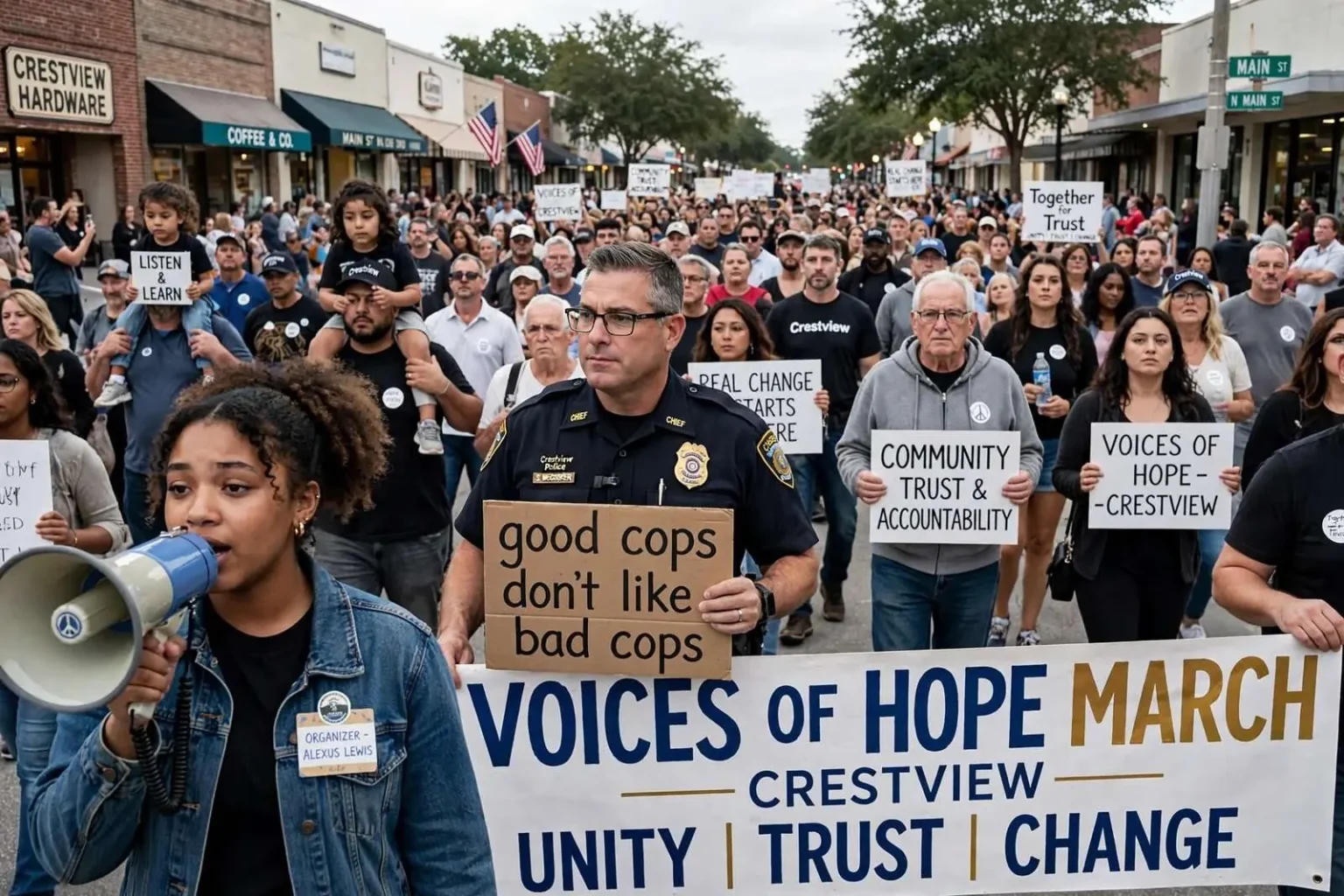
Several hundred people marched through the streets of downtown Crestview to Twin Hill Park Wednesday afternoon as part of the Voices of Hope March. The march brought people out to lift their voices and their signs.
The procession wound its way through the heart of the Okaloosa County seat, drawing participants of all ages from Crestview and the surrounding communities of northwest Florida. Marches of this kind have taken place in cities across the country, but the Crestview gathering carried a distinctly local character: organized by a young resident rather than a national organization, and aimed squarely at the relationship between the city’s police department and the people it serves.
Crestview Police Chief Stephen McCosker joined the march with his own sign that read “good cops don’t like bad cops.” “Bad police officers make our job a lot harder, and it impacts the trust that the community has on us,” McCosker said. The chief’s participation set the tone for an event that was, by design, less a protest against police than a conversation with them — a distinction that shaped both the march itself and the speeches that followed.
Everyone rallied at the park to listen to passionate, emotional speeches and to pray. Twin Hill Park became the gathering point for an afternoon of testimony and reflection, with speakers addressing the crowd on themes of community trust, accountability, and the changes residents hope to see. The blend of speeches and prayer gave the rally the feel of a community convocation as much as a demonstration.
Organized From Within the Community
Alexus Lewis, a young woman in the community, organized the rally and march. “It’s mind blowing how much a community can really come together when they know there needs to be change,” Lewis said.
Lewis’s role as organizer stands out in a summer when many similar events across the country were driven by national groups or seasoned activists. She assembled the march from the ground up — securing the route through downtown Crestview, coordinating the rally at Twin Hill Park, and drawing hundreds of neighbors into the streets for an afternoon. Her observation about what a community can do when it recognizes the need for change captured the spirit organizers hoped would outlast the event itself.
Downtown Crestview provided a fitting backdrop. The city, which bills itself as the hub of northwest Florida, has a compact downtown grid around which marches can move with visibility — storefronts on either side, traffic slowed or rerouted, and residents watching from sidewalks. A march through those blocks puts a message in front of the whole town rather than confining it to a park or plaza.
The turnout itself carried weight. Several hundred participants in a city of Crestview’s size represents a meaningful share of the community, and the crowd’s makeup — families with children alongside longtime residents and young adults — signaled that concerns about community-police relations extend across generational and demographic lines. Marches draw their power from that breadth; when a crowd reflects the whole town, its message is harder to dismiss as a faction’s grievance.
A Chief Joins the March
McCosker’s decision to walk with the marchers rather than merely observe from the sidelines was the event’s most striking image. Police chiefs in communities across the country have wrestled with how to respond to demonstrations about policing; most watch, some speak, and a relative few join. By carrying his own sign — one that made clear he saw bad officers as a problem within his own profession — McCosker aligned himself publicly with the march’s premise that change is needed.
His comments at the rally went further. “Bad police officers make our job a lot harder, and it impacts the trust that the community has on us,” the chief said, acknowledging that misconduct anywhere in a department erodes the legitimacy of every officer in it. That acknowledgment — delivered by the person responsible for the department — gave the event’s call for change an ally inside the institution being called to change.
For the marchers, the chief’s presence cut both ways. It offered reassurance that the department was listening, and it raised the stakes on follow-through: a department that marches alongside its residents has committed itself, publicly and in its chief’s own words, to acting on what it hears.
Recruitment, Reform, and a Challenge Issued
Chief McCosker said they will bring change and hope to bring some of the people at the march onto the police force. “I also wanted to go ahead and make the challenge that if they wanted to be a part of the change, we will sponsor cadets through the police academy, and we’d love to go ahead and recruit people from the group here today,” McCosker said.
The offer is a concrete response to a problem departments everywhere face: recruiting officers who reflect and understand the communities they serve. Sponsoring cadets through the police academy removes the financial barrier that keeps many candidates from applying, since recruits often must pay their own way through training before they can be hired. By extending the offer directly to march participants, McCosker invited the people calling for change to become the people delivering it — from the inside.
Recruitment from within the community carries benefits beyond headcount. Officers who grew up in the town they patrol arrive with local knowledge, existing relationships, and a personal stake in the city’s wellbeing. Departments across the country have pursued similar homegrown strategies, betting that the surest way to build trust is to hire the people the community already trusts. Whether the march produces Crestview’s next class of cadets will be a measure of the event’s lasting impact.
The march also fed directly into the city’s formal governing process. To strengthen relations between police and the community, the mayor announced plans to create a Citizens Advisory Council which will be voted on at the next city council meeting.
A citizens advisory council, if approved, would give residents an ongoing, institutional channel to raise concerns, review issues, and communicate with the police department between crises — formalizing the kind of dialogue the march represented for one afternoon. Cities across the country have adopted similar bodies with varying structures and powers; some focus on review and accountability, others on liaison and communication. The details of Crestview’s version will be settled through the council’s vote, but the mayor’s announcement gave the march’s demands a concrete destination.
That pathway — from a Wednesday afternoon march, through a city council vote, to a standing body with a role in policing oversight — is how community movements translate into durable change. The Voices of Hope March now has that to point toward. The speeches and signs will fade, but the proposed Citizens Advisory Council, the recruitment challenge, and the relationships formed in Twin Hill Park are the parts of the afternoon most likely to endure. Crestview’s next city council meeting, where the advisory council proposal comes up for a vote, will show whether the march’s momentum carries into the machinery of city government — and whether the trust its participants sought becomes something the whole city can see.
The March Through Downtown
The march itself followed the familiar choreography of a community demonstration. Participants gathered in downtown Crestview before setting off on a route that carried them through the city’s main streets toward Twin Hill Park, signs raised and chants punctuating the afternoon. Motorists slowed to watch; some drivers honked in support as the procession passed. For the several hundred marchers, the walk through downtown was the point — a public, physical statement that the issues being raised belonged to the whole community, not to any single group.
Marches also serve a quieter purpose for those who join them. Walking alongside neighbors, many of whom had never participated in an organized demonstration before, builds the sort of horizontal relationships that sustain community initiatives long after the event ends. Organizers of civic movements often note that the contacts made in the street — phone numbers exchanged, committees informally formed — matter as much as the message on the signs.
Twin Hill Park, the march’s destination, offered the space the rally required. The park’s open grounds accommodated the crowd for the speech program and prayer gathering, and its location kept the event rooted in a public space accessible to everyone. Parks have historically hosted exactly this kind of civic gathering, and Crestview’s use of Twin Hill for the Voices of Hope rally continued a tradition as old as American public life itself.
What Comes After the Signs Come Down
The measure of an event like Wednesday’s march is what follows it. Crestview now has three concrete threads to pull on: the mayor’s proposed Citizens Advisory Council awaiting a city council vote, the police chief’s open offer to sponsor march participants through the police academy, and the goodwill generated between the department and the community on an afternoon when both showed up for the same cause.
Residents who want to follow through have clear next steps — attending the next city council meeting where the advisory council is taken up, and contacting the department about the cadet sponsorship program. The Voices of Hope March gave Crestview’s conversation about community and policing both a voice and a vehicle; what the city does with it now is the part of the story still being written.