Hurray for the Riff Raff Celebrates New Album with Alabama Music Box Release Party
Hurray for the Riff Raff brings its My Dearest Darkest Neighbor release party to Mobile's Alabama Music Box Sept. 14 with Promised Land Sound and Banditos.
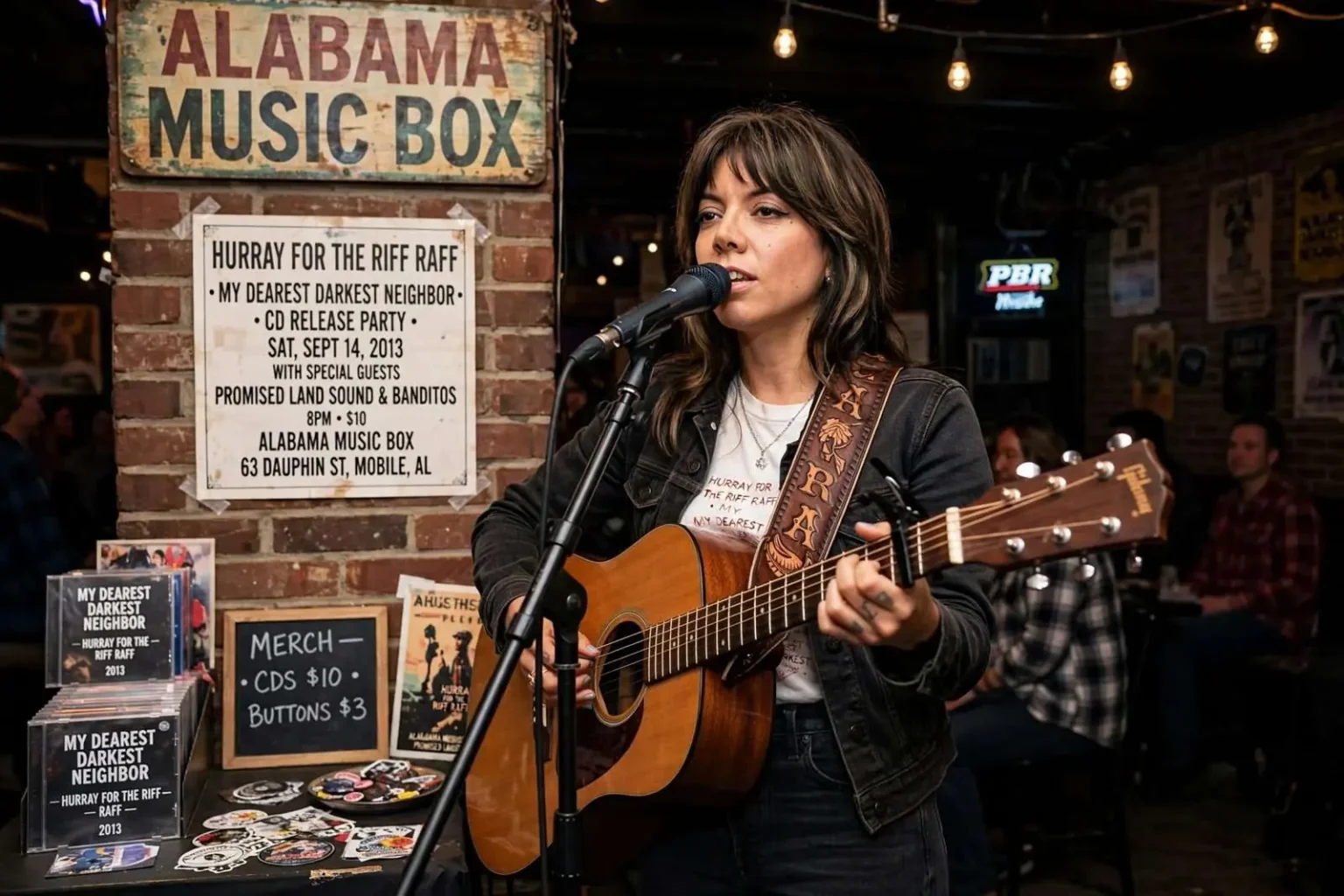
New Orleans indie folk favorites Hurray for the Riff Raff headlined to Mobile on Saturday, Sept. 14, 2013, for a CD release party at the Alabama Music Box celebrating “My Dearest Darkest Neighbor,” joined by two of Nashville’s buzzed-about young bands, Promised Land Sound and Banditos. The triple bill packed the Dauphin Street venue with one of the most closely watched touring lineups to pass through Mobile that fall — a headliner on the way up, and two opening acts the industry was already tracking.
The release show capped a breakout stretch for Hurray for the Riff Raff, the group led by singer-songwriter Alynda Lee Segarra. The band had just signed to ATO Records — the label co-founded by Dave Matthews — and turned heads that summer with a widely praised performance at the Newport Folk Festival, the historic Rhode Island stage whose imprimatur has helped define American folk and roots music for more than half a century.
“My Dearest Darkest Neighbor” found Segarra and company working in the mode that had built their reputation: folk and old-time forms filtered through a distinctly modern, itinerant sensibility — songs of travel, love and survival that sound older than they are and more current than their sources. A release party in a Gulf Coast port city suited a band whose music has always carried the river between New Orleans and everywhere else.
A Band on the Rise
Hurray for the Riff Raff’s path to that night ran through years of touring and self-released records before the major-label attention arrived. Segarra, who grew up in the Bronx and rode freight trains and Greyhounds before settling in New Orleans as a teenager, built the band the way roots acts traditionally have — playing constantly, recording independently, and earning audiences city by city.
By 2013 that patience was paying off. The ATO signing put the band’s music in front of a national audience, and the Newport Folk Festival appearance positioned Segarra alongside the writers and performers the Americana world was championing. Festival sets of that kind tend to reorganize a band’s career; bookings upgrade, press follows, and the next album stops being a local release and becomes an event.
Mobile caught the band at exactly that hinge — past the years of dues-paying, before the wider fame that subsequent records brought, when a CD release party still meant a club show with merch on the table and everyone in the room close enough to the stage to see the details.
Two Nashville Openers on the Way Up
The undercard gave the night its Nashville accent. Promised Land Sound, a young band mining the psychedelic country and cosmic American music tradition, had been drawing attention in Music City circles for shows that stretched from honky-tonk shuffles into long, exploratory jams. Banditos, rough-edged and road-tested, brought a blend of Southern rock, soul and country harmonies that made them one of the most talked-about new acts out of Nashville that year.
Both bands were in the phase of their careers where opening slots are the currency — building followings in new cities, selling records from the merch table, and converting strangers into fans one thirty-minute set at a time. Sharing a bill with a headliner riding festival praise was a placement both acts’ growing labels were glad to arrange.
For Mobile audiences, the lineup amounted to a preview. Within a few years, both Nashville bands would be headlining rooms of their own, which made the Alabama Music Box show the kind of date locals later describe having been at — the night two on-the-way-up acts shared a stage in a small room before the rooms got bigger.
Bands Interviewing Bands
Instead of the usual round of press interviews ahead of the show, the three acts took a playful approach: they interviewed each other. The questionnaires traded between Segarra and her Nashville counterparts ran from hypothetical eating contests to desert-island scenarios, offering fans a loose, unscripted introduction to all three groups before they shared a bill.
The format did what a standard Q&A rarely manages. Musicians asking each other questions skip the rehearsed answers and go straight to the teasing, the mutual admiration, and the odd confidences that only people who live the same life can prompt. Fans reading the exchanges got not just background on the records, but a sense of the tour’s chemistry before the first note was played.
It was also a fit for the bands’ sensibilities. Hurray for the Riff Raff and its Nashville counterparts all operated in the do-it-yourself tradition of roots music — booking tours, running their own social feeds, and treating fans as a community rather than a market. Trading interview questions rather than issuing press releases was that ethos made visible, and it gave the Mobile date a small-town feel that a corporate tour launch could never manufacture.
The Alabama Music Box and Mobile’s Independent Scene
The Alabama Music Box spent the early 2010s as downtown Mobile’s home for national independent touring acts — the room that would book a rising band on a Tuesday and pack it for a Saturday. On Dauphin Street among the district’s bars and venues, it carved out a niche for acts too big for the coffeehouses and not yet at arena scale, and its stage hosted a remarkable share of the artists who broke big in the years after.
Booking is the art in that business: knowing which band on a regional circuit is about to matter, and getting the date before the price climbs. The Riff Raff show fit the pattern precisely — a band with Newport momentum, a brand-new record, and a Saturday night slot that filled the room with exactly the audience Mobile’s independent music scene exists to serve.
For local listeners, the night paired one of the Gulf Coast’s most closely watched touring acts with a hometown venue known for booking national independents — and gave local listeners an early look at two Nashville bands on their way up, all three acts on one bill for the price of a club show.
“My Dearest Darkest Neighbor” in Context
The album being celebrated that night holds a specific place in Hurray for the Riff Raff’s catalog — a record of covers and reinterpretations that reads as a thanks-note to the music that made the band. Its title frames the idea: the songs of predecessors and neighbors, the oldest records and the street corners, treated as family.
Release shows for records like that carry a particular warmth. The material is familiar to the audience — songs many of them grew up hearing — but rearranged through the band’s own arrangements and Segarra’s voice, which can turn a borrowed melody into something that sounds like a memory of the singer’s own. A club full of fans singing along to a band’s new album of old songs is one of the more intimate things a touring act experiences.
The record also arrived at a moment when the band’s story was becoming part of a larger narrative about New Orleans music — the post-Katrina generation of young musicians who came to the city, stayed, and built scenes in its clubs and second lines. Hurray for the Riff Raff’s rise ran parallel to that wave, and Gulf Coast audiences, who understand New Orleans as a neighboring city rather than a distant one, claimed a piece of it.
Newport and the Folk Festival Endorsement
The Newport Folk Festival performance deserves its place in the story because of what Newport has always meant. Since the 1950s, the festival has been the place where American folk music’s next chapter gets read aloud — the stage where careers pivot and genres announce themselves. A “widely praised” set there is not just good press; it is a credential the roots music world takes seriously.
For a band like Hurray for the Riff Raff, Newport was validation of the long approach: years of independent records and van tours leading to a festival slot that signaled the industry had caught up with what the band’s audiences already knew. The praise that followed the 2013 appearance set expectations for the albums that came next — expectations the band would meet and exceed as Segarra’s songwriting reached wider audiences.
Mobile’s show fell in the weeks right after that high point, which gave the Alabama Music Box date its energy. Bands on a post-festival run play with something to prove confirmed; audiences can feel the difference.
The Night Itself
What the combined bill promised was a full evening of American music in its current forms — New Orleans folk from the headliner, Nashville’s young take on country-psych and Southern rock from the openers, all in a room built for proximity. The Alabama Music Box’s size put the audience close to the stage, and close is how these bands were built to be heard.
Club shows on CD release nights carry their own ritual: the record on sale at the table, the band’s gratitude at a full room, the sense that everyone present is in on something the radio hasn’t found yet. For the fans who filled the venue on Sept. 14, 2013, the evening delivered all three acts at the moment their trajectories were steepening — a Saturday night in Mobile that turned out to be a marker on three careers.