Irvington Abduction Suspect Back in Jail After Alleged Bond Violations
Mobile County deputies recaptured James Caballero six days after prosecutors moved to revoke his bond for allegedly texting the victim in his case.
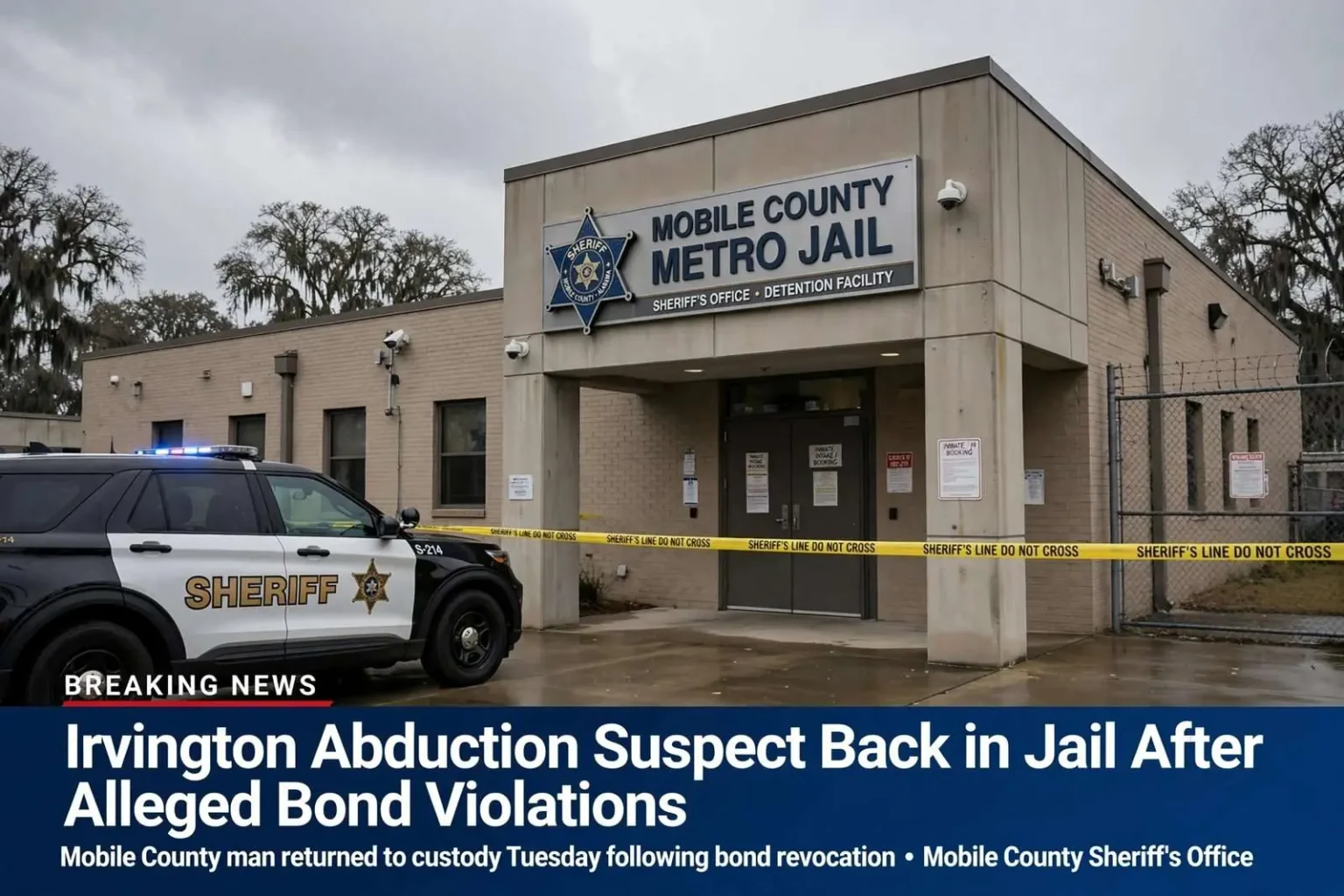
A Mobile County man who was free on bond after being accused of abducting his own children is back behind bars, accused of violating the conditions of his release.
James Caballero was taken into custody Tuesday morning after six days on the run from the Mobile County Sheriff’s Office, closing a chapter that began with his original arrest and reopened almost as soon as a judge released him.
From Arrest to Bond to Revocation
Caballero was first arrested in April in Irvington following the alleged abduction of his children, which ended when deputies took him into custody after a brief standoff. Irvington, an unincorporated community in southern Mobile County along U.S. Highway 90 between Tillmans Corner and Bayou La Batre, is squarely sheriff’s territory — one of the wide swaths of unincorporated Mobile County where the Mobile County Sheriff’s Office answers calls that a city police department would handle elsewhere. Standoffs in these communities draw a heavy response, because deputies there are backed by the agency’s specialized units rather than a municipal SWAT team, and negotiating a peaceful end — as happened here — is the outcome investigators point to whenever they can.
A judge later granted him bond on the condition that he have no contact with the victim in the case. That condition is among the most common a Alabama judge imposes in domestic-related cases, and it comes with a straightforward warning: any contact, however initiated, puts the bond itself at risk.
Court documents show the Mobile County District Attorney’s office moved to revoke that bond last week. According to those documents, Caballero sent text messages to his wife — the victim — initially posing as someone else. Prosecutors allege that once his identity was discovered during an in-person encounter, he became violent.
How Bond Revocation Works
Bond in Alabama is not a release on trust; it is a set of conditions backed by money and, ultimately, by jail. When prosecutors learn that a defendant has violated a no-contact order, the standard next step is a motion to revoke the bond, followed by a hearing where a judge weighs the evidence. If the judge finds a violation, the bond is revoked and the defendant is held without bond until trial — or, in some cases, a new, higher bond is set with tightened conditions.
The alleged conduct described in the revocation motion — messages sent under a false identity, followed by an in-person encounter that turned violent — is the kind of fact pattern that almost guarantees revocation. Judges treat a no-contact condition as a bright line precisely because it protects a victim while the underlying case is pending, and deception about identity signals to the court that the defendant understood the restriction and tried to route around it.
For the District Attorney’s office, which prosecutes all felony cases in Mobile County Circuit Court, bond revocations serve two purposes at once: they remove an immediate risk to the victim, and they preserve the integrity of the pending case by cutting off contact that could become witness tampering or worse.
Six Days on the Run
The six days between the revocation warrant and Tuesday morning’s arrest put the Sheriff’s Office back on familiar ground. Fugitive apprehension is a core function of the agency, which maintains units dedicated to serving warrants and tracking defendants who fail to appear or violate release conditions. In cases like this one, deputies work from known addresses, family contacts, and phone records, and the six-day figure suggests the search moved quickly — days, not weeks or months.
Caballero’s return to custody does not end the underlying case; the abduction charges remain pending, and the alleged bond violations now exist alongside them. If prosecutors proceed on the violations, the effect is practical: a defendant who once had a path to remain free pending trial now sits in the Mobile County Metro Jail, and any future release would require a judge to find that new conditions could actually hold.
Abduction Cases Involving a Parent
Abductions in which the accused is a parent occupy an uncomfortable middle ground in the criminal justice system. To prosecutors, taking a child from a custodial parent — particularly at the end of a standoff with deputies — is a serious criminal matter regardless of the family relationship. To courts weighing bond, the family tie cuts in complicated ways: judges must account for the risk to the children and the other parent, but also for the reality that a parent with no criminal history and local ties is, on paper, a plausible candidate for pretrial release.
That tension is exactly what played out here. A judge granted bond with a no-contact condition, a standard compromise meant to let the case move forward while keeping the parties apart. The allegations that followed — texts from a false identity, then a face-to-face encounter that allegedly turned violent — demonstrate the problem with paper conditions: a piece of paper cannot enforce itself, and the violation was caught only because someone recognized the deception and the District Attorney’s office moved quickly.
Child welfare agencies typically become involved in cases of this kind as well. When children are recovered after an abduction, they are usually placed with a safe relative or in protective custody while the criminal case proceeds, and the family court docket often runs parallel to the criminal one, addressing custody in the wake of the alleged offense. Neither track waits for the other, and outcomes in one frequently shape the other.
The Warning in the File for Victims
For victims and their advocates, the case illustrates a pattern that domestic violence professionals describe often: the most dangerous period in a domestic case is frequently after an arrest, when the accused is out on release conditions but still fixated on the victim. Advocates urge victims to document every attempted contact, preserve messages even from unfamiliar numbers, and report violations immediately — steps that, in this case, appear to have given prosecutors the material they needed for a revocation motion within days.
Technology has changed how no-contact orders are policed. Texting from a borrowed identity, messaging apps, and spoofed numbers all fall squarely within a no-contact condition, and courts have consistently held that a defendant cannot escape the restriction by hiding behind someone else’s name. What matters is the substance of the contact, not the label on the message.
What Comes Next
The case remains active in Mobile County courts. Caballero faces the underlying abduction charges, and the alleged violations could add to his exposure depending on how prosecutors choose to proceed. With bond revoked, the pretrial calculus has shifted: hearings that once assumed a defendant out in the community will now involve a defendant in custody, which typically accelerates a case toward resolution.
For Irvington and the surrounding communities of southern Mobile County, the episode ran its full arc in a matter of months — a standoff in April, a release on conditions, a collapse of those conditions, and a return to jail on a Tuesday morning. The Sheriff’s Office, which handled every stage from the original arrest to the fugitive apprehension, says the case stays with its investigators until the courts are finished with it, and the District Attorney’s office has not indicated whether additional charges related to the alleged violations will be filed.
What the file now shows is the system’s own sequence working as designed: conditions set, conditions broken, conditions enforced. The next chapter belongs to the circuit court, where the abduction case will be resolved on its merits — with the defendant watching from the other side of the bond he once had.
The Sheriff’s Office Role in Unincorporated Mobile County
Cases like this one also highlight the distinct role the Mobile County Sheriff’s Office plays across the county. Alabama has an unusually fragmented map of municipal police departments — Mobile, Prichard, Chickasaw, Saraland, Satsuma, Creola, Bayou La Batre, Dauphin Island, and more — and everything between those city limits falls to the sheriff. That means deputies cover some of the county’s most spread-out geography: the communities along U.S. 90 from Tillmans Corner down toward the bay, the settlements around Grand Bay and Wilmer to the west, and the fishing communities to the south. Response times are measured in miles, not blocks, and the agency’s investigators routinely handle cases that span several of these communities at once.
The April abduction and Tuesday’s arrest bookend a months-long operation that drew on patrol deputies, investigators, and the agency’s warrant and fugitive personnel. sheriff’s officials have not detailed how Tuesday morning’s arrest unfolded or where Caballero was found, and the agency typically withholds those specifics while a case is pending — but the six-day turnaround indicates active, coordinated searching rather than a chance encounter.
Standoffs and How They End
The brief standoff that ended the original abduction is worth understanding on its own terms. When deputies converge on a location and a suspect refuses to surrender, standard practice is to establish a perimeter, open communication, and bring in specialized negotiation resources. The goal is always a peaceful surrender, particularly with children involved. Standoffs in Mobile County end without injury far more often than not, and the ones that end badly tend to be the ones where the suspect is armed and refuses contact altogether. The April episode’s outcome — children recovered, suspect in custody, no reported injuries — reflected that playbook.
For neighbors in communities like Irvington, such an event is jarring in a way that crime in a big city is not. Streets close, deputies with rifles take up positions, and everyone within a few hundred yards becomes part of the scene. In the days that follow, the community usually learns the case’s outline the way residents here did: an arrest, a bond hearing, and a file in circuit court that most people will never see opened again until something happens — as it did this week.
The Bigger Picture on Pretrial Release
Beyond this individual case, the episode lands in the middle of a long-running national and statewide debate over pretrial release. Alabama’s courts have wrestled with how to handle defendants accused of violent offenses, the cost of holding people in county jails while they await trial, and the balance between release conditions and public safety. Cases like Caballero’s become reference points on both sides: critics of release say the alleged violations prove conditions are unenforceable, while defenders of the system point out that the revocation mechanism worked — the violation was caught, the bond was pulled, and the defendant is back in custody.
What no one disputes is that the cost of a failed release condition falls hardest on the victim. Domestic violence advocates in Mobile County have pushed for tighter monitoring in exactly these situations, arguing that a no-contact order without active enforcement is a promise the system cannot keep on its own. The speed with which the District Attorney’s office moved in this case is the kind of response they point to as the model: document the violation, file the motion, get the defendant off the street before the situation escalates beyond repair.
The courts will now decide what the underlying case is worth. Until then, James Caballero sits in the Mobile County Metro Jail, the no-contact order is moot, and the children at the center of the April abduction remain with whoever the family courts have determined can keep them safe — the only outcome in this file that the criminal process cannot guarantee, only protect.