Isle Dauphine Sits Empty, and Dauphin Island Property Owners Are Looking for the Right Tenant
Isle Dauphine sits vacant on Dauphin Island as the Property Owners Association seeks a tenant. About a dozen entrepreneurs have toured the 140-acre property, with proposals due Sept. 15.
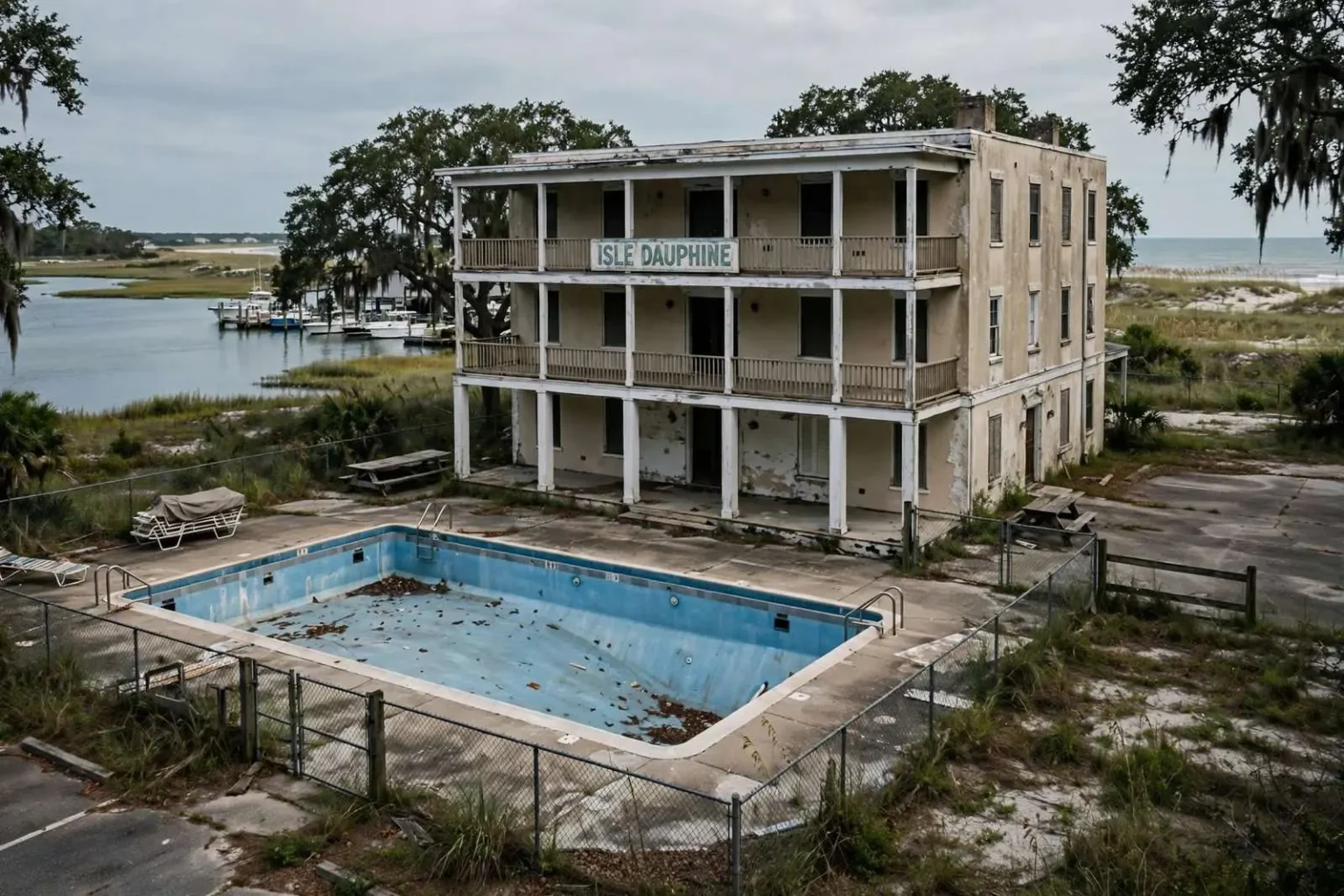
DAUPHIN ISLAND, Ala. — Isle Dauphine has occupied its stretch of sand on Dauphin Island for decades. At the moment, it sits empty.
The old country club has housed a long list of tenants over the years. Most recently Pirates Pizza operated there, before moving to a different location in March.
“There’s nothing running in or out of it right now,” said Will Donaldson, treasurer of the Dauphin Island Property Owners Association.
The vacancy leaves a noticeable hole in the island’s small-town geography. On a barrier island where full-time residents number only around a thousand and amenities are few, a shuttered landmark the size of Isle Dauphine is not just an empty building — it is missing infrastructure: the pool, the gathering space, the restaurant, the views that made it the de facto town square for generations of islanders and summer visitors alike.
A property Donaldson describes in one word
Walking the grounds, Donaldson returned repeatedly to a single word: potential.
“The property is really unmatched,” he said. “It’s three stories. There’s a pool, 140 acres, a beautiful deep-water bay and a couple thousand feet of beachfront. So it’s really a unique opportunity for somebody.”
The property is owned collectively by the members of the Dauphin Island Property Owners Association, but no one currently operates it. Finding a tenant to lease the buildings is the association’s next step.
The ownership structure shapes everything about the search. Isle Dauphine does not belong to the town, to a hotel chain or to an investor with a development timetable; it belongs to the property owners of the island itself, acting through their association. That means any tenant must satisfy not a board of shareholders but a community of neighbors — the same people who would swim in the pool, eat in the restaurant and drive past the grounds every day. It is commercial real estate with a built-in audience and a built-in jury.
The physical endowment is the easy part of the pitch. Deep-water access on the bay side and beachfront on the Gulf side is a combination that developers elsewhere spend fortunes trying to approximate. Two hundred-plus acres of land on a barrier island within reach of Mobile — connected by the Dauphin Island Bridge and the Alabama Port causeway — is the kind of asset that rarely, if ever, comes to market in the northern Gulf. The question is what kind of enterprise can use it sustainably in a town of the island’s size.
Four decades without a renovation
The condition of the buildings is a central part of the equation.
“It hasn’t been renovated in 40 years,” Donaldson said. “What we’ve been doing for the last three or four months is really getting everything cleaned up, and then making it basically ready for the next step.”
Four decades of deferred renovation on a barrier island is not a cosmetic issue. Salt air, hurricane exposure and the simple passage of time are hard on coastal buildings, and any prospective tenant must weigh the cost of bringing a three-story club building up to modern standards against the lease terms the association can offer. The cleanup work of recent months — clearing, cleaning and making the property presentable — is the association’s way of showing the asset honestly: here is what exists, here is the location, and here is the opportunity.
What that next step looks like remains genuinely open. Donaldson said roughly a dozen entrepreneurs have toured the property and pitched ideas, and the range has surprised him.
“They all have an interesting vision. It’s been things I didn’t even expect,” he said.
Proposals close Sept. 15.
The community has to want it
Donaldson was clear that a compelling business plan alone will not carry the day. Someone could arrive with the best idea in the world, he said, but if the community is not interested, the venture has no foundation. For Isle Dauphine to return to anything resembling its former standing, it has to be a place island residents actually want to visit.
That standard filters the field in a specific way. A proposal that treats the property purely as a destination resort for off-island visitors could generate revenue and still fail on the island — resented, underused by locals and politically fragile. A proposal that gives islanders a reason to come back, the way the old club once did with its pool and its dining room, earns the local loyalty that keeps a seasonal business alive through the island’s quiet months.
Dauphin Island’s economy is intensely seasonal, driven by summer beach visitors, fishing tourism and day trippers who cross the bridge from the mainland for the Audubon Bird Sanctuary, Fort Gaines, the Estuarium and the public beaches. Any year-round operator must bridge the boom of Memorial Day through Labor Day and the lean stretch from October to spring — a rhythm that has challenged every restaurant and rental operation the island has hosted. The tenants who last are the ones who give locals a reason to show up all year.
The island’s history is written in the property
Isle Dauphine dates to the era when Dauphin Island’s developers marketed the island as a Gulf Coast destination, complete with a country club that promised residents a swimming pool, dining and social life at the edge of the Gulf. The club became the anchor of the island’s social calendar — weddings, fish fries, Fourth of July gatherings and the informal business of a small town conducted on a veranda facing the water.
Over the decades, as operators changed and the island itself absorbed hurricanes, oil spills and the slow churn of the coastal economy, the property passed from one use to the next, its buildings housing whatever enterprise could make the lease work — most recently the pizzeria that carried the name inland when it relocated in March. Each transition left the building the same and the island slightly different, until the current vacancy forced the association’s hand.
The association’s decision to seek proposals rather than sell reflects the island’s long-running tension: land on Dauphin Island is precious, and selling a 140-acre tract with beachfront and deep-water access would cash out handsomely — and permanently surrender community control of the island’s most significant private gathering place. Leasing keeps the asset in the members’ hands while letting a professional operator take the business risk.
What happens between now and September
The September 15 deadline gives the process a rhythm. Entrepreneurs tour the property, the association collects proposals, and then comes the harder work: evaluating offers not just for their financial terms but for their fit — operating hours, public access, what happens to the pool, whether the grounds stay open to the members who collectively own them.
Small communities across the Gulf Coast have learned that the difference between a beloved landmark and a failed one is usually management, not geography. The same building that thrived under one operator sat empty under the next. The association’s approach — clean the property, show it honestly, listen to a dozen visions, and hold out for one the community will embrace — is a slower path than an auction, but it is aimed at the only outcome that lasts.
For now, the pool is quiet and the dining room dark, and the island’s most prominent piece of real estate is waiting on a plan. The next chapter of Isle Dauphine will be written by whoever can look at three stories, 140 acres, deep water and beachfront — and see not just a business, but a place Dauphin Island wants back.
Why the vacancy resonates on the island
Dauphin Island is a town of roughly a thousand permanent residents, connected to the mainland by a single three-mile bridge across the Mississippi Sound, and its residents are acutely aware of every amenity the island gains or loses. The island has one grocery option, a handful of restaurants, a K-12 school and a volunteer-dependent civic culture. When a pool, a restaurant and an event space all go dark in one building at once, families feel it in their weekly routines — birthday parties, swim practice, a Friday night dinner that does not require crossing the bridge.
The property also carries real financial weight for the association’s members. Lease income from Isle Dauphine supports the association’s operations and, indirectly, the upkeep of island amenities that dues alone cannot fund. An empty clubhouse is not merely an aesthetic problem; it is revenue sitting idle while maintenance costs on a 40-year-old coastal building continue regardless.
There is a broader lesson in the exercise for coastal towns across Alabama and Mississippi. Barrier-island communities that lose their gathering places rarely get them back on the same terms; the land gets repriced, the buildings get replaced with condominiums, and the community’s center of gravity moves somewhere else or disappears. Dauphin Island’s association members, by controlling the property collectively and leasing rather than selling, are attempting to opt out of that trajectory.
What the proposals might hold
Keeping the range of visions broad serves the association’s evaluation. A restaurant-and-pool operator answers one set of needs; a boutique hotel or event venue answers another; a marina-adjacent concept, a wellness retreat, or a hybrid of public and private uses answers others still. The dozen tours so far suggest the market sees what Donaldson sees: irreplaceable acreage within day-trip range of Mobile and within vacation range of the entire central Gulf Coast.
The association’s task is to distinguish visions from viable businesses — and to press each finalist on the two questions islanders will ask first: what will it cost to bring the buildings back, and who gets to enjoy them?