
Milton Florida Santa Rosa County
‘It’s Been a Nightmare’: Milton Family Prays for Return of Missing Woman Cindy Hoover
Cindy Hoover, 60, vanished March 8; her Jeep was found on I-10 near Blackwater River as family, friends and searchers refuse to give up.
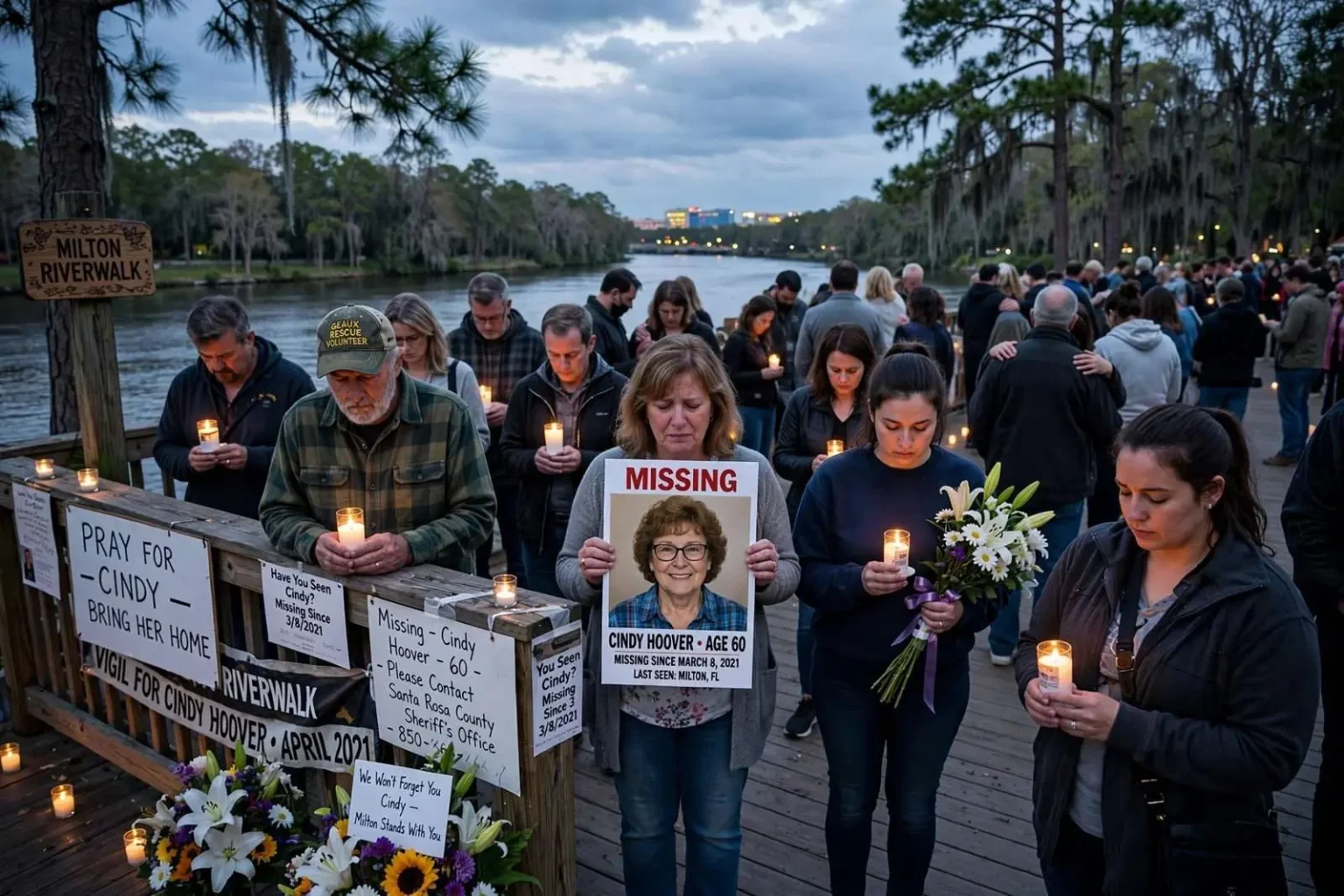
Dozens of friends and family members gathered at the Milton Riverwalk in April 2021 to pray for the safe return of 60-year-old Cindy Hoover, who had not been seen or heard from since March 8. The riverside park along the Blackwater River, normally the setting for festivals and evening strolls through downtown Milton, became a gathering point for a community refusing to let a missing neighbor fade from memory.
“This is like a movie you watch on TV, and it’s been a nightmare,” her sister, Deborah Weekley, told reporters at the vigil. “This is not my sister’s character to up and just leave.”
Weekley said the turnout from the community — neighbors praying together and refusing to give up on the search — had carried the family through weeks of uncertainty. For a family living through the kind of open-ended crisis that rarely makes national headlines, the support of strangers along the riverfront mattered as much as any official update from investigators.
Vigils like the one in Milton serve a purpose beyond mourning or hope. They keep a case visible. When a disappearance stretches from days into weeks, attention naturally drifts elsewhere, and families often find that the public’s memory is the single most valuable resource they have. In Santa Rosa County, where residents across Milton, Pace, and Gulf Breeze tend to follow local news closely, the gathering sent a signal that Hoover would not be forgotten while the investigation continued.
A Jeep on I-10 and a Trail Gone Cold
Weeks before the vigil, Hoover’s gray Jeep was found abandoned on the westbound side of Interstate 10 west of the Blackwater River, its front passenger-side fender missing from an earlier accident. That detail alone made the vehicle distinctive to anyone who had seen it traveling the corridor, and it became one of the few fixed points in an otherwise shapeless case.
The discovery of the Jeep shifted the search from a missing-person canvas into a mystery with no visible edges. What happened between the time Hoover left her mother’s house and when the vehicle turned up along I-10 remained unknown. Investigators had a starting point and an ending point, but nothing in between — no confirmed sighting, no transaction, no communication that could account for the gap.
The stretch of Interstate 10 west of the Blackwater River is a heavily traveled segment of the Panhandle’s main east-west artery, linking Milton and the surrounding communities of Santa Rosa County with Pensacola to the southwest and the rest of the Florida Panhandle to the east. Vehicles abandoned along the corridor are typically documented quickly by the Florida Highway Patrol, and the Jeep’s location gave searchers a defined area to work outward from rather than an entire county to blanket.
But a defined area is not the same as an answer. Volunteers and deputies walked the wooded ground near the highway, checked with businesses along the exchanges, and asked drivers who regularly made the run whether anything had caught their eye in the days after March 8. The terrain between the interstate and the Blackwater River basin is a mix of pine forest, creek bottoms, and rural property — country where a person could be difficult to find and where foot searches move slowly.
Volunteers Cover Hundreds of Miles
Geaux Rescue founder George Ruiz, whose volunteer group had spent weeks assisting the family, said searchers had covered several hundred miles on foot and were widening the search area. The Louisiana-based organization specializes in searches for missing people, and its volunteers work alongside families in cases where official resources may be limited or stretched across competing priorities.
Searches of this kind are grinding work. Ground teams move in grid patterns through ditches, fence lines, and tree lines, often in heat and humidity, covering ground a vehicle can only pass by. Several hundred miles on foot represents thousands of individual decisions about where to look next, made by volunteers who know that the terrain will not give up its answers easily.
Ruiz acknowledged that the case baffled both volunteers and detectives. “There’s no digital footprint, no cell phone data, no bank transactions. There’s nothing,” he said.
That absence of digital evidence is what set the Hoover case apart from most modern disappearances. Investigators in the 2020s routinely build a timeline from phone pings, toll transponders, credit card swipes, and social media activity, and those traces usually resolve questions about a person’s movements within days. In this case, every one of those avenues came up empty. Either the devices and accounts simply went unused after March 8, or whatever happened to Hoover left no transaction to record. Both possibilities kept the case open to a wide range of theories, and neither pointed anywhere in particular.
For the family, the lack of data cut both ways. There was nothing to suggest foul play — and nothing to suggest Hoover had simply gone somewhere by choice. Deborah Weekley’s insistence that her sister’s disappearance was out of character reflected a lifetime of knowing how Hoover lived: close to family, predictable in her routines, and connected to the people around her.
What Investigators Consider in Cases Like This
Missing-person investigations in Florida typically begin at the local level and escalate as circumstances warrant. The Santa Rosa County Sheriff’s Office, which handles most of the county outside the Milton city limits, would have taken the initial report and coordinated with the Florida Department of Law Enforcement as the weeks passed. FDLE maintains the state’s missing-person database and can issue public alerts when a case meets specific criteria, though adult cases are treated differently from missing-child cases under state law.
Adults have the legal right to be unaccounted for, which means an adult case does not automatically trigger the emergency machinery that applies to children. Investigators must instead build a picture of whether the disappearance is voluntary or not, using behavioral history, medical needs, financial activity, and the accounts of people who knew the person well. When all of those indicators point in no clear direction, as they did here, the case remains open and active, awaiting the one tip or fragment of evidence that breaks it.
The April vigil came at the one-month mark after the Jeep was discovered, and by then the search had expanded across Santa Rosa County. Family members used the gathering to ask anyone with information to come forward, renewing the appeal that had accompanied the case since early on. In cases with no digital trail, investigators say, the break usually comes from a person rather than a machine — a driver who remembers something, a neighbor who saw a vehicle, a detail that only means something when connected to a name in the news.
The Milton Community Responds
Milton, the county seat of Santa Rosa County, is a city of roughly 8,000 people along the Blackwater River, and its residents have a long habit of organizing when one of their own is in trouble. The Riverwalk itself is the city’s gathering place — the same stretch of boardwalk that hosts the Riverwalk Food Truck Festival and holiday events was, in April 2021, lined with people holding candles and photographs of Cindy Hoover.
The turnout said something about the scale of the concern. Missing-person vigils in small cities draw the extended circles of the missing person’s life: church members, former coworkers, neighbors from decades past. When dozens of people stand in one place, word of the case reaches networks that flyers and social media posts do not always penetrate, and those networks are where tips are born.
Community response also lightens the load on the family in practical ways. Organizing searches, printing materials, coordinating with volunteer groups like Geaux Rescue, and fielding the constant stream of questions from reporters are tasks that quickly exceed what a grieving family can manage alone. The Milton effort absorbed much of that burden, which allowed family members to focus on staying in contact with investigators and keeping the public appeal current.
The Wider Problem of Missing Adults on the Gulf Coast
Hoover’s case belongs to a broader and sobering category. Tens of thousands of adults are reported missing across the United States in any given year, and a significant number of those cases are never resolved. The Panhandle’s landscape — interstate corridors, large tracts of forest and rural land, and waterways running to the Gulf — presents particular challenges for searchers, who must consider terrain that can conceal evidence indefinitely.
The corridor between Pensacola and Tallahassee has seen its share of long-unsolved disappearances, and each one leaves behind families in the same position as the Hoovers: waiting, searching, and asking the public to remember. Organizations like Geaux Rescue exist precisely because these cases do not pause when news coverage moves on. Volunteer searchers return to the same ground repeatedly over months, working from the assumption that visibility itself can produce the tip that detectives need.
For residents of Milton, Pace, Jay, and the surrounding communities, the case was also a reminder of how quickly an ordinary day can become an open-ended ordeal. Hoover was 60 years old, had been at her mother’s house, and left in a familiar vehicle. Nothing about the outline of the case suggested anything unusual until the hours and days passed without contact — the way most missing-person cases begin, with silence rather than spectacle.
How the Public Can Help
Law enforcement agencies investigating missing adults consistently emphasize the same steps for the public. Anyone with information, however small it may seem, should report it rather than assume it is insignificant. A vehicle description, a time of day, a detail about weather or traffic on I-10 — fragments that mean nothing on their own can complete a timeline when matched against other reports.
Families in Hoover’s position also benefit when the case stays in circulation. Sharing verified information from official sources, attending organized searches rather than conducting solo ones, and keeping the person’s name and photograph in public view all contribute to a case remaining active in the community’s mind. Volunteers involved in the Milton effort noted that searchers should coordinate with the family and law enforcement rather than entering private property or potentially disturbing evidence on their own.
As the vigil ended at the Riverwalk that April evening, the family’s message was the one they had carried since March 8: someone knows something. The Jeep on the westbound side of Interstate 10 told investigators where the story ended, but not what happened in between. Until those questions were answered, the people of Milton planned to keep Cindy Hoover’s name in the open — praying, searching, and refusing to let the case go quiet. Anyone with information about Hoover’s whereabouts or her movements after March 8, 2021, was urged to contact the Santa Rosa County Sheriff’s Office or the investigating agency assigned to the case.