Ivey Seeks Major Disaster Declaration for 23 Counties After Isaias, Including Baldwin, Escambia
Gov. Kay Ivey has asked for a federal major disaster declaration for 23 Alabama counties hit by Hurricane Isaias, a step that could open FEMA aid for local governments and households in Baldwin, Escambia, Monroe, Clarke and Washington counties.
MONTGOMERY, Ala. — Gov. Kay Ivey on Friday, Oct. 23, asked President Donald Trump for a federal major disaster declaration for 23 Alabama counties damaged by Hurricane Isaias. The list includes Baldwin, Escambia, Monroe, Clarke and Washington counties in southwest Alabama. If approved, the declaration would let the Federal Emergency Management Agency help pay for storm recovery and could open direct aid to households for the first time since the storm.
Update: How the damage assessment process works this time
State emergency management officials and response teams have been deployed across affected areas, including Baldwin, Mobile, Clarke, Escambia, Monroe, Washington, Conecuh, Coffee and Houston counties. As recovery moves forward, many south Alabama residents seeking FEMA help are finding that the disaster recovery system has changed in key ways in the six years since Hurricane Sally.
Local emergency management officials say federal assistance is no longer treated as arriving on a guaranteed timeline. Instead, it depends on meeting strict preliminary criteria:
- Local assessments come first. State and county emergency management crews go door to door, photographing damage and documenting specific structural losses.
- Joint Damage Assessment. Those findings are compiled into a formal Joint Damage Assessment to determine whether the storm meets monetary thresholds, such as individual county minimums of $10 million and a collective state total of more than $50 million.
- Governor submits, FEMA decides. Only after the local and state assessments are completed and formally submitted by the governor does FEMA conduct its final review and decide whether to approve a major disaster declaration and open federal programs for residents.
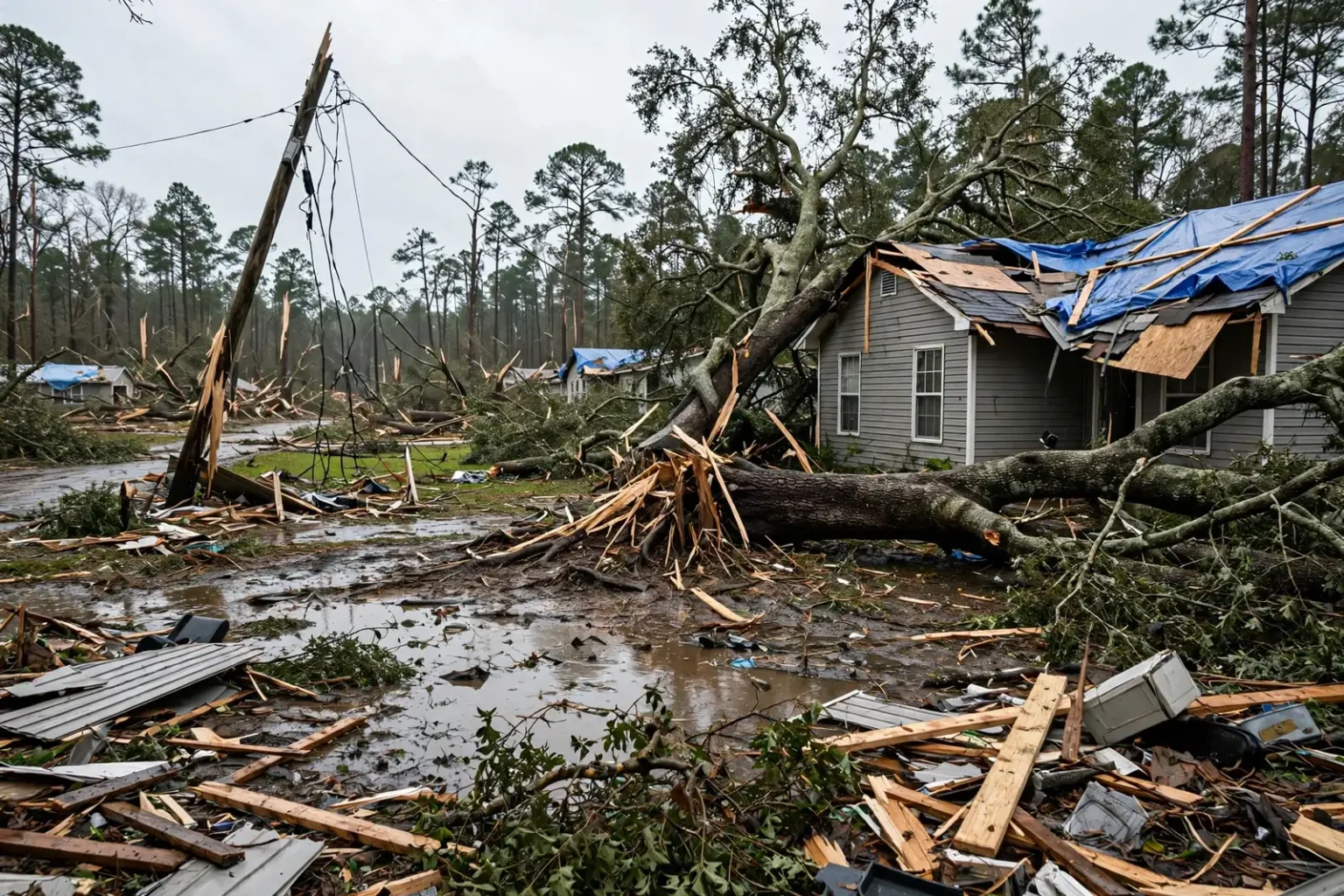
Preliminary joint damage estimates across the affected southern counties currently exceed $50 million in total, with individual counties reporting local damage figures as high as $27 million. The storm caused power outages for hundreds of thousands of homes and businesses, widespread roof damage and structural damage from falling trees in coastal and inland communities.
The original report follows.
The request seeks Public Assistance, which reimburses eligible hurricane-related costs for local governments and certain nonprofits. It also seeks Individual Assistance, which could give support to households affected by the storm.
Counties in the request
The 23 counties currently in the request are:
- Baldwin
- Barbour
- Butler
- Choctaw
- Clarke
- Coffee
- Conecuh
- Covington
- Crenshaw
- Dale
- Dallas
- Escambia
- Geneva
- Henry
- Houston
- Lowndes
- Marengo
- Monroe
- Perry
- Pike
- Sumter
- Washington
- Wilcox
State officials said damage assessments are still underway and more counties may be added if warranted. Mobile County, which was included in the earlier federal emergency declaration, is not on the current list.
What the governor said
“Assessments indicated this hurricane certainly caused significant damage across communities in parts of Alabama. We saw individual homes and public infrastructure impacted. Having support from FEMA is critical to states like Alabama, and I am hopeful this request will be fulfilled so we can get Alabamians quickly back on their feet.”
How this differs from the earlier declaration
This is the second federal step in Alabama’s Isaias response, and it is broader than the first.
On Oct. 9, the day Isaias made landfall near Destin, Florida, as a Category 2 hurricane, the president approved an emergency declaration for Mobile, Baldwin and Escambia counties and the Poarch Band of Creek Indians. That declaration was meant for the immediate response. It authorized FEMA to provide emergency protective measures as direct federal assistance, with the federal government paying 75% of the cost. It did not open aid applications for individual households.
A major disaster declaration is for recovery. It can cover debris removal, repairs to roads and public buildings, and other permanent work. If Individual Assistance is approved, it can also give homeowners and renters in designated counties access to federal grants and other help.
The new request also covers far more of the state. Hard-hit Monroe and Conecuh counties, where state teams went house to house documenting damage after the storm, were not part of the first declaration but are on this list.
How a major disaster request works
Federal disaster aid is governed by the Robert T. Stafford Disaster Relief and Emergency Assistance Act. Under FEMA regulations, a governor’s request goes to the president through FEMA’s regional administrator. For Alabama, that is FEMA Region 4 in Atlanta. The request generally must be made within 30 days of the incident unless FEMA grants an extension. Ivey’s request came two weeks after landfall.
The request must show that the disaster is beyond what state and local governments can handle on their own. It must also include:
- Confirmation that the governor acted under state law and put the state emergency plan into effect. Ivey declared a state of emergency for 40 counties on Oct. 7 and later extended it through Oct. 28.
- An estimate of damages and losses, built from local and state damage assessments.
- Information on the state and local resources already committed to the response.
- Preliminary estimates of the federal help needed.
- The governor’s certification that the state will meet the Stafford Act’s cost-sharing requirements.
FEMA reviews the request and makes a recommendation, and the president decides. There is no fixed deadline for a decision. The president can approve some programs or counties and not others, and counties can be added later by amendment as assessments continue.
Where the damage numbers come from
The process starts locally. County emergency management agencies collect damage reports from residents and local governments. Alabama Emergency Management Agency teams verify the damage, and when the totals look large enough, FEMA joins in preliminary damage assessments. Brewton Mayor Frank Nalty said FEMA representatives were in Escambia County and Brewton on Oct. 19 assessing conditions.
Officials have urged residents to report damage to their county EMA even if they have already filed an insurance claim. The more complete the local record, the stronger the state’s case.
What Public Assistance covers
If approved, FEMA’s Public Assistance program reimburses eligible applicants, including state agencies, counties, cities, tribes and certain private nonprofits, for a share of disaster costs. FEMA groups the work into categories:
- Category A: Debris removal
- Category B: Emergency protective measures
- Category C: Roads and bridges
- Category D: Water control facilities
- Category E: Public buildings and equipment
- Category F: Public utilities
- Category G: Parks, recreational facilities and other facilities
The federal share is at least 75% of eligible costs. Debris has been one of the largest jobs across the region. The Alabama Department of Transportation has crews clearing state highways, and on Oct. 20 the Baldwin County Commission voted to accept roughly 500,000 cubic yards of Isaias debris from neighboring Escambia County, Florida, at Baldwin County landfills.
What Individual Assistance could mean for households
Individual Assistance is the part of a declaration that helps people directly. If it is approved for a county, residents there can apply. Programs can include:
- Housing assistance, such as money for temporary rental housing or for repairs to make a primary home safe and livable.
- Other Needs Assistance, which can help with disaster-related expenses such as personal property, transportation, and medical or funeral costs.
- Low-interest disaster loans from the U.S. Small Business Administration for homeowners, renters and businesses.
- Disaster Unemployment Assistance for people who lost work because of the storm and do not qualify for regular unemployment benefits.
- Crisis counseling and disaster legal services.
FEMA aid is meant to cover basic, essential needs. It does not replace insurance or duplicate benefits from other sources. Applicants are generally asked to file insurance claims first.
What residents can do now
- Don’t wait to document damage. Take photos and video, keep receipts for repairs, tarps, tree removal and hotel stays, and note the dates of damage.
- Report damage to your county EMA through its website, social media page or app.
- Watch for official announcements. Federal applications open only if the president approves Individual Assistance for your county. If that happens, applications are usually accepted at DisasterAssistance.gov, by phone at 1-800-621-3362 or through the FEMA app.
- Beware of scams. FEMA and SBA staff do not charge fees to inspect damage or help with applications, and they carry official photo identification. Anyone who asks for money in exchange for a federal grant does not work for FEMA.
Isaias recovery so far
Isaias came ashore Oct. 9 and knocked out power to more than 95,000 Alabama customers, with some of the worst damage inland in Escambia, Monroe and Conecuh counties. Brewton was among the hardest-hit cities, and families in East Brewton were displaced from damaged apartments. The Alabama Forestry Commission estimated timber damage at more than $33.5 million.
Other relief is already available. The IRS has given taxpayers in all 40 counties under the governor’s emergency declaration until Feb. 4, 2027, to file many federal returns and make payments. United Way has opened a Hurricane Isaias Community Crisis Fund, and residents with unmet needs can call 211 for help finding food, shelter and cleanup resources.
Coastal Alabama has been through this before
Major disaster declarations have followed other storms on the Alabama coast. After Hurricane Sally made landfall near Gulf Shores in September 2020, a major disaster declaration brought federal help to Baldwin, Mobile and other Alabama counties for debris removal, repairs and aid to individuals. That experience shaped how many local governments documented costs this time. Foley officials, for example, have credited lessons from Sally for a smoother Isaias response.
What comes next
FEMA will review the governor’s request and send a recommendation to the White House. If the president approves it, FEMA will announce which counties are designated and which programs are available in each. Damage assessments are continuing, and the state could ask to add counties or programs later. South Alabama News will report any decision and how residents in approved counties can apply.