Baldwin County’s J. Larry Newton School Earns PLC ‘Promising Practices’ Status, Raising Questions Under Alabama’s SB 129
The school's recognition comes from All Things PLC, owned by Solution Tree — a publisher whose broader catalog includes diversity and equity professional development, prompting questions about Alabama's 2024 law.
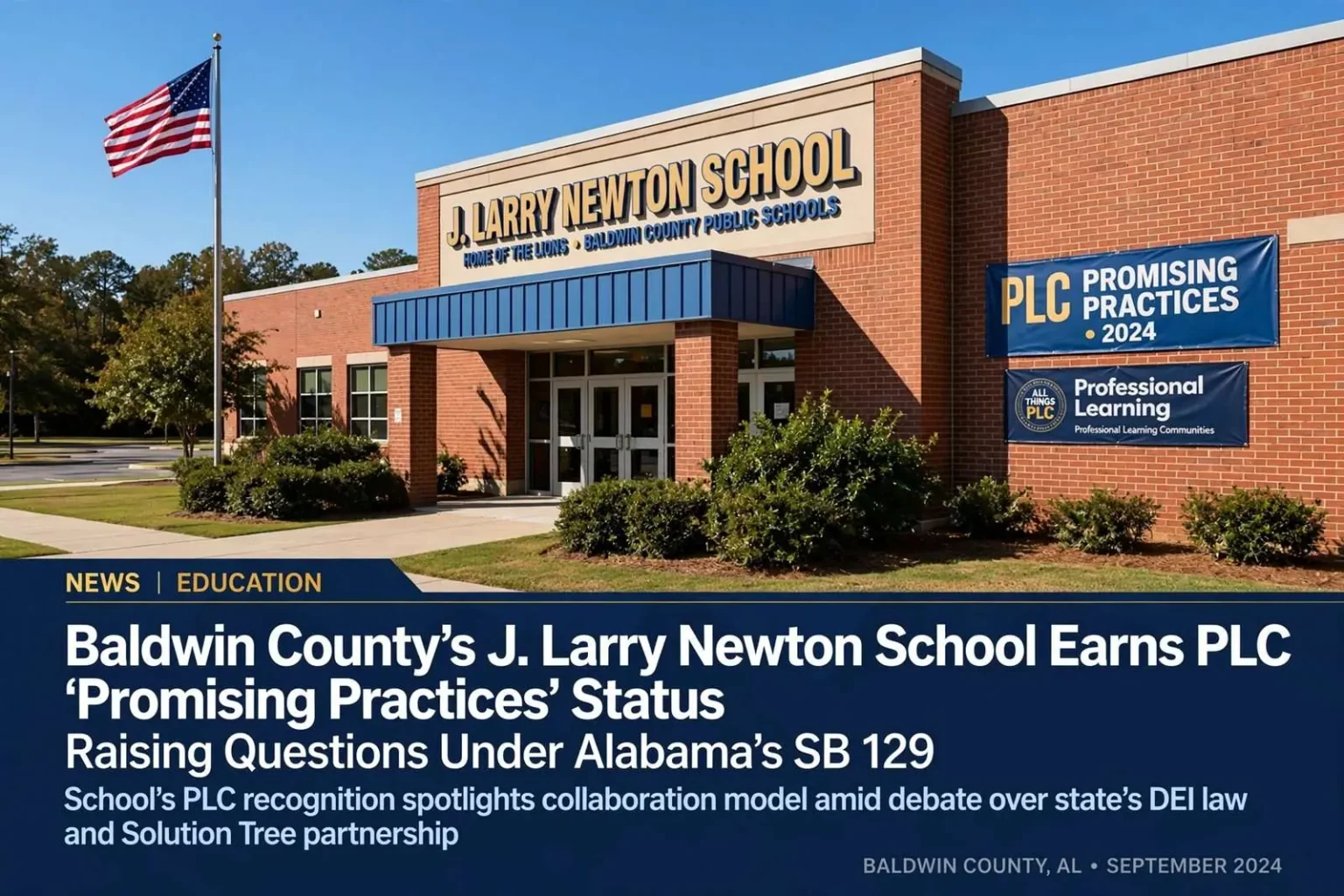
J. Larry Newton School in Baldwin County recently announced that it had received Professional Learning Communities (PLC) Promising Practices Status — a recognition granted by the group All Things PLC. The announcement has drawn attention because of the organization behind the designation and Alabama’s 2024 law restricting diversity, equity and inclusion programming in public education.
What the School Received
According to the All Things PLC website, “Promising Practices schools have strong evidence of the solid foundation required to become a Model PLC at Work and share at least one year of data that shows student achievement growth.”
The school celebrated the designation on social media. “We are exceedingly happy for and proud of our teachers and faculty members who came together to achieve this goal,” the school wrote. “It’s all about teamwork — and the true winners are our students.”
What a Professional Learning Community Is
The PLC at Work framework is a school-improvement model built around collaborative teacher teams. Its core structure asks educators, working in teams by grade level or subject, to answer four recurring questions: what students should learn, how the school will know whether they learned it, what happens when they do not, and what happens when they already have.
In practice, that means common assessments, regularly scheduled team meetings and a data cycle that tracks results by standard and by student. It is a widely adopted model in American public education, and its stated focus is academic achievement rather than any particular curricular content.
The Certification Tiers
All Things PLC is owned, operated and maintained by Solution Tree, which grants the tier classifications.
According to Solution Tree, to qualify as a Model PLC, a school must demonstrate a commitment to PLC at Work concepts, implement those concepts for at least three years, present clear evidence of improved student learning, and provide data every year showing it continues to meet the criteria of the PLC at Work process.
Promising Practices status, the tier awarded to J. Larry Newton School, is the preceding step — evidence of the foundation required to reach Model status, supported by at least one year of achievement growth data.
Baldwin County’s Other Recognized Schools
According to the Baldwin County Public Schools website, seven of its schools hold PLC designations.
The schools recognized as PLC Model Schools in the system are Elberta Middle School, Central Baldwin Middle School and Spanish Fort Middle School.
With the addition of J. Larry Newton School, the schools holding Promising Practices status are Robertsdale High School, Fairhope Middle School and Foley High School.
The Publisher Behind the Program
Solution Tree publishes catalogs of K–12 professional development books, workshops, webinars and free resources, including a category specifically for diversity and equity.
Its diversity and equity offerings include on-site professional learning resources such as an equity audit of a school. Workshops in that category include material described as “strategies and resources for navigating anti-racism,” encouraging educators to “initiate conversations rather than reacting to questions,” and to “examine the beliefs, expectations, and habits that create equitable, justice-driven school environment.”
One workshop is titled “The Antiracist School Leader: What to Know, Say, and Do.” Its description says educators are taught to “reinforce systems that lead to equitable student outcomes” and to “practice strategies for addressing stakeholders’ fears, deflections, or rejections of antiracist work.”
Other titles in the company’s catalog include “Raising Equity Through SEL: A Framework for Implementing Trauma-Informed, Culturally Responsive Teaching and Restorative Practices”; “Building Blocks for Social-Emotional Learning”; and “Finding Your Blind Spots: Eight Guiding Principles for Overcoming Implicit Bias in Teaching.”
Another, “The Identity-Conscious Educator: Building Habits and Skills for a More Inclusive School,” describes a “framework for building awareness and understanding of five identity categories: race, social class, gender, sexual orientation, and disability.” Its sixth chapter covers gender identity, moving beyond a gender binary, gender-diverse needs, and talking with students about gender diversity.
Solution Tree also partners with the organization Paradigm for its own internal staff training. “Solution Tree started their DEI journey with a two-day Cultural Competency Training with a DEI expert,” the company’s site reads. “When this training received overwhelmingly positive feedback from staff, Solution Tree realized they needed a more scalable solution that gave employees options to learn at their own pace.”
Alabama’s SB 129
Alabama was among the first states in the nation to pass legislation addressing certain concepts in schools and universities, enacting Senate Bill 129 in March 2024.
The law restricts public universities from teaching what it defines as divisive concepts related to race and sexual identity, and prohibits state agencies, public K-12 schools and public colleges from funding or sponsoring DEI programs and offices.
The Question Being Raised
Baldwin County Public Schools does not list any DEI programs or offices on its website.
The question raised by critics is whether participation in a certification framework administered by a company that also markets diversity and equity training amounts to indirect sponsorship under the law — particularly where the certification requires professional development of educators.
Those who see no conflict would point to a straightforward distinction: the PLC at Work framework itself is an academic-achievement model, its certification criteria as published are about instructional collaboration and student data, and a publisher’s broader catalog is not the same thing as the specific program a district adopts. Districts routinely purchase materials from vendors whose full catalogs extend well beyond what any one district buys.
Those who see a potential conflict would counter that the law reaches funding and sponsorship, not only formal offices and stated programs, and that the relationship between a district and a certifying organization is not merely a purchase.
Neither the Baldwin County school system nor state education officials had addressed the question publicly at the time of the school’s announcement, and no determination has been made by any state authority that the designation implicates SB 129.
What Would Resolve It
The practical answer would come from documentation of what professional development the district actually purchased and what materials teachers actually received — the specific trainings, titles and content delivered under the PLC certification process, as distinct from what is available elsewhere in the vendor’s catalog.
Absent that record, the debate rests on inference about a publisher’s broader offerings rather than on the content of the program a Baldwin County school adopted.