Jack Edwards Airport breaks ground on control tower, eyes passenger service for Gulf Shores
Gulf Shores Airport Authority breaks ground on a new air traffic control tower at Jack Edwards National Airport, signaling plans for passenger service.
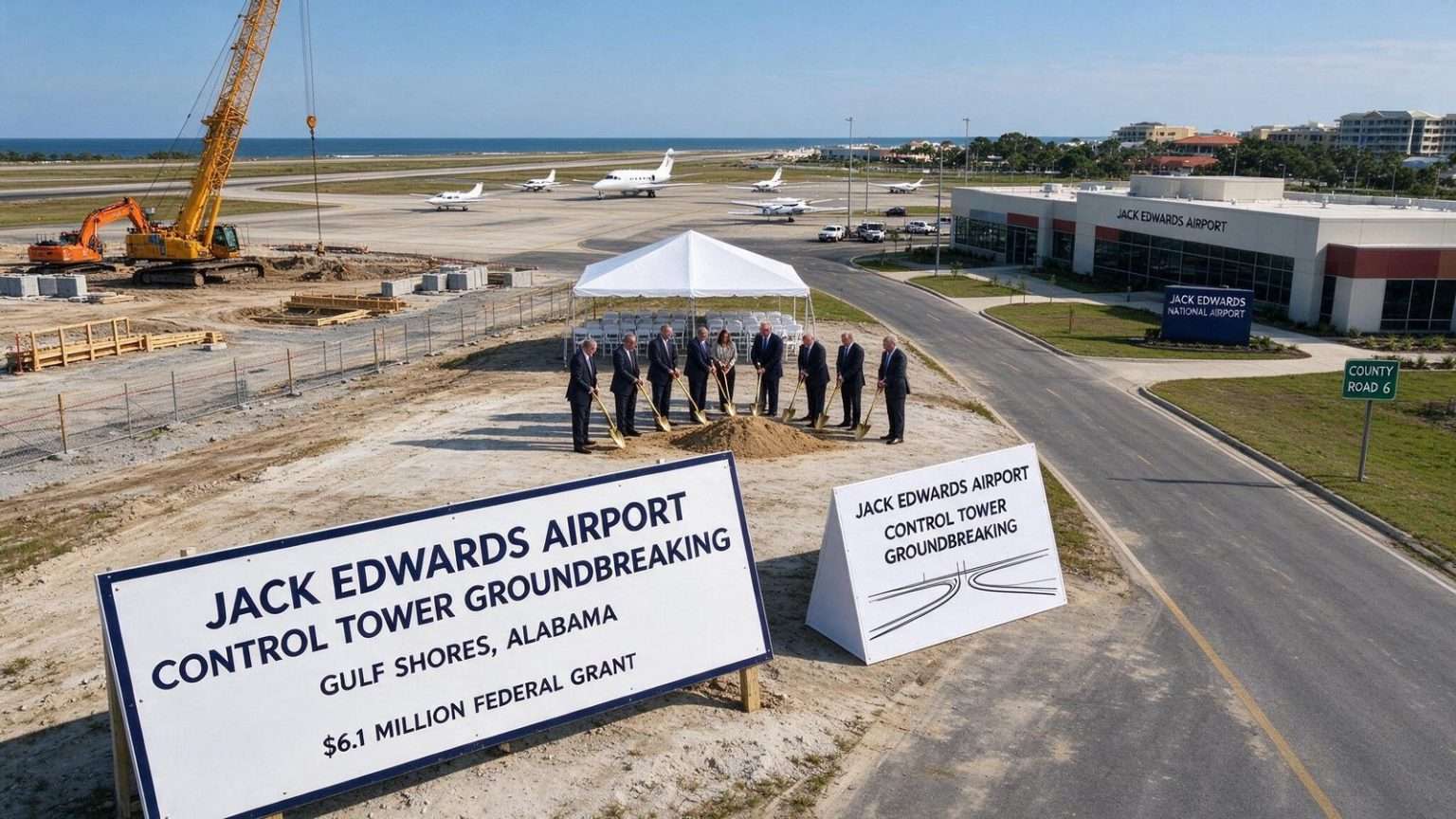
The Gulf Shores Airport Authority has broken ground on what officials are calling the first new air traffic control tower built in the United States in more than a decade, a project funded by a $6.1 million federal grant announced earlier this year. The ceremony marks the start of construction on a facility that local officials have pursued for years, and it positions the fast-growing Baldwin County beach city to join the ranks of airports with on-site control of their own airspace.
During a ceremony Friday, the authority also confirmed plans for a passenger terminal at Jack Edwards National Airport and said it has been in talks with Elite Airways, a Portland, Maine-based carrier, about launching select regional passenger service to Gulf Shores at an undetermined future date. Taken together, the tower and the terminal would transform an airport known today as a busy general aviation field into a small commercial gateway for one of Alabama’s premier tourist destinations.
Jack Edwards is the second-busiest airport in Alabama behind Birmingham-Shuttlesworth International. The ranking surprises travelers who know the field only as a quiet strip off County Road 6, but the airport logs heavy traffic from corporate jets, charter flights, flight training and private aircraft bound for the Gulf Shores resort economy. Its position along the Alabama coast also puts it in the path of significant transient traffic, particularly during summer weekends, spring break and major beach-season events when pilots converge on the area from across the Southeast.
Airport Manager Scott Fuller said the facility has “been trying to deal with the air traffic issue here for 15 years.” For more than a decade, the Federal Aviation Administration enforced a moratorium on applications for new contract towers — a pause Fuller said was lifted in 2018 with help from local congressional efforts. During the moratorium years, airports that wanted control towers had few options, and Jack Edwards operated under visual flight rules with pilots coordinating their own arrivals and departures on a common frequency.
Fuller credited U.S. Sen. Richard Shelby with securing a new five-year FAA funding bill that included a provision for new towers, “forcing the FAA back into the tower business” after four years of continuing resolutions. Federal aviation funding had limped along on short-term extensions for years, leaving airports unable to plan long-term projects, and the multi-year bill restored the certainty needed for programs like the contract tower program to accept new applicants. Working with the FAA, the authority developed a streamlined application process and partnered with the city of Gulf Shores to assemble an 11-acre site on the south side of the airport for the tower.
Contract towers are a longstanding FAA arrangement in which the agency funds construction and operation while a private contractor staffs the facility with certified controllers. The model gives mid-size airports professional air traffic control without the cost of a full FAA-staffed facility, and it has been the standard path for growing general aviation airports across the country. Once operational, a tower provides separation between arriving and departing traffic, sequencing for training flights and a single point of coordination for emergency responders.
Safety, Then Service
Gulf Shores Mayor Pro Tem Phillip Harris said the tower will improve safety and communication at an airport where “pilots have to individually manage their way in and out today.” He noted it will also help manage flyovers, touch-and-go training flights and traffic effects on surrounding communities, while opening the door to economic development and commercial air service. Tower controllers can route practice patterns away from neighborhoods, spread noise across a wider area and give residents a point of contact for concerns about low overflights.
Because the FAA is covering 100 percent of tower construction, the authority was able to redirect its $600,000 local match toward designing and building the new passenger terminal. That financial pivot means the airport advances two major projects for the price of one local commitment, and it explains why officials could confirm terminal plans on the same day they broke ground on the tower. The terminal would give Gulf Shores the infrastructure to receive scheduled airline service rather than charter flights alone.
It has also received a letter of intent from Elite Airways to eventually offer passenger service. Elite Airways CEO John Pearsall said the carrier operates charter and scheduled routes primarily along the East Coast and specializes in point-to-point service to unique destinations. “We are always looking for special projects and unique destinations and we think this is a very special destination,” Pearsall said, adding that his team is working with Fuller on possible destinations. A carrier of that profile fits Gulf Shores’ situation: a market that draws visitors from a handful of distant cities rather than a broad hub-and-spoke catchment.
What Commercial Service Would Mean for Gulf Shores
Gulf Shores and neighboring Orange Beach draw millions of visitors a year, most of whom arrive by car along Highway 59 or via Pensacola and Mobile airports more than an hour away. Direct air service would shorten that trip dramatically for travelers from the carrier’s East Coast markets, and tourism officials have long listed commercial air access among their top infrastructure priorities. Visitors who fly directly into Gulf Shores would land roughly fifteen minutes from the beach, a selling point that could reshape the city’s visitor mix toward shorter, higher-frequency vacations.
The economics of small-city air service favor the point-to-point model Elite Airways described. Traditional carriers concentrate their aircraft at hubs and serve secondary cities through connections, but a specialty carrier can place a plane in Gulf Shores for peak-season routes without committing to a full network. Airports that have attracted such carriers typically pair them with community commitments or minimum-revenue guarantees, and Gulf Shores’ hotel and restaurant industry has a direct stake in making those numbers work.
For Baldwin County’s broader economy, the airport’s expansion complements the growth already visible across the county, one of the fastest-growing in Alabama. Corporate travel, real estate investment and construction activity along the coast generate much of the general aviation traffic that made Jack Edwards the state’s second-busiest field, and a control tower plus terminal gives that traffic professional infrastructure to grow into. Business leaders who recruit companies to the county now have a concrete answer to the aviation questions prospects ask.
From Groundbreaking to First Flight
A Fifteen-Year Pursuit
The road to Friday’s ceremony stretched back well before the current grant announcement. Airport officials had identified the need for a tower as traffic climbed through the 2000s, but the FAA’s moratorium on new contract tower applications left the airport with no path forward no matter how busy its runways became. In the interim, the airport invested in the improvements it could control — runway and taxiway work, fencing, lighting and terminal-area upgrades — while continuing to make the case to Alabama’s congressional delegation that a tower was warranted.
The breakthrough came through the combination Fuller described: a five-year FAA funding bill with a provision allowing new towers into the program, and an application process that the authority and the FAA worked through together rather than in opposition. The city of Gulf Shores’ role in assembling the 11-acre site on the airport’s south side gave the project a footprint to build on, and the $6.1 million federal grant announced earlier this year converted the application into a funded construction project. For a city whose airport ranks second in the state in traffic, the tower closes a gap between how busy Jack Edwards is and how it operates.
Construction timelines for control towers run in years rather than months, with design, environmental review, construction and controller staffing each taking time before the facility goes operational. Elite Airways officials described the passenger service timeline as undetermined, tied to the terminal’s completion and the carrier’s scheduling plans. Officials have framed the sequence deliberately: safety infrastructure first, commercial service as the following act.
For now, the groundbreaking ceremony itself is the milestone local officials have awaited for a decade and a half. A project that began with a frustrated airport manager, a frozen federal program and a growing beach city has moved through a congressional funding bill, a streamlined FAA application and an assembled 11-acre site to a $6.1 million construction start. Local leaders expect the visible work on the south side of the field to continue drawing attention as the tower rises, keeping both the airport’s expansion and the promise of passenger service in front of the community it will serve.
When the tower opens and, later, the first scheduled flight lands, Gulf Shores will hold something no other Alabama beach city has — its own commercial airport, controlled airspace and a direct line to markets far beyond the drive-time radius that has always defined its tourism.