Jennifer Claire Moore Foundation Launches Survey to Shape Youth Mental Wellness Education
The Jennifer Claire Moore Foundation has launched a countywide survey to guide future youth mental wellness education programs across Baldwin County, seeking input from parents, educators and caregivers.
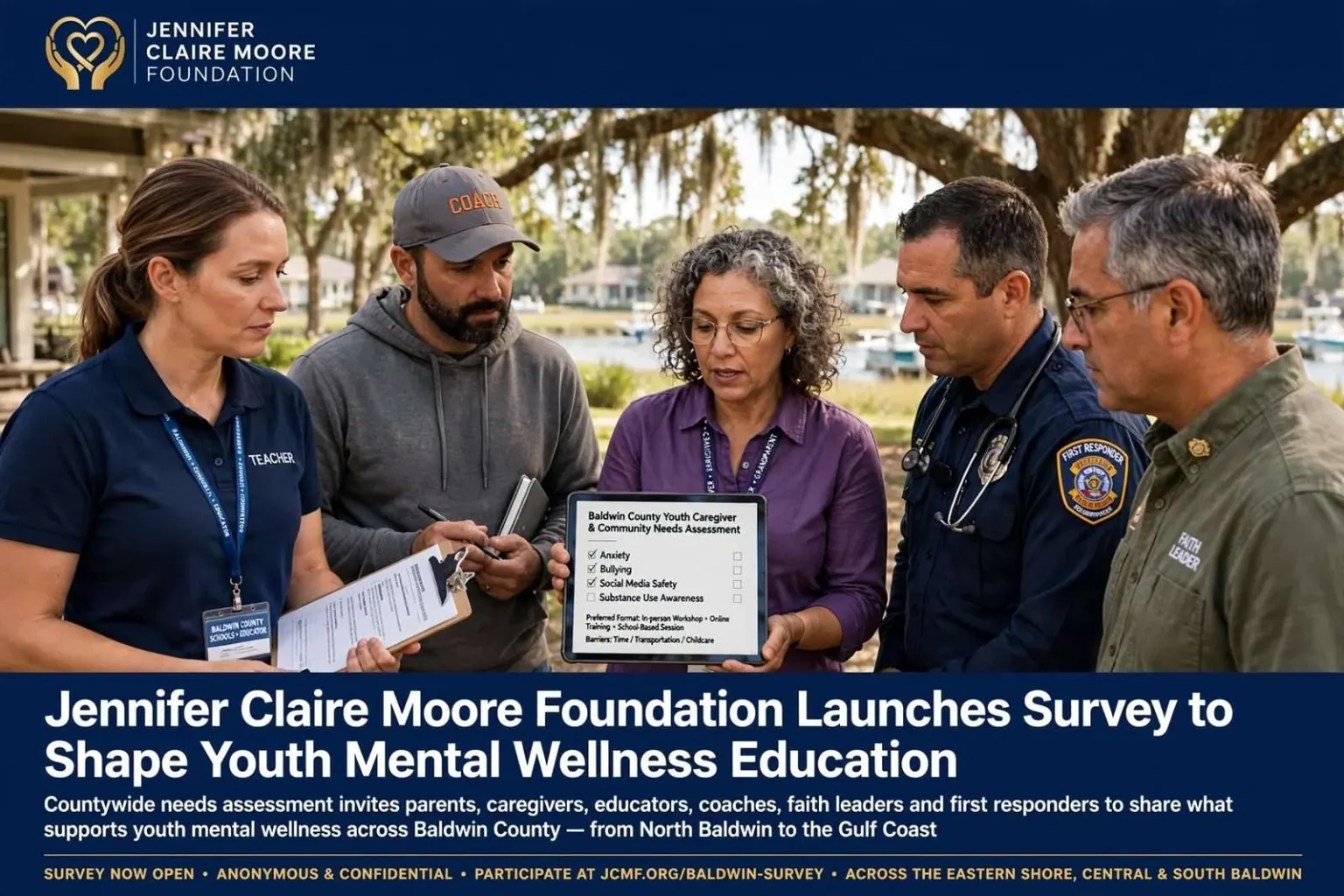
The Jennifer Claire Moore Foundation has launched the Baldwin County Youth Caregiver & Community Needs Assessment, a countywide survey aimed at better understanding the mental wellness education needs and priorities of local families and community members. Foundation leaders said information gathered through the assessment will help shape future educational programs, workshops and community events throughout Baldwin County.
The organization said it is seeking community input before developing new initiatives to ensure programs address current local needs. Rather than building programming around assumptions, the foundation wants residents to describe directly what they are seeing with young people in their homes, classrooms, teams and neighborhoods, and what kind of support would actually help them respond.
What the Survey Asks
The survey asks participants to identify topics of greatest interest, including anxiety, bullying, social media safety and substance use awareness, while also gathering feedback on preferred learning formats and potential barriers to participation in educational programs. Respondents can indicate whether in-person workshops, school-based sessions, online trainings or community events would work best for their families, and what obstacles stand in the way of attending them.
The foundation is encouraging all adults who support or interact with youth to take part, including parents, grandparents, caregivers, educators, faith-based leaders, coaches, first responders and health care providers. The wide net is deliberate: the adults around a young person each see a different slice of that child’s life, and the foundation wants the full picture rather than a single vantage point.
Anonymity and Reach
All survey responses will remain anonymous and confidential to encourage candid participation, according to the foundation, which said the assessment will play a key role in building a healthier, more informed community by identifying residents’ educational needs and priorities.
Organizers said the assessment is designed to capture a broad range of perspectives from across Baldwin County, including North Baldwin, Central Baldwin, South Baldwin, the Gulf Coast and the Eastern Shore. Community members interested in taking part can access the survey through the foundation’s website.
Why Baldwin County, Why Now
Baldwin County is Alabama’s largest county by land area and one of its fastest-growing, with new subdivisions, schools and businesses spreading from the Eastern Shore communities of Daphne, Fairhope and Spanish Fort through Central Baldwin toward Foley and the beach cities of Gulf Shores and Orange Beach. That growth has been paired with rapid change in the county’s school system, one of the largest in the state, and with the everyday pressures that come for families relocating, commuting and working in the tourism economy.
Against that backdrop, the needs of young people are not uniform from one end of the county to the other, and the foundation’s push for geographic spread in the responses reflects that reality. A family in Bay Minette, a caregiver in Foley and a coach in Gulf Shores may face very different circumstances, and programs designed for one community may not translate cleanly to another.
The Foundation’s Mission
The Jennifer Claire Moore Foundation has long focused on youth mental wellness and bullying prevention across Baldwin County, working with schools and community partners to bring education and awareness programming to students and the adults who support them. Its work is grounded in the belief that informed, connected adults are the first line of defense for young people navigating anxiety, social pressure and online harms.
By surveying before building, the foundation is trying to make sure its next round of programs starts from what residents say they need rather than what outside providers assume they need, a posture organizers described as essential to earning community trust and participation.
The Topics Residents Will Be Asked About
Anxiety tops the list of subjects the assessment asks about, and it is a concern that surfaces consistently in conversations about adolescents and young adults across the Gulf Coast. School expectations, family finances, social comparison and an always-on digital environment all contribute to worry that many young people carry quietly, and adults often do not recognize the signs until problems have compounded.
Bullying remains a central focus for the foundation, which has spent years supporting anti-bullying education in Baldwin County schools. The survey’s inclusion of the topic signals that organizers want to know where parents and educators still see gaps, whether on playgrounds, on buses, in hallways or in the group chats and comment threads that follow students home.
Social media safety is a newer frontier for many caregivers, and one where the adults in a child’s life frequently feel a step behind. Questions about what platforms children use, what risks families worry about most and what kind of guidance would help are folded into the assessment so future trainings can meet participants at their actual level of comfort with the technology.
Substance use awareness rounds out the named topics, an area where education for families has to move in step with what is circulating in a given community and era. The survey gives residents a structured way to say what they want to learn more about, rather than leaving organizations to guess which prevention messages would land.
Learning Formats and Barriers
Beyond subject matter, the assessment digs into how people want to learn. Preferred formats matter because a working parent in Robertsdale, a grandparent in Bay Minette and a youth pastor in Foley may have entirely different windows of availability and comfort levels with virtual versus in-person settings.
The questions about barriers to participation are equally practical. Transportation, work schedules, evening timing, childcare and simple awareness of when and where programs happen are the mundane realities that determine whether a well-intentioned workshop fills a room or falls flat. By asking directly, the foundation can schedule, locate and format its offerings to fit Baldwin County life instead of the other way around.
Who the Foundation Wants to Hear From
The invitation list is intentionally broad. Parents and guardians are the obvious audience, but the foundation’s message is that everyone who touches a young person’s life has something to contribute and something at stake.
Educators see academic and social pressure up close. Coaches observe how students handle competition, disappointment and team dynamics. Faith-based leaders are often the first trusted adults families turn to in a crisis. First responders encounter young people on some of their worst days and carry a perspective few others hold. Health care providers see the clinical side of mental wellness and know where community education could prevent problems from reaching an emergency room.
Grandparents and other informal caregivers, an often-overlooked group, are explicitly included as well, reflecting the reality that many Baldwin County children are raised or heavily supported by extended family. Each of these audiences will bring different priorities to the survey, and organizers said that variety is exactly what makes the findings useful.
What Happens With the Results
The stated purpose of the assessment is forward-looking. Information gathered will help shape future educational programs, workshops and community events throughout Baldwin County, giving the foundation a resident-driven roadmap for where to invest its programming energy next.
That sequencing, survey first and initiatives second, is meant to guard against programs that miss their audience. The foundation said ensuring new offerings address current local needs is the whole point of asking, and the assessment results will be the measure against which future decisions about topics, formats and locations are made.
A Region With Rapid Change
Baldwin County’s population growth has reshaped nearly every community in it over the past two decades. The county’s school buildings have expanded and multiplied, municipalities from Loxley to Elberta have annexed and developed at a steady clip, and the seasonal swell of visitors along the Gulf Coast adds a rhythm to local life that more settled parts of the state do not experience.
Growth of that kind brings strain on families: longer commutes across a county that stretches from the Mississippi state line to the Florida border, newer residents without local support networks, and institutions, from schools to churches to civic clubs, racing to keep up. Mental wellness education is one of the areas where that strain shows up, and where a countywide organization can play a coordinating role.
The foundation’s regional framing of the survey, spanning North Baldwin, Central Baldwin, South Baldwin, the Gulf Coast and the Eastern Shore, mirrors the way residents actually talk about their communities. Each region has its own school feeder patterns, its own civic institutions and its own character, and the foundation wants the results to be able to speak to each of them.
Why Input Before Programs
Community needs assessments are a standard tool for nonprofit organizations, but they are only as good as the participation behind them. A survey answered mostly by one demographic or one corner of the county produces a skewed picture, which is why the foundation has emphasized that all adults who support or interact with youth are welcome to respond, not only parents.
The anonymity of the responses is intended to remove a further obstacle. Topics like bullying, anxiety and substance use can be uncomfortable to discuss openly, and caregivers may hesitate to admit worries about their own children. Confidentiality lowers that barrier and, in the foundation’s view, produces the candid answers that make the data useful.
Organizers also framed the assessment as a community-building exercise in its own right. Asking residents what they need, and then visibly acting on the answers, is the kind of feedback loop that builds the healthier, more informed community the foundation described as the end goal.
How to Take Part
Residents who want to participate can access the survey through the Jennifer Claire Moore Foundation’s website. There is no cost to take part, and the foundation has made clear that every adult who supports or interacts with young people in Baldwin County, whatever their role, is part of the intended audience.
The questions cover which mental wellness topics matter most to each respondent, which learning formats would make participation realistic, and what barriers have kept them from engaging with educational programs in the past. Responses, the foundation reiterated, are anonymous and confidential.
Once responses are in, the foundation will use them to plan the next generation of educational programs, workshops and community events across the county. For the organization, the assessment is the starting point for programming that reflects Baldwin County as it actually is: large, fast-changing and varied from the Eastern Shore to the Gulf, and home to families who want practical, accessible help in supporting the young people around them.