For the Shumocks, a $1 Million Gift to South Alabama Started With a Phone Call
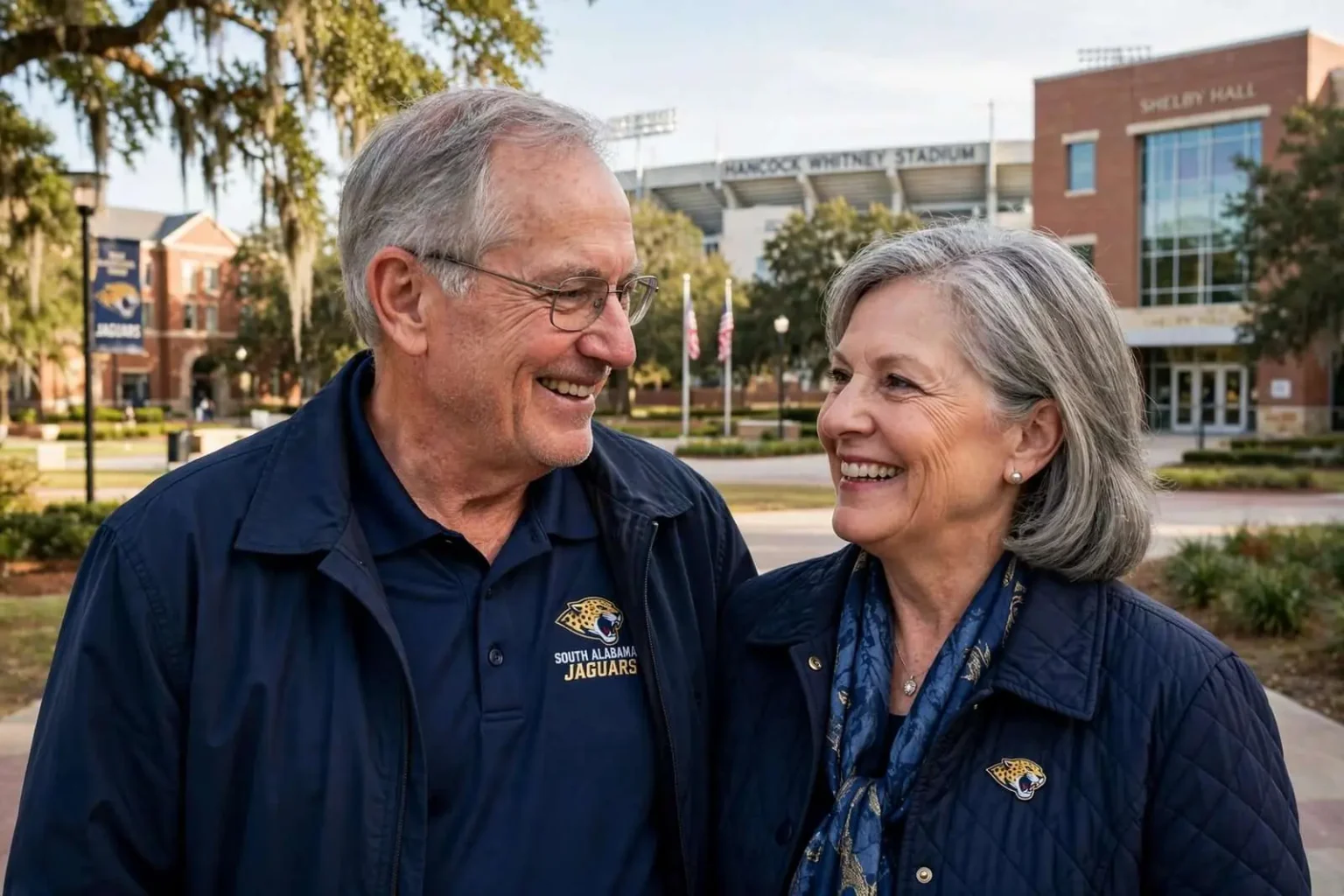
A phone call from his former high school baseball coach reconnected Jimmy Shumock with his alma mater. Four decades later, he and his wife, Debbie, have committed at least $1 million to the University of South Alabama.
MOBILE — Five years out of college, Jimmy Shumock was not thinking much about the University of South Alabama. He had a wife, a job at Thompson Engineering and a degree he had worked hard to finish and then leave behind.
Then the phone rang.
It was Steve Kittrell, his high school baseball coach. “At that time, Coach Kittrell was a few years into coaching South Alabama Baseball,” Shumock said. “We had lunch, reconnected, and through my job I had the opportunity to get involved with the program.”
That lunch turned out to be the beginning of a relationship that has now lasted four decades and ended in a commitment of at least $1 million. James H. “Jimmy” Shumock and his wife, Debbie, have made a planned gift to the University of South Alabama that they hope will encourage others to do the same.
What the Gift Supports
The commitment is broadly designated rather than aimed at a single building or program. It is intended to support several areas that have become particularly meaningful to the couple: academics, athletics, the Jaguar Marching Band and USA Health.
That breadth is itself a statement about how the Shumocks see the institution. A university is not one thing, and a gift split across a classroom, a locker room, a band room and a hospital reflects a donor who has spent time in all four.
From a Reunion to a Partnership
The reconnection with Kittrell opened a door that kept widening. What began as a personal relationship grew into Thompson Engineering’s name being attached to the Jaguars, and into the Shumocks’ own philanthropy taking root at his alma mater.
Shumock earned an accounting degree in 1980 and became a Certified Public Accountant. He spent 38 years at Thompson Engineering, rising to board chairman and chief executive officer before retiring.
His time as a student in the Mitchell College of Business was, by his own account, not especially rich in campus involvement.
“I didn’t grow up with a lot, so I worked hard to get my degree and get out,” he said. “But sports was always my connection to the University.”
That description will be familiar to a large share of graduates at institutions like South Alabama, which has served working and commuting students since its founding in the 1960s. Many arrive with a job, finish with a job, and do not think of themselves as having had a college experience in the residential sense. The Shumocks’ story is partly about what happens when someone comes back later and finds the door still open.
Showing Up, Not Just Writing Checks
Decades on, the connection through sports has expanded to nearly everything the athletics department puts on the calendar. The couple rarely miss a chance to be in the stands, whatever the sport.
“If there’s a ball involved, I want to see what’s going on,” Shumock said — volleyball, basketball, football, baseball.
Over the years the Shumocks have welcomed South Alabama coaches and staff into their home for meals and fellowship, spent time watching teams practice, and made a habit of simply being present for the students and the people who make the University work.
Shumock tells one story that captures what he thinks that presence is worth.
“After attending a recent basketball practice I went to, I was waiting to speak to Coach Riley,” he said, “when one by one, the players came over to shake my hand. There was not a single dollar spent, but the players appreciated the fact that somebody was interested enough to come out and watch them practice.”
It is a small anecdote that describes something development officers at every university try, usually unsuccessfully, to explain to prospective donors: attendance is a form of giving, and students notice it.
A Family That Kept Coming Back to South
Debbie Shumock spent most of her career with the U.S. Postal Service. She attended South Alabama as an adult student, motivated in part by wanting to set an example for the couple’s daughter.
The example carried. In 2025, the Shumocks’ granddaughter graduated from South — a third generation of the family passing through the same institution.
For Mrs. Shumock, the decision to make the gift was not framed as an obligation.
“We’ve gotten so much out of the University just by the fellowship, the friends and the activities,” she said. “We felt this wasn’t just something we needed to do, but something we wanted to do.”
Four Decades of Service
Alongside the giving, Shumock has taken on an unusually long list of volunteer leadership roles at the University.
He served 16 years on the Board of Trustees, three of them as chair pro tempore. He is president of the Jaguar Athletic Fund, a Mitchell College of Business fellow and a former member of the USA Foundation Board. He also served six years on the USA National Alumni Association Board and received the University’s Distinguished Alumni Award in 2016.
Currently, alongside Meredith Mitchell Hamilton, he serves as co-chair of the Where Bold Begins Campaign Leadership Committee, helping lead the largest comprehensive campaign in the University of South Alabama’s history.
Board service and campaign leadership are demanding in ways that rarely make the news. Trustees set tuition, approve budgets, hire and evaluate presidents, and answer for decisions that affect thousands of students and employees. Campaign co-chairs, meanwhile, spend years asking other people for money — a task that is generally only credible when the person asking has given first.
Where Their Support Has Already Landed
The couple’s giving has already touched several parts of the campus. Their support has reached the College of Engineering and contributed to the construction of Shelby Hall, a major science and engineering building, and Hancock Whitney Stadium, the on-campus football venue that opened in 2020 after decades in which the Jaguars played their home games off campus.
They also endowed a scholarship in Mr. Shumock’s parents’ name through the Mitchell College of Business.
Endowed scholarships work differently from a one-time gift. The principal is invested and only a portion of the annual return is spent, which means the fund is designed to pay out indefinitely. A scholarship endowed today will still be awarding money to students long after everyone involved in creating it is gone — which is precisely why families use them as memorials.
What a Planned Gift Is
The Shumocks’ $1 million commitment is structured as a planned gift, a category that covers arrangements made during a donor’s lifetime but realized later, most commonly through a bequest in a will or a beneficiary designation on a retirement account or life insurance policy.
Planned giving is the quiet backbone of university fundraising. It allows donors of ordinary means — people who could not write a seven-figure check from a checking account — to make a gift at a scale that reflects a lifetime of work rather than a single year’s income. Universities count documented planned gifts toward campaign totals because the commitment is real even though the money arrives later.
Because the arrangements are made in advance and in writing, they also let a donor be specific about intent while they are alive to explain it, rather than leaving the decision to heirs.
The Point of Going Public
Donors are not required to let their names be attached to a gift, and many decline. The Shumocks did the opposite, and said they hope the commitment encourages others.
That is a well-understood dynamic in philanthropy. Announced gifts function as social proof, particularly among people who know the donor and share their circumstances. A retired executive and a retired postal employee committing $1 million is a different message than an anonymous line item — it identifies a path, and the people it is meant to reach can see themselves in it.
What the Shumocks describe as the origin of all of it, though, was not a strategy. It was a coach picking up a phone, and a young accountant agreeing to lunch.