
Joe Cain Classic Marks 29th Year With 5K, Moon Pie Dash in Downtown Mobile
The 29th annual Joe Cain Classic runs March 3 in downtown Mobile with a certified 5K, one-mile run, kids' Moon Pie Dash and Mardi Gras block party.
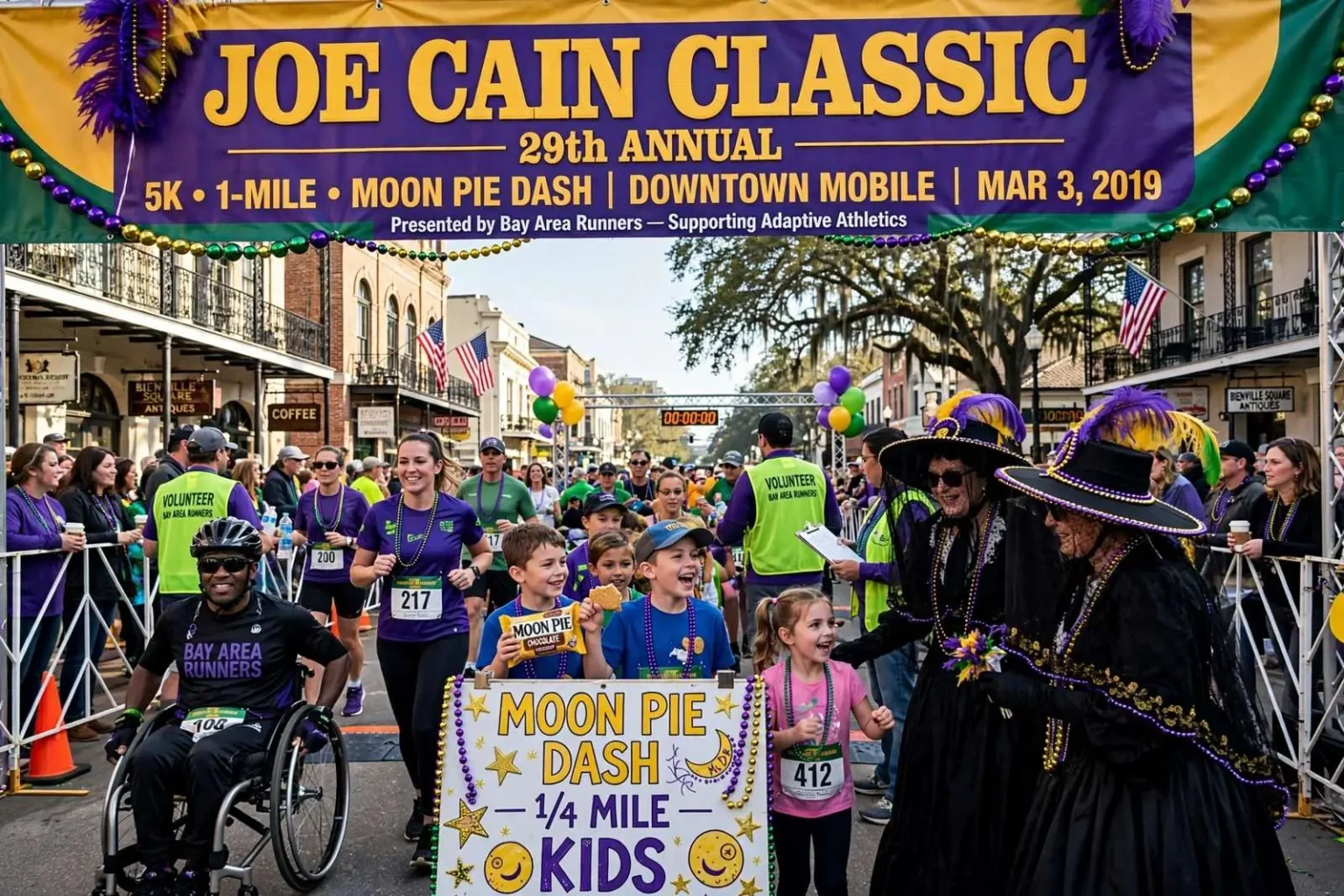
Mardi Gras season’s favorite road race returns to downtown Mobile on Sunday, March 3, 2019, when the 29th annual Joe Cain Classic steps off at 8 a.m. Presented by Bay Area Runners, the race has become a fixture on the Gulf Coast running calendar, blending serious competition with the pageantry that only Mobile — the birthplace of America’s Mardi Gras — can provide.
The Joe Cain Classic has drawn steadily growing fields of runners, walkers and wheelchair athletes since the inaugural event in 1991. What began as a modest neighborhood fun run nearly three decades ago has matured into one of the region’s signature late-Mardi Gras events, drawing participants from across Mobile and Baldwin counties and from as far away as Pensacola and the Mississippi Gulf Coast.
The 5K and one-mile courses are certified for competitors chasing state records. Course certification matters to serious runners: a measured, certified route guarantees accurate distance, which means times set on the course count toward state and regional records and can qualify athletes for championship races. For everyday runners and walkers, that same certification ensures the distance is what the race flyer promises.
A Morning Built for Families
The morning is built for families as much as racers. Alongside the 5K there’s a one-mile walk/run and a quarter-mile “Moon Pie” dash for kids of all ages — an event that has become a beloved tradition in its own right, giving the youngest members of Gulf Coast families their first taste of race-day excitement at a distance they can manage.
The Moon Pie theme is pure Mobile. The snack cake has been intertwined with the city’s Mardi Gras celebrations for generations, tossed from parade floats to revelers lining the streets, and its presence at the Joe Cain Classic ties the race directly to the Carnival culture that surrounds it. Children sprinting a quarter mile in a Moon Pie-themed dash are participating in Mobile history as much as in athletics.
Afterward, a Mardi Gras block party follows with refreshments, music and a visit from Joe Cain’s widows — the society of costumed revelers who keep alive the memory of the man credited with reviving Mobile’s Mardi Gras after the Civil War. Their appearance at the race gives participants a brush with one of the city’s most cherished Carnival traditions without waiting for a parade roll.
Who Was Joe Cain?
For newcomers to the Gulf Coast, the race’s name carries more than a century of history. Joseph Stillwell Cain, a Mobile clerk and storyteller, took to the streets in 1866 dressed as a legendary Chickasaw chief, declaring that the festivities of Carnival would continue despite the hardships of the Reconstruction era. That one-man parade is credited with reigniting Mobile’s Mardi Gras after the war, and Cain’s legacy is celebrated in the city every year on Joe Cain Day, the Sunday before Fat Tuesday.
Holding a road race in his honor in early March extends the Carnival spirit by a matter of weeks — a last burst of celebration after the parades have rolled. The event’s late-Mardi Gras timing has made it a bridge between the revelry of Carnival and the quieter calendar of spring, and its growing fields suggest the combination works.
Race director Cindy McMillan has been encouraging Gulf Coast runners to sign up early for what has become one of the region’s signature late-Mardi Gras events. Early registration helps organizers plan course staffing, water stops and post-race festivities, and it typically saves participants money compared with race-week registration.
Running for a Purpose
Beyond the fun, the race serves a serious purpose — raising financial assistance for adaptive athletic programs in Mobile and Baldwin counties that help handicapped individuals compete in athletic competitions. Every registration fee and sponsorship dollar funnels toward equipment, coaching and competition opportunities for athletes who might otherwise be shut out of organized sports.
Adaptive athletics has grown across the country over the past several decades, from wheelchair road racing and track to adaptive basketball, swimming and cycling. Local programs give athletes with physical disabilities a place to train, compete and travel to meets, and community fundraising events like the Joe Cain Classic keep those programs within reach for families who might not otherwise afford the specialized equipment involved.
The race’s inclusive field reflects that mission. Wheelchair athletes line up alongside runners and walkers on certified courses, and the family-friendly distances make it possible for participants of nearly every ability level to take part. For many Gulf Coast families, the Classic is their first exposure to competitive adaptive sports — and often the reason a child joins a program afterward.
Bay Area Runners and the Local Scene
The presenting organization, Bay Area Runners, is part of a thriving Gulf Coast running community. Mobile-area running clubs host training runs, track workouts and race calendars throughout the year, and local races — from Mardi Gras-themed 5Ks to half marathons along the Bay — draw thousands of participants annually. The Joe Cain Classic sits comfortably in that ecosystem, and its longtime presence on the calendar has made it a benchmark race for local runners’ spring training.
Club-organized races also serve as economic and community events for downtown Mobile. A morning race crowds the streets around the historic district with hundreds of participants and spectators, many of whom linger downtown for breakfast or brunch afterward, supporting the restaurants and shops that line the area near Bienville Square and Dauphin Street.
Certified courses, chip-timed results and well-marked routes have become the standard for races in the region, and the Classic’s certification for the 5K and one-mile signals that it meets the standards serious runners look for when selecting goal races.
Race-Day Logistics
The 8 a.m. start keeps runners ahead of the March sun and clears the courses in time for the block party that follows. Downtown streets near the start and finish close briefly for the events, a familiar routine for an area accustomed to parade routes and festival traffic throughout the Carnival season.
Participants are advised to arrive early for parking and packet pickup, a standard recommendation for downtown events. Runners chasing state records on the certified courses will find the flat, fast terrain of downtown Mobile’s streets to their liking, while families can set up near the finish line to cheer on the Moon Pie dash that follows the main events.
Twenty-Nine Years of Tradition
Reaching a 29th annual edition puts the Joe Cain Classic in rare company among Gulf Coast events. Races that survive nearly three decades do so through committed volunteers, loyal sponsors and a community that shows up year after year — and the Classic has accumulated all three. Generations of Mobile-area families have grown up with the race, some running the Moon Pie dash as children and returning later to run the 5K alongside their own kids.
The event’s growth since 1991 mirrors the broader rise of recreational running in America, but with a distinctly Mobile flavor. Where other cities have their holiday-themed fun runs, the Port City blends its athletics with its unique Carnival heritage, and the Joe Cain Classic is the clearest expression of that marriage — a certified road race that ends with Mardi Gras music, refreshments and costumed royalty.
The visit from Joe Cain’s widows, in particular, connects the race to a living tradition. The widows — men in dresses and veils mourning the city’s patron of Mardi Gras — parade through Mobile’s streets each Joe Cain Day, and their appearances at community events like the Classic keep the legend of Old Man Joe Cain in front of new generations of Mobilians who may not yet have learned the full story behind the name.
What It Means for Adaptive Athletes
The funds raised each March flow to adaptive athletic programs serving both Mobile and Baldwin counties, ensuring that the race’s impact stretches across the bay. Programs supported by community races provide track and field opportunities, road racing, team sports and recreational activities for children and adults with disabilities — services that often depend almost entirely on local fundraising to operate.
For the athletes who benefit, the support translates into racing wheelchairs, adaptive bicycles, coaching and travel to regional and national competitions. Success stories from such programs frequently begin at community events exactly like this one, where a young athlete’s first taste of organized competition comes in a family-friendly, supportive setting.
That dual identity — a Mardi Gras-flavored fun run and a genuine fundraiser for adaptive sports — is the reason organizers, volunteers and participants have kept the Joe Cain Classic rolling for 29 years. On Sunday, March 3, 2019, downtown Mobile will once again host the blend of competition, celebration and community service that has defined the race since its first running in 1991, and Gulf Coast runners, walkers and wheelchair athletes will once again be at the center of it.


