Joe Jefferson Players turn to virtual Vaudeville showcase to weather pandemic shutdown
Mobile's Joe Jefferson Players launched a virtual Vaudeville fundraiser, inviting residents to perform and donate while pandemic closures idled the.
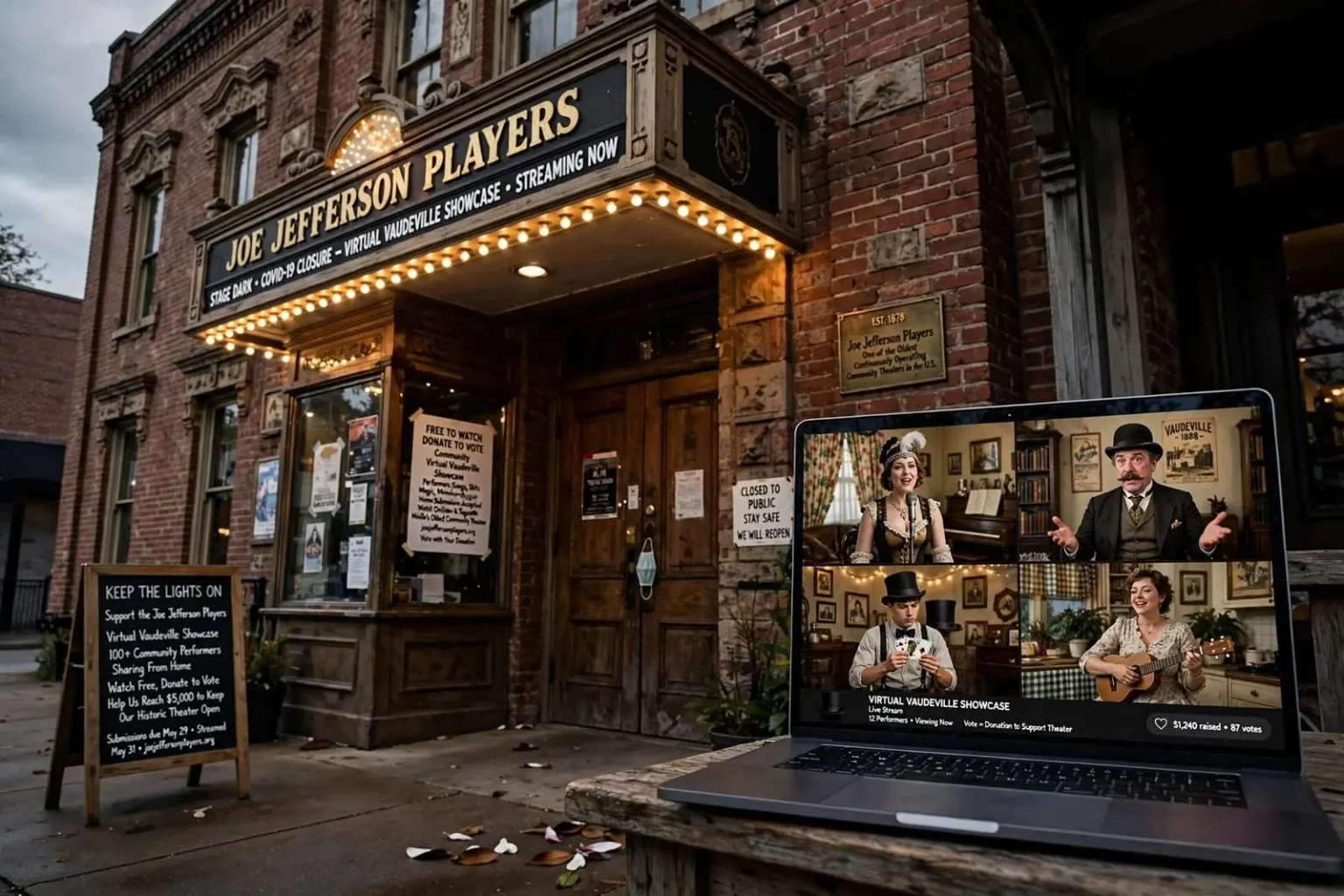
With its stages dark because of the coronavirus pandemic, Mobile’s Joe Jefferson Players found a creative way to raise money: a virtual Vaudeville showcase that invited the community to perform — and donate — from home. The idea drew on a piece of local history. Vaudeville variety shows toured the Mobile area in the late 1800s, and participants were encouraged to create and film their own routines from that era and submit them for inclusion in an online show.
The concept turned a shutdown into a stage. Instead of asking patrons to wait out the pandemic, the playhouse asked them to entertain — sending in filmed songs, skits, magic acts and monologues styled after the variety bills that once crisscrossed the Gulf Coast — and then packaged the submissions into a single production the whole city could stream. It was fundraising, community theater and a history lesson rolled into one broadcast.
How the virtual showcase worked
The mechanics were deliberately simple. Performers sent video submissions to the playhouse’s artistic director by late May. Organizers then assembled the entries into a single edited show, which was released online two days later. Viewers could watch for free, pick a favorite performer and follow a link to vote with donations — turning the audience itself into the judges and the box office at once.
That free-to-watch, donate-to-vote structure inverted the economics of a normal theatrical evening. Rather than charging admission and hoping the room filled, the Joe Jefferson Players let the show travel to wherever its audience was, then gave viewers a reason to contribute: backing the performer they loved. Every donation counted as a ballot, so the competition gave casual viewers a stake in the outcome while the theater collected the proceeds it could no longer earn at the ticket window. For a community theater with no corporate parent, that kind of distributed support can be the difference between a quiet season and a closed one.
A nod to Mobile’s Vaudeville past
The Vaudeville framing was more than a theme. Vaudeville variety shows genuinely toured the Mobile area in the late 1800s, bringing traveling bills of comedians, singers, acrobats and novelty acts to Gulf Coast stages in an era before cinema and radio — a time when live variety was popular entertainment across America. By inviting contributors to film routines “from that era,” the playhouse connected its current crisis to the resilience of the performers who worked those stages more than a century ago.
Eric Brown, director of the Joe Jefferson Players, said the format doubled as a history lesson, pointing anyone unsure about the era toward classic films set in the Vaudeville period for inspiration. The suggestion gave would-be performers a starting point — the fast-paced billing, the polished patter, the broad physical comedy of the variety tradition — while quietly teaching the audience where the American stage comedy they know today comes from. Standup comedy, sketch shows and talent competitions all trace their lineage to the Vaudeville circuits, and Mobile’s own theatrical history runs straight through them.
Keeping the lights on
The playhouse, one of the oldest continuously operating community theaters in the country, had canceled several productions because of COVID-19 — a serious blow for a facility that relies on ticket sales as its main source of income. Community theaters operate on thin margins in the best of years: ticket revenue pays the rent on the building, the costumes and sets, the rights to the shows, and the small staff that keeps an operation running. Remove a season of performances and the income disappears immediately, while the fixed costs of a historic building do not.
Brown said proceeds from the virtual showcase would help keep the theater open so patrons and actors could return indoors for the upcoming season once it was safe to reopen. That is the arithmetic of survival for a nonprofit stage — bridge the gap between the last sold-out house and the next one, and the theater lives to mount another season. The showcase’s donations flowed directly into that bridge.
A theater with deep roots
The Joe Jefferson Players take their name from the celebrated 19th-century American actor Joe Jefferson, the Mobile-connected performer best remembered as the definitive stage Rip Van Winkle, and the troupe has carried his name through decades of community productions in Mobile. Being among the oldest continuously operating community theaters in the country is a distinction few American stages can claim, and it comes with a building, a membership tradition and an audience built over generations — all of which are worth protecting through a crisis that threatened the “continuously operating” part of the honor.
The pandemic shutdown hit community theaters nationwide with a uniformity few events ever manage: every stage, everywhere, went dark at once. Nationwide, community theaters responded with virtual readings, streamed cabarets and online fundraisers, and Mobile’s virtual Vaudeville showcase stands as a particularly fitting version of that response — a theater improvising, as theater people do, when the script runs out.
What the community sent in
The invitation to film routines “from that era” opened the door to the full variety of the Vaudeville tradition: singers, comedians, musicians, magicians, dancers and the assorted novelty acts that made old variety bills unpredictable. Contributors worked at home with whatever cameras and props they had, and the playhouse’s artistic director took on the task of shaping a pile of homemade videos into a coherent show — editing, sequencing and polishing the entries into something that played like an evening at the theater rather than a playlist.
The format also lowered barriers that a live stage imposes. Community theater auditions can intimidate people who have never performed; a filmed submission from the living room does not. The showcase effectively recruited performers who might never have set foot on the playhouse stage, and some of those first-time participants may well become future volunteers, cast members and season-ticket holders once the doors reopen — a long-term benefit beyond the immediate fundraising.
The road back to the stage
The showcase was conceived as a bridge, not a replacement. Streaming can carry a community through an emergency, but it cannot reproduce what makes community theater communal: an audience and a cast sharing a room, the intermission conversations, the transformations that happen in a historic playhouse when the house lights go down. Brown’s stated goal — keeping the theater open so patrons and actors could return indoors for the upcoming season once it was safe — framed every donation as a down payment on that return.
Until then, the edited show remained online, viewable free, with the donation link still functioning as a ballot for favorite performers. For a theater company that has survived more than a century of wars, storms and economic cycles, a pandemic-induced dark stretch was one more chapter — and the virtual Vaudeville showcase was the troupe’s way of writing it in the spirit of the traveling performers who entertained Mobile more than a century ago: the show went on, one way or another.
Why the fundraiser’s design worked
The showcase’s design solved the two problems every pandemic-era arts fundraiser faced: distance and incentive. Distance, because a traditional benefit gala depends on a ballroom full of people, and no ballroom was safe in the spring of 2020. Incentive, because asking for donations with nothing in return rarely moves a community to give twice. The vote-with-donations structure addressed both — the show came to the audience, and every dollar came with a vote that made giving feel like participation rather than charity.
It also gave the theater something scarce during the shutdown: content. A theater with no productions has no story to tell its supporters, but the showcase generated a weeks-long narrative — submissions arriving, the deadline, the editing, the release, and finally the vote tally. Each stage of that arc was a reason to mention the playhouse again, share the link again, and remind Mobile that the oldest continuously operating community theater in the area was still working, still entertaining and still planning a future.
Community theater’s fragile economics
The crisis exposed how fragile community theater finances are everywhere. Unlike commercial theaters backed by investors or universities backed by endowments, community theaters live almost entirely on what the box office takes in each weekend. When a season of shows is canceled, there is no reserve to dip into, and the choices quickly narrow: cut staff, defer maintenance, dip into restricted funds or appeal directly to the community. The Joe Jefferson Players chose the appeal — but dressed it as entertainment, which is perhaps the most theatrical solution available.
Their approach also mirrored what the playhouse does best: involve volunteers. A community theater runs on people who act, build, sew and usher for the love of it, and the virtual showcase extended that volunteer model into fundraising. Mobile residents who might never buy a season ticket still had a role — performer, voter, donor — in keeping a piece of the city’s cultural history alive through its quietest months. When the season resumes and the house lights come up again, the audience that streamed the Vaudeville show will be there, and so will the theater it helped save.