John Wahl Calls Flock Safety Cameras Unconstitutional, Cites Fourth Amendment
Republican lieutenant gubernatorial nominee John Wahl argues Flock Safety license plate cameras are unconstitutional and violate Fourth Amendment protections.
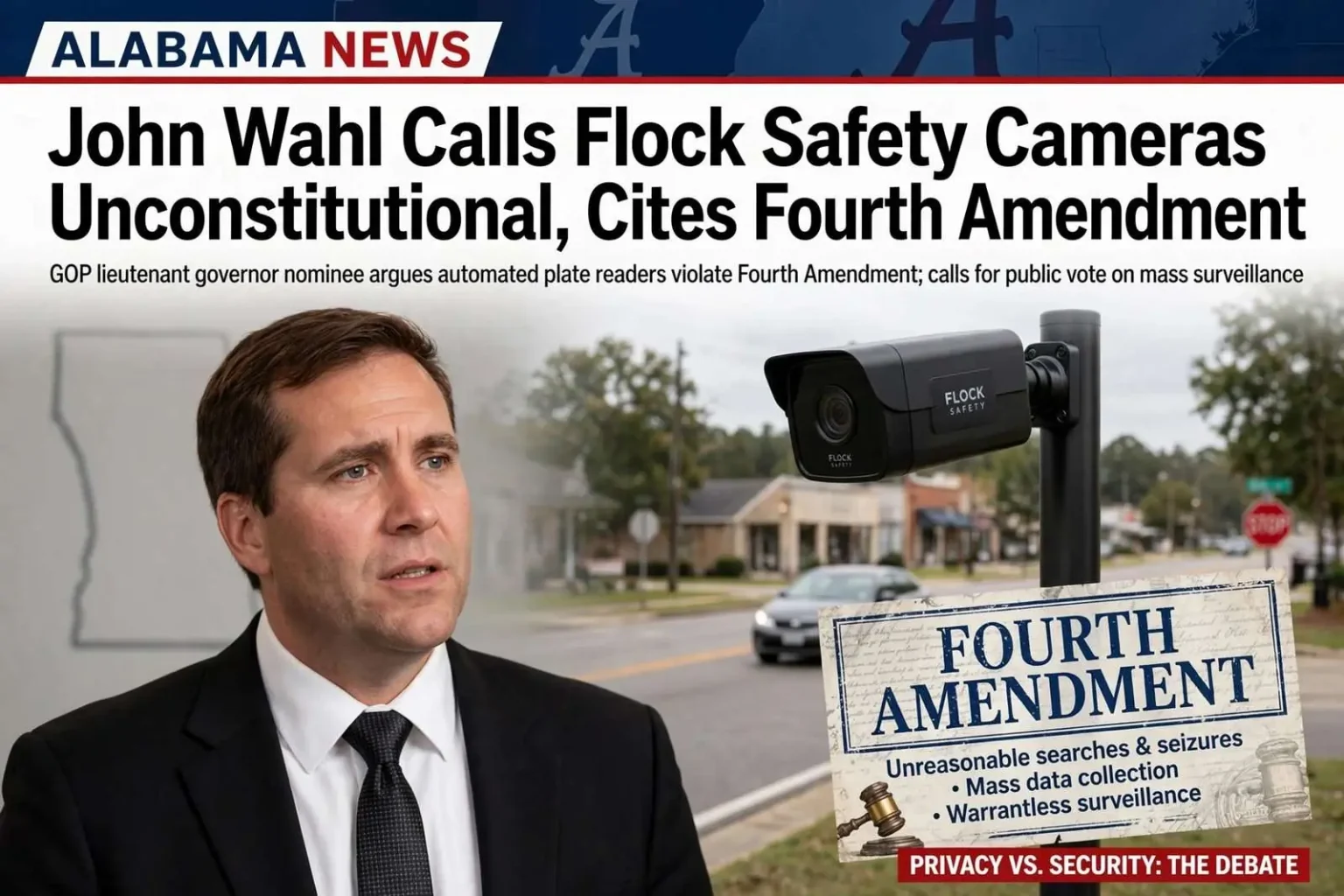
Republican lieutenant gubernatorial nominee John Wahl spoke out against Flock Safety cameras during an interview Tuesday, arguing the automated license plate readers violate the U.S. Constitution. According to the former Alabama Republican Party chairman, the controversial technology runs afoul of the Fourth Amendment — and he said the debate should be settled by the people, not by agencies deploying the devices one contract at a time.
Wahl’s comments place him in a growing national argument over Flock Safety, the Atlanta-based company whose camera systems now read plates for police departments, homeowners associations and school campuses across the country. The devices photograph every license plate that passes — not just those tied to an active investigation — and log the location, date and time into searchable databases that agencies can query.
“The Flock camera issue comes after pretty much one thing: is it constitutional? I’m a strong supporter of the Constitution. I am a constitutionalist,” Wahl said. “I believe a lot of our problems can be solved by going back to the basics, by understanding the vision of our founding fathers and why they secured the liberties and the rights they did. I believe that our rights come from our Creator; they don’t come from government. And government can’t just change what your rights are. These are transcendent rights that our founding fathers recognized and guaranteed in the Constitution, and one of those is the Fourth Amendment.”
Concerns Over ‘Mass Collection’
Wahl expressed concern about the “mass collection” of private citizens’ information made possible by the technology.
“The people of this country have a right to be safe and secure in their property, to not have searches without warrants, to have the ability to travel in privacy, and so I think the question is: Are Flock cameras constitutional? I think they are not. I think the mass collection of information on innocent, average, everyday voters and citizens is unconstitutional.”
His argument goes to the heart of how the Fourth Amendment has been debated in the digital era. The amendment protects against unreasonable searches and seizures, and courts have long weighed whether sweeping data collection — as opposed to a search of a specific person or place — counts as a search requiring a warrant. Wahl’s position is that a network capturing the movements of every driver, every day, crosses that line regardless of how the collected data is used afterward.
The concern is not hypothetical. License plate reader networks have been used in other states to reconstruct a motorist’s travel history, flag vehicles that visited particular places of worship or medical facilities, and in at least some documented instances to enforce out-of-state abortion-related investigations and minor traffic stops. Civil liberties groups on both the left and right have catalogued those uses, and the technology has drawn opposition from an unusual coalition of progressive privacy advocates and conservative constitutionalists.
The scale of the collection is the technology’s defining feature. A single camera can capture thousands of plates per day, and a municipal network records the movements of its own residents and every visitor alike. Flock’s system holds that data — typically for thirty days under default settings — and allows participating agencies to search it from a single interface, which is how a query about a suspect vehicle in one city can surface a car’s entire recorded journey across a region.
The Fourth Amendment Argument
Wahl framed his objection in the language of natural rights rather than policy trade-offs. In his telling, the question is not whether license plate readers reduce crime — Flock’s marketing and many police departments say they help solve cases from stolen vehicles to violent crimes — but whether a government that documents the movements of every citizen without individualized suspicion is doing something the Constitution forbids.
“The people of this country have a right to be safe and secure in their property, to not have searches without warrants, to have the ability to travel in privacy,” Wahl said, folding the right to travel into the same constitutional tradition as the warrant requirement.
That framing echoes arguments now moving through the courts. U.S. Supreme Court decisions over the past decade — on cell phone location data, on GPS trackers attached to vehicles — have increasingly treated sustained location tracking as a search implicating the Fourth Amendment. Critics of automated plate readers argue those precedents point in one direction; defenders of the technology argue that a camera photographing a plate visible in public is no different from an officer writing down a tag number by hand.
Wahl clearly places himself in the former camp. As a former chairman of the Alabama Republican Party and now the party’s nominee for lieutenant governor, his remarks carry weight in a state where municipalities and counties have been signing Flock contracts at a steady pace, joining hundreds of agencies across the Southeast.
A Proposed Path Forward
Wahl offered a solution for those who disagree with his view of the cameras’ constitutionality.
“If someone doesn’t like it, they should bring up changing the Constitution. Don’t ignore the rules we have in place, but make the argument to the public of why they should,” he explained. “I think the argument should be taken to the public, and they should have a chance to vote on it or decide, rather than them just having mass amounts of data collected on them without their permission.”
It is a distinctive position: rather than calling for regulation or limits on data retention, Wahl argues the technology’s legality should be ratified or rejected by the public itself — through constitutional amendment or a direct vote — before mass deployment is treated as settled.
The privacy question is amplified by what happens to the data after collection. Retention periods, search auditing, inter-agency sharing and the absence of a warrant requirement for queries are all contractual details rather than statutory ones in most Alabama deployments. That means the rules governing some of the most sensitive data a government can hold about its citizens are set by the vendor agreement a city signed, not by any law the public’s representatives debated — a gap Wahl’s public-vote proposal is aimed squarely at closing.
The Flock Debate Reaches Alabama
Flock Safety’s expansion across Alabama has followed the pattern seen nationally. Municipalities sign contracts, cameras go up at intersections and neighborhood entrances, and police departments tout recoveries of stolen cars and missing persons cases. The devices are typically sold with the pitch that they pay for themselves in recovered vehicles and solved cases, and many departments credit them for exactly that.
But the contracts often arrive with little public debate, and that is the portion of the pattern Wahl’s comments target. Residents frequently learn the cameras are in place after they are installed; the data-sharing agreements between agencies that make the network powerful are rarely discussed at council meetings. Privacy advocates argue that a driver’s movements are among the most sensitive categories of data government can hold, and that the retention policies, access rules and audit practices matter as much as the cameras themselves.
The Political Context
Wahl’s remarks come in a campaign season where the lieutenant governor’s office — the Senate-presiding role and a traditional platform for constitutional questions in Alabama — gives him a statewide megaphone for the issue. His constitutionalist framing aligns with the position that has made license plate readers one of the few privacy questions to generate genuine bipartisan tension in statehouses around the country.
Several states have moved to restrict or regulate the networks: some have banned data sharing with agencies in other states, some have capped retention periods, and others have debated outright moratoriums. In Congress, members from both parties have raised alarms about the scale of the databases. Alabama has so far handled the question contract by contract, city by city — precisely the incremental approach Wahl argues should be replaced by an explicit public decision.
What he is proposing, in effect, is that Alabama treat mass plate collection the way it would treat any expansion of government power: as something that requires the consent of the governed, expressed through the constitutional process, rather than something that becomes a fact on the ground because a vendor and a city signed an agreement.
What to Watch
The debate is likely to sharpen as camera networks expand and the first court challenges test the technology against current Fourth Amendment doctrine. For now, Wahl’s position defines one pole of the argument: the mass collection of ordinary citizens’ movements is unconstitutional, and the burden belongs on those who want it to make their case to the public and change the Constitution — not on citizens to prove, after the fact, that they should be left alone.
Whether Alabama’s legislature takes up the question — and whether municipalities pause or accelerate their Flock deployments — will be the measure of how much weight the argument carries in the state. The cameras, for their part, keep reading plates.
For Alabama voters, the issue offers a rare moment of clarity on a genuinely constitutional question. It does not divide cleanly along party lines: conservative voters skeptical of government surveillance and progressive voters skeptical of policing technology find themselves on the same side, while law enforcement agencies and crime-weary neighborhoods often see the cameras as an unambiguous good. How that tension resolves — through city councils, the legislature, the courts or, as Wahl suggests, the ballot — will shape the privacy landscape for Alabama drivers for years to come.