Judge dismisses two charges, issues gag order in Washington County buried Hummer case
A judge dismissed two charges and issued a gag order in the Washington County buried Hummer insurance fraud case against Gene Parnell.
CHATOM, Ala. — The Washington County man accused of burying a 2006 Hummer H2 to collect insurance money appeared in court Tuesday for a preliminary hearing that turned into a mini-trial and an attack on the investigation. Gene Parnell is accused of burying the Hummer on property in the Tibbie community in 2016 — six years after reporting the vehicle stolen — in what prosecutors describe as a scheme to eventually dig it up and pursue an insurance claim on the once-expensive SUV. The hearing at the Washington County courthouse in Chatom stretched to roughly three hours, far longer than the routine probable-cause proceeding it was scheduled to be, as the defense turned the session into a wide-ranging assault on the case against his client.
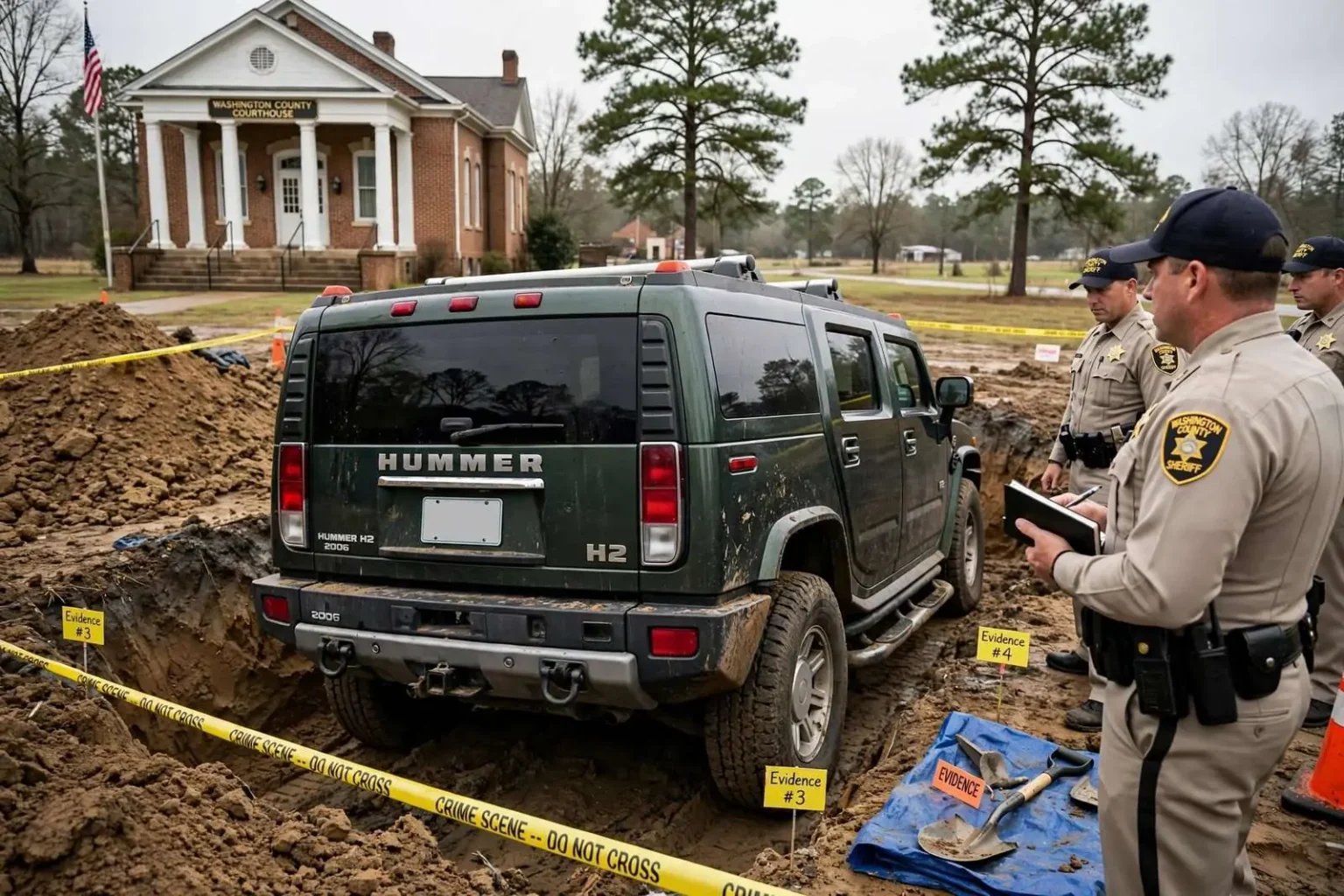
The unusual case began when a tip led investigators to the buried vehicle. Somewhere in the rural stretches of the Tibbie community — a small settlement near the Tombigbee River in southern Washington County — the 2006 Hummer H2 had been interred, hidden from view of passersby on the county’s sandy back roads. Investigators who followed up on the tip discovered the vehicle, which Parnell had reported stolen six years earlier. The discovery transformed what had been a dormant theft report into an active fraud investigation: a vehicle reported stolen, still in the county, six feet under the ground on property connected to the man who reported it missing.
Investigators testified at the hearing that Parnell told a friend he was going to make the Hummer disappear and not to ask questions. That account — a statement allegedly made before the vehicle vanished from view — formed part of the state’s showing that the burial was deliberate and concealed rather than accidental or innocent. Prosecutors used the testimony to sketch a narrative for the court: a man under financial pressure, a vehicle worth thousands of dollars, a report of theft, and a machine buried in the dirt waiting for the right moment to resurface as the subject of an insurance claim.
A Defense Built on the Attack
Defense attorney Blane Dolbare spent the hearing working every angle available to him. He asked the judge to dismiss all charges on a technicality, challenged the mechanics of the investigation itself, and pressed the state’s witnesses hard enough that the preliminary hearing took on the texture of a trial — opening arguments in miniature about a case that is still months from any actual trial. Dolbare, a longtime figure in southwest Alabama’s legal community, is known for aggressive defense work in the region’s rural courts, and the strategy on display Tuesday fit that reputation.
In a move that raised eyebrows in the courtroom, Dolbare called Washington County Sheriff Richard Stringer as a witness, putting the county’s top law enforcement officer on the stand to testify about the investigation his office conducted. Cross-examining the sheriff allowed the defense to probe how the tip was handled, how the burial site was located and processed, and whether proper procedures were followed at every step — groundwork for potential suppression arguments and reasonable-doubt themes should the case ever reach a jury.
Dolbare also encouraged another witness to invoke his Fifth Amendment right while on the stand, an unusual posture for a defense attorney that underscored the strategic thickets of the hearing. And at the heart of his argument sat a simple alibi claim: Dolbare argued his client could not have buried the Hummer because he was in Mobile when it was reported stolen. The defense’s theory framed the timeline of the vehicle’s disappearance as the case’s central contradiction, telling the judge that the state’s own account required Parnell to be in two places at once.
The Case So Far
The allegations trace a path through a decade of documents and dirt. The 2006 Hummer H2, a large luxury SUV that sold new for tens of thousands of dollars, was reported stolen six years before the burial came to light — meaning the vehicle sat missing, and presumably the insurance file stayed closed, while Parnell lived on with the claim unresolved. When the 2016 burial on Tibbie community property was discovered, investigators gained what fraud cases rarely have: physical evidence. An exhumed vehicle can be examined for damage, for mechanical condition, for the soil record of when it was buried — the kind of hard evidence that turns a suspicion about an old theft report into a chargeable case.
What prosecutors must ultimately prove is intent: that the theft report was false and the burial was staged as part of a plan to defraud an insurer. The hearing’s testimony about a friend being told the Hummer would “disappear” pointed at that intent, as did the sheer logistics of burying a vehicle — an operation that requires heavy equipment, time, and a place to do it out of sight. Defense counsel’s counterweight, the claim that Parnell was in Mobile when the vehicle was reported stolen, attacks the same narrative at its foundation, and the dueling versions of the timeline will shape everything that follows.
The Judge’s Rulings
In the end, the case was bound over to a grand jury, meaning the judge found enough evidence to send the charges forward for the grand jury’s review — the next step in Alabama’s felony process, where a panel of citizens decides whether an indictment is warranted. The binding-over decision kept the prosecution alive despite the defense’s three-hour assault, but it came with significant trims.
Judge Jerry Turner issued a gag order and dismissed two of the three charges against Parnell. Only the first-degree insurance fraud charge remains. The gag order restricts what attorneys, investigators and parties can say publicly about the case, an unusual step for a rural county criminal matter that reflects the attention the buried-Hummer story has attracted across southwest Alabama. The dismissal of two charges narrowed the prosecution’s path to the single most serious count — the first-degree insurance fraud allegation that sits at the center of the case.
The rulings leave both sides with something to weigh. For prosecutors, a single surviving charge is still a viable case if the grand jury indicts, but the dismissal signals the court’s view of the weaker counts. For the defense, the hearing achieved partial results while preserving the core arguments — the alibi, the technicalities, the challenges to the investigation — for the rounds ahead. Parnell, for his part, left the Chatom courtroom still presumed innocent, still facing one felony count, and still at the center of one of the strangest cases Washington County has seen in years.
What a Grand Jury Will Decide
The case now heads toward the grand jury process in Washington County, where a citizen panel will hear the state’s evidence in secret and decide whether to return an indictment on the surviving first-degree insurance fraud charge. If indicted, the case would proceed to arraignment and eventually to trial in the county’s circuit court in Chatom — a process likely to take months, with the defense’s preliminary-hearing arguments foreshadowing the fight to come.
Insurance fraud prosecutions of this kind are rare enough in rural Alabama counties to draw lasting attention, and the image at the center of this one — a luxury SUV dug out of the south Washington County dirt six years after its owner swore it was stolen — guarantees the case will be watched closely from Tibbie to Chatom and beyond. Whatever the grand jury decides, Tuesday’s hearing established the battle lines: the state’s buried vehicle and disappearing act against a defense that says its client was miles away in Mobile when the story was supposedly set in motion.
A Case That Grips a Small County
Washington County, stretching across the piney woods and river bottoms of southwest Alabama with a population of roughly seventeen thousand people, does not often host criminal cases that become regional talking points. The county seat of Chatom handles the steady docket of a rural circuit — thefts, assaults, drug cases — but the image of an insurance-fraud scheme buried in the mud of the Tibbie community has traveled far beyond the courthouse square. Residents across the county have followed the case’s twists with the kind of attention usually reserved for high school football, and Tuesday’s packed hearing suggested the fascination is not fading.
Part of the appeal is the sheer improbability of the scheme alleged. Insurance fraud takes many forms — inflated claims, staged thefts, arson — but physically burying a vehicle and waiting six years before circling back for a payout is an approach whose audacity borders on the hard to believe. That improbability cuts both ways: prosecutors argue that no innocent explanation accounts for a reported-stolen Hummer entombed on the owner’s connected property, while the defense argues that the very strangeness of the accusation shows how thin the investigation truly is. Somewhere between those two readings of the same dirt-covered SUV sits the case the grand jury will be asked to evaluate.
The case also spotlights the machinery of small-county justice, where the same names recur across decades. Sheriff Richard Stringer’s office conducted the investigation, and his appearance as a defense witness illustrated how personal the practice of law becomes in a county this size, where attorneys like Blane Dolbare have appeared before judges like Jerry Turner for years. The gag order imposed after the hearing will quiet the public commentary, but it will do little to slow the conversation in the feed stores, churches and fish camps where Washington County has been debating this case since the Hummer first came out of the ground.
The Road Ahead
For now, the procedural calendar governs. The grand jury will convene, hear the evidence on the surviving first-degree insurance fraud charge, and either indict — moving the case toward a trial where the alibi claim and the investigation’s methods will be tested before a jury — or decline, ending the prosecution. Either outcome will take months to arrive, and the legal fight in the meantime will continue in motions and filings rather than headlines, thanks to the judge’s order.
What is already clear is that the preliminary hearing accomplished what preliminary hearings rarely do: it previewed an entire trial. The state presented its buried-vehicle narrative and its testimony about a promised disappearance. The defense attacked the investigation, called the sheriff, sheltered a witness behind the Fifth Amendment, and planted its Mobile alibi flag. Judge Turner trimmed two charges, bound over the core fraud count, and shut the door on public sparring. When the case next surfaces publicly, the buried Hummer H2 of Tibbie will either be the centerpiece of an indictment or the last artifact of a prosecution that fell apart — and Washington County will be watching either way.