
Federal Judge Accepts No-Jail Sentence in Orange Beach International Parental Kidnapping Case
Chief U.S. District Judge Jeffrey Beaverstock sentenced Haley Leah Harris to time served and one year of supervised release for international parental kidnapping after she took her 3-year-old daughter from an Orange Beach home to Mexico.
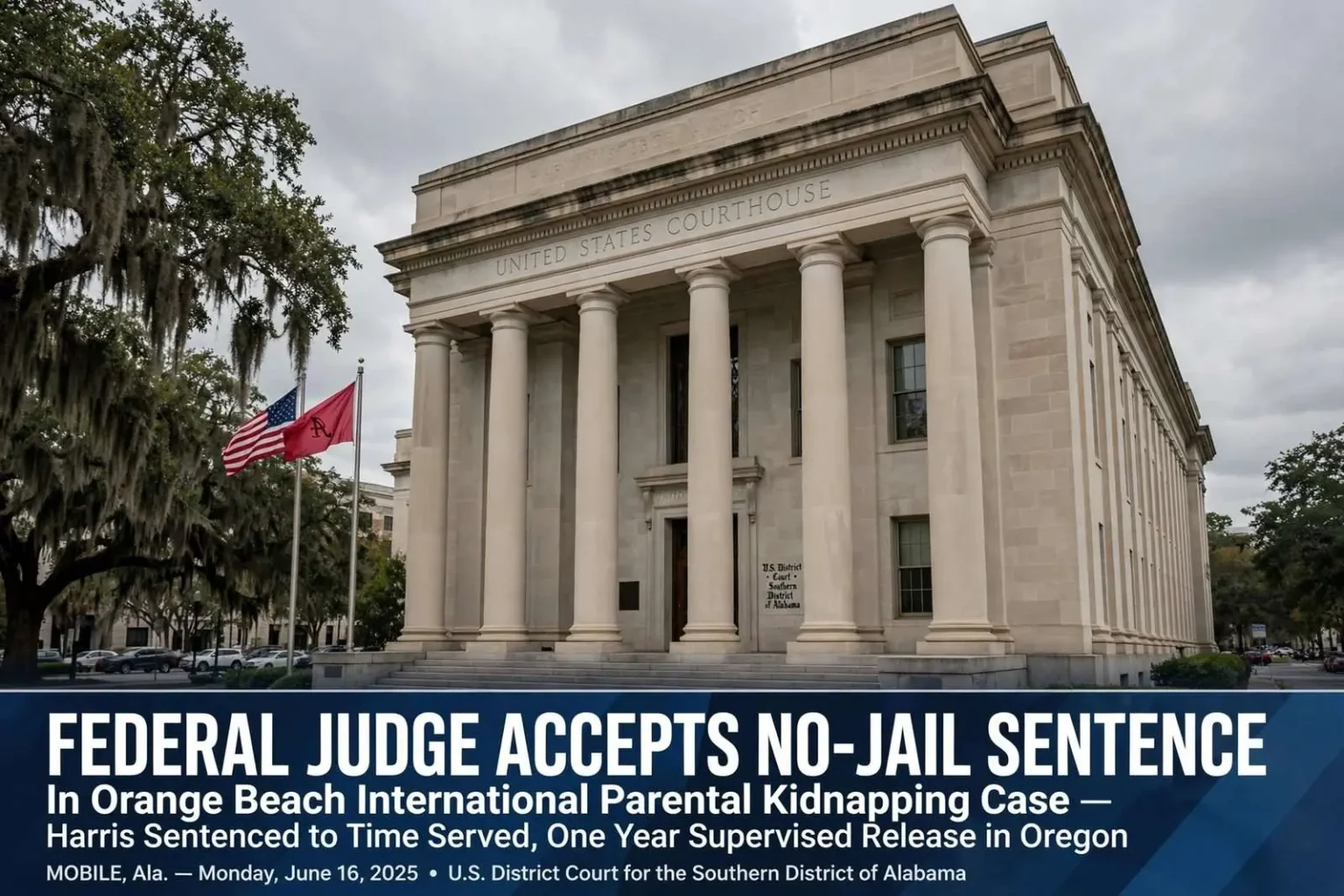
MOBILE, Ala. — A federal judge on Monday accepted the sentence recommended by prosecutors for Haley Leah Harris, the woman convicted of international parental kidnapping after taking her 3-year-old daughter from the child’s father’s Orange Beach home and traveling to Mexico in a case that drew statewide attention last year.
Chief U.S. District Judge Jeffrey Beaverstock sentenced Harris to time served for the period she spent in custody following her return from Mexico in October 2025 until the judge agreed to release her on June 15. Harris, 24, will also spend one year under supervision by the U.S. Probation Office and will not be permitted to leave Oregon, where she now lives.
How the case reached a judge
The case began when Harris took her daughter, Kionni, from the Orange Beach home of the child’s father, Bryce Haugen, and left the United States for Mexico. The cross-border disappearance triggered a multi-agency effort to locate the girl and drew the involvement of some of Alabama’s highest elected officials, who publicly pressed for her return.
A jury heard the case earlier in the year but could not reach a unanimous verdict, deadlocking in March. Rather than pursue a retrial, both the prosecution and the defense agreed to let Beaverstock decide the matter. The judge found Harris guilty of international parental kidnapping.
The sentencing outcome
Federal prosecutors recommended a sentence of time served, a resolution that spared Harris additional incarceration given the months she had already spent in custody between her return from Mexico in October 2025 and her June 15 release. The judge accepted that recommendation.
The terms of Harris’s supervised release include a mandate that she receive mental health treatment and that she have no contact with the victim or the victim’s family. The geographic restriction keeps her in Oregon, where probation officers in that district will supervise her compliance and report any violations back to the federal court in Mobile.
Victim impact statement
Haugen submitted a written victim impact statement and said in court Monday that Harris had made his family’s life miserable for two weeks when they did not know where the child was.
Defense plans an appeal
Defense attorney Richard Shields said his client intends to appeal the conviction, and that he believes she has a good case on the central argument the defense advanced at trial: that because no court order had revoked Harris’s custody rights at the time she left with Kionni, she had every legal right to travel with her own daughter.
“It was a recommendation by the government that we thought was acceptable,” Shields said of the sentence.
The appeal will focus on whether the federal international parental kidnapping statute applies when no court order has specifically restricted a parent’s right to travel with her own child. The prosecution’s position is that removing a child from the country without the other parent’s knowledge or consent is itself a federal violation, regardless of any existing custody order.
Custody and family developments
While in jail in Alabama following her return from Mexico, Harris gave birth to a baby she had with the man in Mexico she had gone to be with. Shields said his client has custody of that baby and remains engaged to the man.
Shields said Harris plans to seek joint custody of Kionni when her supervised release term ends. “At some point, she’d like to go back and have a normal relationship with her daughter,” he said.
A federal case in Mobile
The sentencing took place at the federal courthouse in downtown Mobile, the seat of the U.S. District Court for the Southern District of Alabama, where federal crimes committed in coastal Alabama, including Baldwin and Mobile counties, are typically handled. Beaverstock, a veteran federal jurist, presided over both the bench trial that ended in Harris’s conviction and Monday’s sentencing.
International parental kidnapping is a federal offense that carries serious penalties, particularly when a child is taken across an international border without the consent of the other legal parent. Federal prosecutors frequently coordinate with foreign governments, the FBI and the State Department to locate missing children and secure their return. The Orange Beach Police Department and the Baldwin County Sheriff’s Office were both involved in the early stages of the investigation, working alongside the FBI and federal prosecutors, and Alabama’s statewide political leadership helped coordinate communications with federal agencies and with Mexican authorities as the search extended into Mexico.
The road ahead
The case is far from fully closed. With an appeal planned and a future custody question looming once the supervised release period ends, the issues at the heart of the dispute — what custody rights Harris held, and whether her travel with her daughter was lawful — are likely to return to court.
Family courts in Alabama and other states have tools to prevent international travel by a parent, including orders that restrict a parent’s ability to obtain a passport for a minor child. When those tools are not in place, the legal options available to the parent left behind are more limited, and the situation can quickly become a law enforcement matter.


