Judicial and Legislative Candidates Square Off at Semmes Political Forum
Candidates for Mobile County Circuit Court, District Court, sheriff and the Alabama House squared off at a Semmes forum weeks before the 2018 primary, debating judicial philosophy, prison overcrowding and school safety.
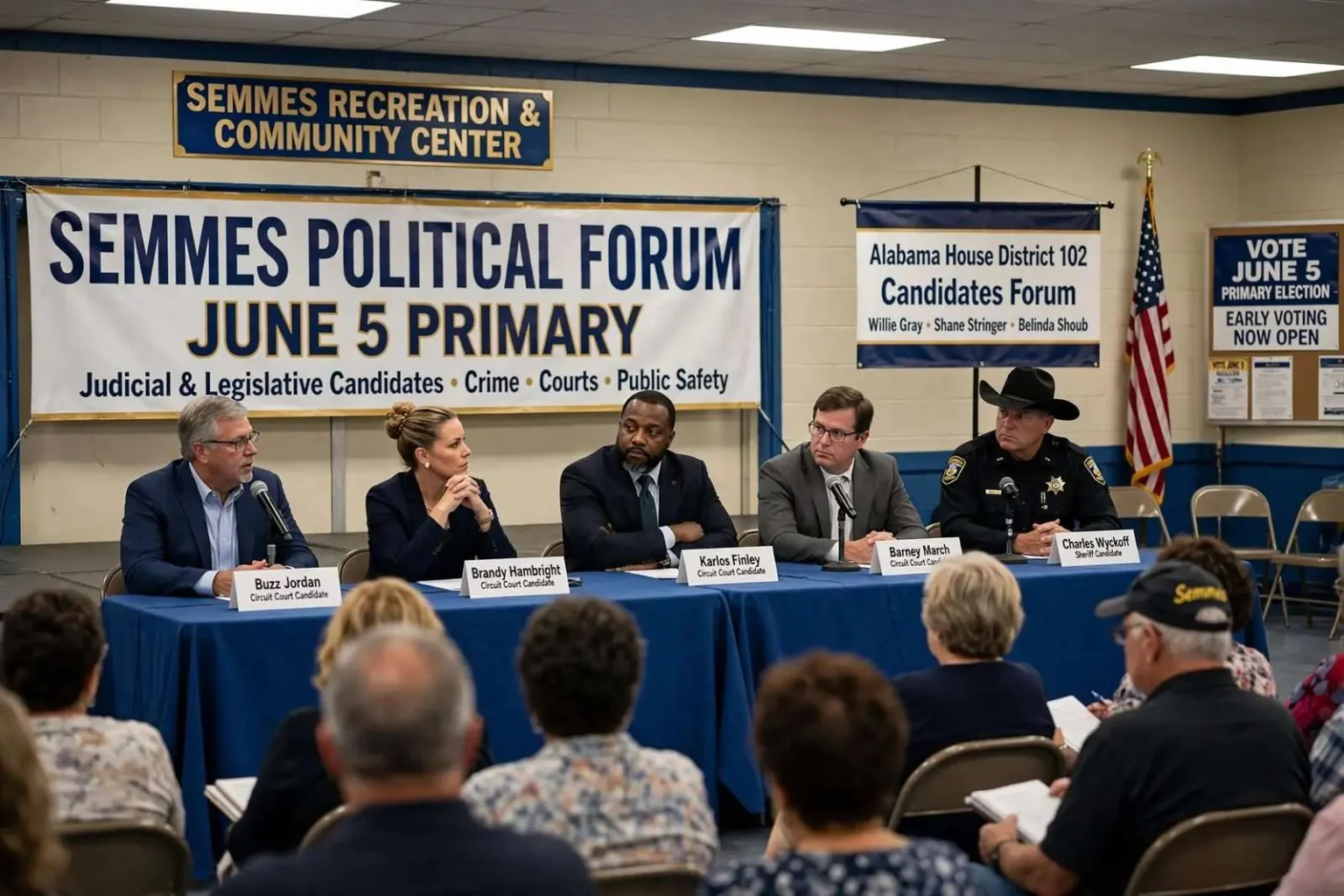
Candidates running for judicial and legislative seats across Mobile County gathered in Semmes on a Tuesday evening for a political forum that put their views on crime, the courts and public safety on full display just weeks before the June 5 primary election.
The forum, held at the Semmes Recreation and Community Center, drew candidates vying for a spot on the Mobile County Circuit Court, the Mobile County District Court and the Alabama House of Representatives, along with the two Republicans competing to be Mobile County’s next sheriff. For voters in Semmes and the surrounding communities of western Mobile County, it was a rare chance to see most of the county’s down-ballot races on one stage in a single night.
Semmes, a city of roughly 6,000 residents in the western corner of the county near the Mississippi line, has grown rapidly in recent decades from a rural nursery town into one of the Mobile area’s faster-developing suburbs, and its civic center has become a regular gathering point for candidates who want to reach voters outside the city of Mobile itself. The races on display that evening touch residents across the county, from Citronelle in the north to Bayou La Batre in the south.
Circuit Court hopefuls spar over the role of judges
Much of the evening’s discussion centered on the Circuit Court Place 6 race, where candidate Harry Satterwhite described himself as the most conservative option on the ballot. Satterwhite told the crowd he disagreed with the legal reasoning behind two landmark U.S. Supreme Court rulings, Roe v. Wade and Obergefell v. Hodges, calling both examples of the court “legislating from the bench.”
“The Supreme Court legislated that… and it’s wrong,” Satterwhite said. “They should never have done that.”
His opponents in the race, Republicans Buzz Jordan and Brandy Hambright and Democrat Karlos Finley, along with fellow candidate Barney March, took a different tack when asked the same question, each emphasizing that judges are bound to uphold existing law rather than rewrite it from the bench. The divide framed the race in familiar terms for Alabama voters: whether a candidate sees the bench as a place to apply the law as written or as a platform for pushing back against rulings from Washington.
Jordan, a Mobile attorney, also defended the traditional 12-person jury system. “It’s a great way to decide if someone is guilty or not guilty,” he told the audience. Alabama’s circuit courts, which handle felony trials, major civil cases and family matters across each county, rely on juries drawn from the county’s registered drivers and voters.
Finley, who serves as a Mobile municipal judge, agreed the jury process is fundamentally fair, adding that any changes to make it more equitable would need to come from the state legislature rather than the courts. Satterwhite argued the process of selecting jurors from driver’s license records could be improved — a long-standing debate in Alabama, where critics say license-based jury pools can underrepresent residents who do not drive.
Candidates split on prison overcrowding
The candidates offered some of their most varied answers when asked how Alabama should address chronic prison overcrowding, a problem that has shadowed the state’s corrections system for decades and repeatedly drawn federal scrutiny.
Hambright said a Circuit Court judge’s obligation is simply to follow the law, while acknowledging that violent crime remains a serious problem in Mobile County. “Following the law is the only thing we can do,” she said.
Jordan argued that the state needs to prioritize who actually goes to prison, pushing back against locking up nonviolent drug offenders. “I don’t want to send addicts to prison,” he said. “Their only crime is being addicted to marijuana or opioids. They don’t need to be taking up prison space.”
March, also a Mobile attorney, said both circumstance and personal choice play a role in criminal behavior. “A lot of people have bad circumstances and we need to foster programs to help them,” he said, “but if someone makes a bad choice they should pay the consequences for it.”
Finley said overcrowding ultimately traces back to the underlying crime problem, calling for a balance between being tough on crime and offering alternatives to incarceration for some offenders. Taken together, the answers sketch the range of thinking that Mobile County voters will see on the June 5 ballot: a courtroom-bound approach, a sentencing-priority approach, and a middle path that pairs accountability with treatment and diversion programs.
Alabama’s prisons have operated far above their designed capacity for years, and the state has faced lawsuits and federal intervention over conditions in its men’s facilities. Debates like the one in Semmes — over who belongs in prison and what alternatives exist — have become a fixture of judicial campaigns across the state, because trial judges are the officials who send most of the people there.
House District 102 candidates talk schools, growth and safety
The forum also featured the three Republicans running for the Alabama House District 102 seat: Willie Gray, Shane Stringer and Belinda Shoub. The district stretches across northwestern Mobile County, taking in communities such as Citronelle, Wilmer, Semmes and the rural corridors along U.S. 45 and Alabama 217, and its legislative races have often been decided in those small towns rather than in the city of Mobile.
Gray, a co-owner and publisher of a Citronelle newspaper, said his priorities in office would be education, infrastructure and economic development. Shoub, who serves on the board of the Penelope House domestic violence shelter, said she would focus on education, infrastructure and growth.
Stringer, who serves as Citronelle’s police chief, said his top priorities would be infrastructure, public safety and, in particular, school safety, saying he wants to get ahead of potential threats “before we have a problem.” Stringer said arming teachers is part of his proposed solution to the threat of school shootings — a position that echoes legislation debated repeatedly in Montgomery since mass shootings elsewhere in the country have pushed school security to the top of state agendas.
The three also addressed the intersection of homelessness and mental illness in their communities, a topic with particular resonance in north Mobile County.
Gray said he sees the two issues as closely linked and pledged to connect people with treatment and, where possible, help them re-enter the workforce.
Shoub pointed to the closure of Searcy Hospital in north Mobile County as a factor that worsened an already difficult local mental health landscape, and suggested stronger oversight of group homes as part of the solution. The state’s closure of its remaining mental health hospitals, including Searcy in Mount Vernon, shifted thousands of patients into community-based care — and, critics say, left many without adequate services.
Law enforcement officials have long raised concerns about the number of people with mental illness who end up in county jails that have limited treatment resources. Stringer said he would push to get those individuals into facilities equipped to actually help them, framing the issue as both a public safety question and a question of where the state spends its money.
District Court and sheriff’s race also represented
Attendees also heard from candidates in the Mobile County District Court Place 4 race, as well as the two Republicans competing for Mobile County Sheriff: incumbent Sam Cochran and challenger Charles Wyckoff, both of whom fielded questions on their respective platforms for the office.
The sheriff’s race is the county’s marquee law enforcement contest, overseeing a department of several hundred deputies responsible for patrol, corrections and court security across Alabama’s second-most-populous county. Cochran has held the office for multiple terms, and challenges to long-incumbent sheriffs have become more common in recent election cycles as debates over jail conditions and staffing have intensified.
District Court judges, meanwhile, handle misdemeanors, small claims, preliminary hearings and traffic cases — the docket most Mobile County residents are actually likely to touch — making the Place 4 seat a practical matter for anyone who has appeared in the county’s lower courts.
The Semmes forum offered voters across Mobile County a chance to hear directly from candidates ahead of the June 5 primary, with races ranging from the courthouse to the Statehouse on the ballot. With early voting momentum building and absentee ballots already in motion, the evening gave each candidate a stage that few down-ballot contests ever get.
For west Mobile County voters, the June 5 primary will effectively settle several of these races. Republican primaries in Alabama have historically decided judicial and countywide offices outright in strongly Republican districts, and Mobile County’s judicial benches have long been dominated by Republicans, so the winners emerging from nights like the Semmes forum are likely to hold office without a November opponent.
That arithmetic makes candidate forums especially consequential down-ballot, where name recognition is thin and a single strong showing at a civic center can move a race. Voters who missed the Semmes event will have other chances before June 5, but the questions posed there — how judges should treat precedent, who belongs in Alabama’s prisons, how the state handles mental illness and homelessness, and how schools should be protected from violence — are the questions that will follow every candidate on the ballot to Election Day.