
Jury Selected as Murder Trial Begins for Man Accused of Killing Daphne Man
A Baldwin County jury has been seated in the murder trial of Joseph Gurley, accused of fatally shooting Daphne resident Matthew Bonnell Jr. and wounding a second man in 2024.
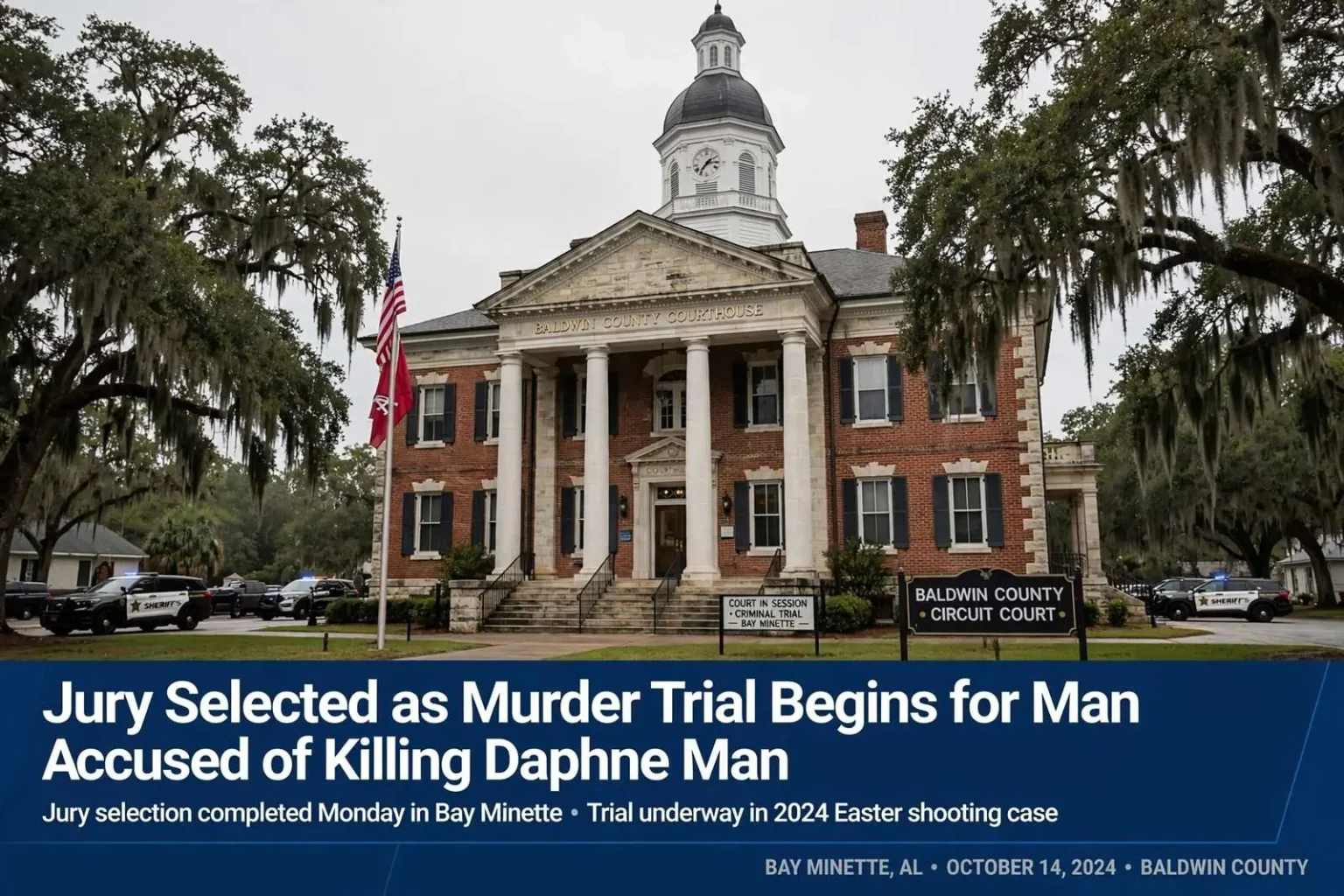
The trial for a man accused of fatally shooting a Daphne man on Easter morning two years ago got underway Monday in Bay Minette, opening with jury selection. Joseph Gurley listened as attorneys from both sides questioned potential jurors and previewed details of the case. It took just over two hours for the panel of 12 jurors to be seated, a relatively quick process that allows the trial to proceed on schedule.
Jury selection, known in Alabama courts as voir dire, gives both sides the chance to question potential jurors about their backgrounds, their knowledge of the case and any connections to the parties involved. In a case that has drawn attention in Baldwin County, screening for pretrial publicity and personal ties is a central concern. The speed with which the panel was seated suggests the pool of candidates was workable for both prosecutors and defense attorneys.
The allegations
Gurley is accused of shooting and killing Matthew Bonnell Jr. and then shooting Michael Roe at Audubon Place Apartments in 2024. Roe survived his injuries. The two men, one killed and one wounded in the same early-morning episode, form the core of the prosecution’s case as it was previewed to jurors.
There is no dispute that Gurley fired the shots; the central question at trial is why. Defense attorneys argue the shootings were an act of self-defense. Prosecutors, meanwhile, laid out a timeline they say shows the shootings stemmed from methamphetamine use and dealings in illegal firearms, framing the episode as the culmination of a chain of events rather than a split-second reaction to an immediate threat.
Under Alabama law, a self-defense claim generally requires showing a reasonable belief that deadly force was necessary to prevent imminent harm, a determination that will fall to the newly seated jury. The state’s self-defense framework has been the subject of extensive litigation, and judges instruct juries on the precise legal standard before deliberations. How jurors weigh that instruction against the facts they hear over the coming days will decide the outcome.
Prosecutors spent Monday afternoon calling witnesses to build their case. The trial, being held in Bay Minette, the seat of Baldwin County, is expected to last three to four days. Early witnesses in homicide prosecutions typically include first responders, investigators and civilians who observed parts of the events, with forensic testimony following later in the state’s presentation.
Baldwin County’s judicial system handles one of the heaviest caseloads along the Gulf Coast, and its circuit court in Bay Minette is the venue for the county’s most serious felony trials. The courthouse sits at the center of the small county seat, a short drive from the Eastern Shore communities of Daphne and Fairhope where the events unfolded. Local judges and prosecutors are accustomed to managing high-profile cases, and court security and scheduling accommodate multi-day trials as a matter of routine.
Self-defense claims in Alabama homicide cases turn on detailed factual disputes: who moved first, what words were exchanged, where each person stood and whether a reasonable person in the defendant’s position would have feared imminent death or serious injury. Investigators reconstruct those moments through witness statements, physical evidence, phone records and, increasingly, video. Both sides will spend much of the trial arguing about those details, and the jury’s verdict will hinge on which account they find credible.
The involvement of illegal firearms and drug use, as alleged by prosecutors, adds layers to the case. Evidence about firearms transactions and substance use typically comes in through testimony from investigators and witnesses familiar with the events leading up to the shooting, and defense attorneys can be expected to challenge both the relevance and the reliability of that material. How much of it jurors ultimately hear depends on rulings from the bench as the evidence is offered.
For the families involved, the trial marks the first public accounting of the events of that Easter morning. Homicide prosecutions often take years to reach trial, a timeline shaped by investigations, forensics, motion practice and crowded court dockets. Families of victims frequently describe the wait as its own ordeal, and the trial week, with its public testimony and difficult details, brings a different kind of strain even as it moves the case toward resolution.
The structure of the week ahead is predictable. The prosecution presents its evidence first and must prove guilt beyond a reasonable doubt. The defense then presents its case, which in a self-defense claim centers on the defendant’s account and any evidence supporting a reasonable fear of harm. Closing arguments follow, then the judge instructs the jury on the law, and deliberations begin. Verdicts in comparable Baldwin County trials have come after days of testimony, though juries are not bound by any timetable.
A conviction for murder in Alabama carries a range of sentences set by statute, and juries recommend sentences in many felony cases, with judges making the final determination. An acquittal, by contrast, ends the prosecution outright. If the jury deadlocks, the court may declare a mistrial and the case can be retried. Those possible outcomes frame the stakes for everyone involved as testimony begins.
Daphne, a fast-growing city along the Eastern Shore of Mobile Bay, has generally ranked among the safer communities in the region, and episodes of lethal violence there draw attention out of proportion to their frequency. Audubon Place Apartments, the site of the shootings, sits within the city’s residential fabric, and the case has been followed closely by local readers since the initial reports two years ago.
As testimony continues through the week, this story will be updated as the trial proceeds. What the jury hears over the next several days, from first responders to the final witnesses, will determine whether Joseph Gurley walks out of the Baldwin County courthouse a free man or faces a sentence that could define the rest of his life.
Observers unfamiliar with criminal trials often misunderstand what “burden of proof” means in practice. The state does not have to prove every detail of its narrative, only the elements of the charged offense beyond a reasonable doubt. The defense, meanwhile, does not have to prove innocence; in a self-defense case the defense typically must produce some evidence supporting the claim, after which the state must persuade the jury beyond a reasonable doubt that the use of deadly force was not justified. That structure shapes every witness examination this week, and experienced attorneys on both sides will build their questions around it.
Eyewitness testimony will carry particular weight, as it does in most shooting cases. Research on memory has made courts more cautious about the reliability of identification and recall, especially under stress, and defense attorneys routinely probe the conditions under which witnesses observed an event: lighting, distance, duration and the passage of time before they spoke with police. Physical evidence, from shell casings to gunshot residue to wound trajectories, is often used to corroborate or challenge those accounts.
The role of the judge in a trial like this is quieter but consequential. Rulings on what evidence comes in, how witnesses may be questioned and what the jury is ultimately instructed on the law can determine the shape of the case long before deliberations. In self-defense prosecutions, the instructions on the use of deadly force, the duty to retreat where applicable and the standard of reasonableness are among the most closely read sections of any Alabama charge to the jury.
Media coverage of the trial will be limited to what happens in open court, and jurors are typically instructed not to follow news reports or discuss the case outside the jury room. That instruction is harder to enforce in an era of constant connectivity, but courts take it seriously, and any violation can upend a trial. For readers following along, the distinction between testimony and argument is worth keeping in mind: what attorneys assert in opening statements is not evidence, and only what comes in through witnesses under oath counts when the jury deliberates.
The community’s interest in the case is straightforward. A man died on a holiday morning, another was wounded, and the question of accountability has been pending for two years. This week, for the first time, the evidence will be laid out in public, under oath and subject to cross-examination, which is what the trial process is designed to provide.
Baldwin County juries have a reputation among Alabama trial lawyers for careful, prosecution-friendly verdicts in violent felony cases, though every panel is different and self-defense claims have succeeded there before. The 12 residents seated Monday will hear the case without alternates after the quick selection process, and they will be sequestered only for deliberations if the court deems it necessary. Their identities are generally not publicized, a standard practice meant to shield them from pressure while the trial is underway.
Whatever the verdict, the proceeding in Bay Minette this week is the machinery of the justice system working through its most serious business, one witness at a time, in a courtroom not far from where it all happened two Easter mornings ago.


