Kayaker Completes 7,000-Mile Journey from Canada to the Gulf Coast, Honoring Late Wife
After 144 days and 7,000 miles, kayaker Mark Ervin has reached the Gulf Coast, raising money for Doctors Without Borders in honor of his late wife, Kirsten.
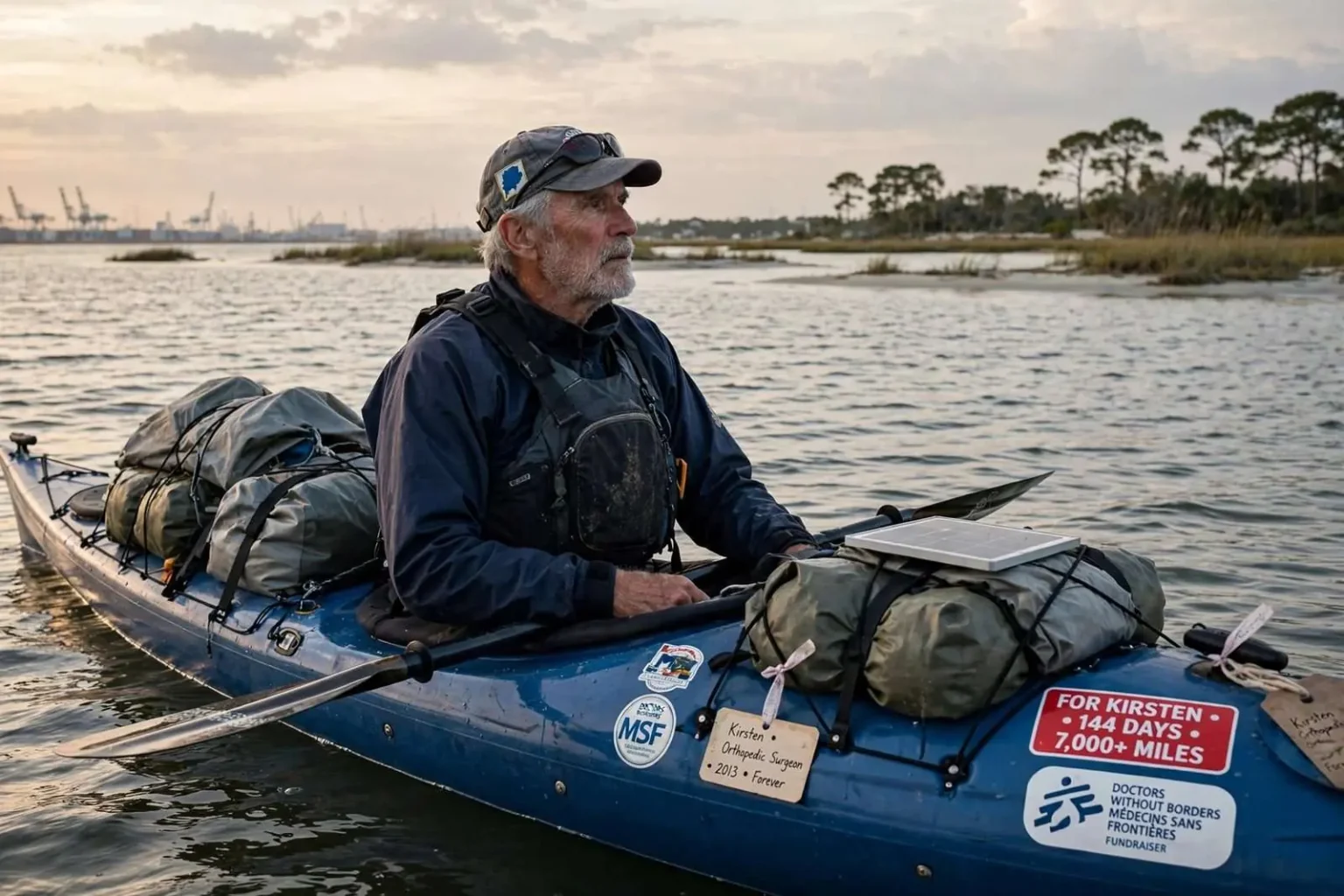
PERDIDO KEY, Fla. — After 144 days and more than 7,000 miles of paddling, a longtime kayaker has reached the Gulf Coast, a journey he undertook to honor his late wife and raise money for a global medical charity. Mark Ervin, 65, set out from Nova Scotia and worked his way south, paddling rivers and bays and sleeping in a tent wherever he could find shelter. The final legs of the route carried him through some of the most demanding paddling of the entire trip, as inland waterways gave way to the open bays and barrier islands of the northern Gulf Coast.
This week he is making his way from Mobile Bay toward the Florida Panhandle before turning north to head home. The approach through Mobile Bay is one of the more scenic stretches of any route along the northern Gulf, with the bay’s wide waters, the working port of Mobile to the north and the barrier islands to the south. Perdido Key, where his progress has been tracked this week, sits at the western end of the Panhandle chain of barrier islands, just across the state line from Alabama’s Orange Beach.
The trip is a fundraiser for Doctors Without Borders, the organization that provides emergency medical care around the world. The choice of beneficiary ties the journey directly to the memory of the person it honors. Ervin said the mission took on deeper meaning after the death of his wife, Kirsten, an orthopedic surgeon who died of brain cancer in 2013. “Some of her focus and energy I’ve taken on this trip and I thank her for her dedication,” Ervin said.
A route measured in seasons, not weeks
The scale of the journey is difficult to overstate. Setting out from Nova Scotia, a paddler must work down the New England coast or through the region’s connected waterways, then thread southward along the Eastern Seaboard before reaching the Gulf, covering thousands of miles of coastline, rivers and inland passages along the way. Covering that distance under human power requires paddling day after day through spring, summer and into fall, in conditions that range from glassy morning bays to winds and chop that can trap a kayaker on shore for days at a time.
The logistics are as demanding as the mileage. Sleeping in a tent wherever he could find shelter meant paddling each day until a usable campsite appeared, then repeating the routine the next morning — loading the boat, checking weather, plotting the day’s stretch of water. A journey measured in seasons rather than weeks demands a different kind of patience than an expedition with a fixed endpoint, and the route’s improvisational character, following rivers and bays rather than a single fixed channel, is part of what has kept it moving for nearly five months.
Along the way, the country a paddler sees from the water is different from the country anyone sees from the road. Marshes, river mouths, industrial waterfronts, small fishing towns and long empty stretches of shoreline pass at hull speed, and the people who live along those waters are the ones a traveling kayaker actually meets — the marina workers, the waterfront property owners who offer a lawn for a tent, the fellow paddlers who recognize the journey for what it is.
The people along the way
Ervin said the people he has met along the Gulf Coast are part of what has made the journey memorable. That observation will surprise no one who has traveled the northern Gulf by small boat. The stretch of coast from Mobile Bay through the Panhandle is dotted with communities that have deep relationships with the water, from the working fleet at Bayou La Batre to the fishing piers and boat ramps of Perdido Key, and the culture of helping travelers on the water is old and durable in this part of the country.
Small-boat travelers depend on that culture. Unlike a driver, a kayaker cannot simply push on past dark; the day ends where shelter is, and shelter on the water is often someone’s dock, backyard or beach access. Journeys like this one are stitched together from hundreds of small acts of hospitality, and the paddler carries those encounters as faithfully as the mileage log.
The woman the journey honors
The emotional center of the trip is the one Ervin describes in his own words. Kirsten Ervin was an orthopedic surgeon, a profession built on the same qualities her husband’s journey demands in different forms: endurance, precision, and the willingness to keep working when the work is hard. Her death from brain cancer in 2013 left a absence that a journey of this length gives a person a great deal of time to sit with. “Some of her focus and energy I’ve taken on this trip and I thank her for her dedication,” Ervin said — a tribute that frames the paddling not as escape but as continuation.
The connection between a surgeon’s life and a fundraising drive for Doctors Without Borders is a natural one. The organization sends medical professionals into crisis zones — conflict areas, epidemics, disaster zones — where emergency care is scarce, and it depends heavily on private donations to sustain that work. A fundraising journey attached to a surgeon’s memory links the paddler’s miles directly to the organization’s field work, and gives supporters a concrete way to participate: the miles are already being paddled; the giving turns them into medical care.
There is also the more private dimension. A trip of 144 days and counting is a long time alone with a memory, and the daily rhythm of the journey — pack, paddle, find shelter, sleep, repeat — gives each day a structure in which that memory has a place. Ervin’s framing of the trip as honoring his wife makes the fundraising and the remembrance a single project rather than two, which is how the best memorial journeys tend to work.
The final approach: Mobile Bay to the Panhandle
The last stretch of a southbound journey to the Gulf carries its own challenges. Mobile Bay is a wide, shallow body of water where wind and tide matter more than distance, and the bay’s open reaches can build serious chop when the wind opposes the tide. Paddlers working the bay typically plan their crossings around weather windows, hugging the eastern or western shorelines and timing their moves between the Mobile ship channel’s heavy commercial traffic and the bay’s exposed middle.
South of the bay, the route follows the barrier islands that separate the Gulf from the quieter waters of the back bays — a chain that runs from Dauphin Island through Orange Beach and Perdido Key toward Pensacola. Paddling that line means trading between the Gulf side, with its surf and open water, and the bay side, with its marshes, channels and boat traffic. It is some of the most beautiful water on the Gulf Coast, and some of the most carefully negotiated.
For a paddler finishing the southern leg of a continent-spanning route, the Panhandle towns along that chain offer the last ports of call before the turning point. Ervin’s plan — working from Mobile Bay toward the Florida Panhandle before turning north — means the journey’s midpoint has arrived. The southern half is complete; the northern half, the trek back home, remains.
The return north
He expects the trek back home to take another four to five months. The arithmetic of the return says everything about the scale of the undertaking: if the southbound leg covered more than 7,000 miles in 144 days, the northbound journey — whatever its exact routing — will stretch the total trip well past the better part of a year under paddle power. The return will bring its own conditions, with fall turning to winter as the miles accumulate, and the physical toll of a journey already this long carried into a second half that is not simply a retracing of the first.
Long-distance paddlers describe the second half of a round trip as a different journey psychologically. The outbound leg runs on momentum and novelty; the return runs on purpose. For Ervin, the purpose is the clearest possible one — the memory of his wife, the cause he is raising money for, and the commitment to finish what he started — and it is the kind of purpose that has historically carried memorial expeditions through the stretches where legs and weather argue for stopping.
Why journeys like this still matter
In an era when the distance between Nova Scotia and the Gulf Coast can be crossed in a few hours of flying, a journey of 144 days under paddle power stands out precisely because of its impracticality. Long-distance human-powered expeditions endure as a form because they compress a large idea into something a community can watch pass by: a cause made visible, mile by mile, in a way that a checkbook never is. The paddler cannot hurry, cannot skip the hard water, and cannot hide from the weather — and that stubbornness is the message.
The fundraiser structure gives that stubbornness somewhere to go. Supporters who follow a journey like this one are invited to convert the miles into dollars for Doctors Without Borders, whose teams deliver emergency medical care in some of the hardest places on earth. The pairing is apt: a journey that refuses shortcuts, raising money for medical workers who run toward crises that everyone else is fleeing.
Long-distance paddlers describe the second half of a round trip as a different journey psychologically. The outbound leg runs on momentum and novelty; the return runs on purpose. For Ervin, the purpose is the clearest possible one — the memory of his wife, the cause he is raising money for, and the commitment to finish what he started — and it is the kind of purpose that has historically carried memorial expeditions through the stretches where legs and weather argue for stopping.
For now, the journey passes through the Gulf Coast’s front yard. As Ervin works from Mobile Bay toward the Panhandle this week, residents along the route have the rare chance to watch the kind of journey that is usually only read about afterward — a 65-year-old paddler, more than 7,000 miles from where he started and more than 7,000 from where he is going, making his way down a barrier island chain on a trip that carries a hospital’s worth of meaning in a single kayak.
For the Gulf Coast, the passage this week is a small piece of the region’s long tradition of playing host to travelers on the water. Mobile Bay and the Panhandle barrier islands have absorbed shipwrecked sailors, returning fishermen, migrating boaters and every kind of small-craft voyager for centuries, and the communities along that chain still know how to welcome one more. Ervin’s stop here will be brief — the northward leg is waiting — but the coast becomes another entry in a journey log that already spans half a continent, and the people he met here become part of the story he will tell when it ends.