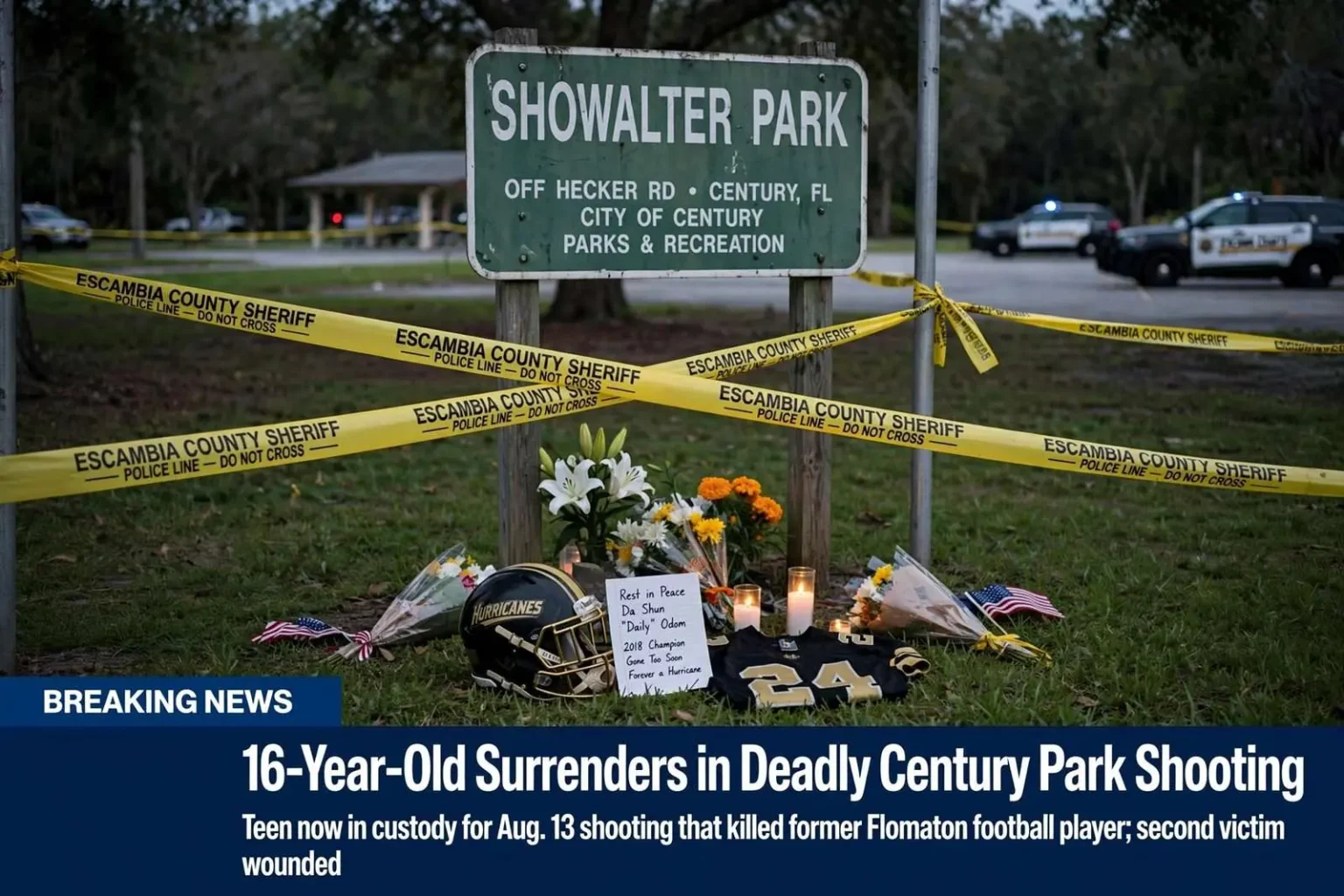
CENTURY, Fla. — A 16-year-old wanted on a first-degree murder charge in the Aug. 13 shooting at Showalter Park surrendered to the Escambia County Sheriff’s Office on Friday night and is now in custody.
Keyunta Ewing, known locally as “Baby K,” had been the subject of an active arrest warrant announced earlier Friday by Sheriff Chip Simmons. Investigators identified him as the person who fired the fatal shots. Additional details surrounding the surrender were not immediately available.
The surrender closed the search for the park shooting’s suspected gunman two days after the attack, though it opened the longer process that follows: first-degree murder proceedings against a juvenile in a case that had already rattled this small Escambia County city on the Alabama line.
What happened at Showalter Park
The shooting occurred about 6:30 p.m. on Thursday, Aug. 13, at Showalter Park off Hecker Road. The Escambia County Sheriff’s Office received a shots-fired call and arrived to find an adult male with gunshot wounds in a parking area between a ball field and a children’s playground. He was pronounced dead at the scene.
A second adult male victim later arrived at Jay Hospital with a through-and-through gunshot wound to the leg that was not believed to be life-threatening, according to Sgt. Melony Peterson.
Family members identified the man killed as Adarius Da’Shun Odom, known locally as “Daily.” Da’Quan “Money” Johnson was the victim shot in the leg. Both were members of the 2018 state championship Flomaton High School Hurricanes football team and are now in their twenties.
The connection to Flomaton, the small Alabama town just across the state line, gave the case its unusual two-state footprint. Odom and Johnson had grown up a few miles north of Century, teammates on a Hurricane squad that won a state championship, and both still had family throughout the area where they were shot.
A fight that turned deadly
Simmons said seven to eight people, some from Alabama and some from Florida, had gathered at the park to fight over a girl. He described a scene in which two people fought while others stood watching. Someone then left the crowd, returned with a gun and fired several rounds into the group.
“Seven or eight people had gathered around for a fist fight, and after that fight someone left from the crowd and they pulled a gun and just fired several times into our victim, ultimately killing him and injuring another,” Simmons said.
The sheriff’s account laid out the case’s central horror: a scheduled fistfight, spectators on both sides, and a decision by one person in the crowd to turn a brawl into a shooting. Investigators worked through the following day to identify who had left the crowd and come back armed, and by Friday morning they had secured the warrant naming Ewing.
Deputies canvassed the neighborhood around the park through the evening, collecting shell casings from the parking area and interviewing witnesses who had scattered when the shots rang out. The park sits in a residential section of Century, and the sound of gunfire carried through streets where families were still outside in the summer dark.
Youth practices were underway nearby
No organized activities were taking place at Showalter Park at the time. But youth football and cheerleading practices were underway a short distance away at neighboring Anthony Pleasant Park, where many people reported hearing multiple gunshots.
Practices were halted and families left out of an abundance of caution, according to Century Blackcats Youth Football and Cheerleading.
A small wooded area separates the two parks, which are connected by a trail and footbridge.
The near-miss became the detail parents across the area kept returning to. Dozens of children — youngsters in pads and helmets, cheerleaders mid-drill — had been within earshot of a fatal shooting, separated from it by a strip of woods and a footbridge. Youth football volunteers spent the following days fielding questions from families about security and practice schedules, and the organization’s announcement that practices had been halted out of caution underscored how close the danger had come.
“It’s certainly tragic that an individual would be killed, and it’s certainly concerning the individual that is involved felt the need to take this type of action and not have any concern about the safety of the other individual that was shot in the leg or anyone that might be nearby,” Simmons said. “We as a community should say that’s unacceptable.”
A second shooting the same night
A second shots-fired incident occurred around 8 p.m. on Mayo Street, a few blocks from the park. Numerous bullet holes were found in a home.
“We believe that the individual that did the shooting has a connection to that house and we feel like it was retaliatory,” Simmons said at the time. “We believe that people know who did it. People know who the shooter is, who the killer is, and we want them to tell us instead of taking matters into their own hands.”
The Mayo Street attack, roughly 90 minutes after the park shooting, turned a homicide investigation into a two-scene case and deepened the sheriff’s worry about a cycle of retaliation. Bullet-scarred siding on a residential street a few blocks from where a man lay dead gave the night its arc — and gave investigators a second set of scenes, casings and witness accounts to reconcile.
Simmons’s public appeal for witnesses was direct: people in both communities knew who fired the shots, and the sheriff’s office needed them to come forward rather than settle scores themselves. The warning about retaliation reflected a recurring problem in small-town gun violence, where bonds of family and team pull the affected communities toward private answers.
Funeral services and a community’s grief
Funeral services for Odom were held at the Flomaton High School Auditorium, following a visitation. The family requested that flowers be sent to Jackson-McMurray Funeral Services at 130 West Hecker Road in Century.
Choosing the school auditorium — the gym-adjacent hall where Odom had been honored as a state champion — said everything about how Flomaton remembered him. Small-town funerals for young men killed by gunfire draw whole communities, and in a town the size of Flomaton, a former state champion’s service filled the largest room the school had. Teammates from the 2018 championship roster attended, as did families from Century across the line who had watched the same boys grow up on both sides of the state border.
The visitation and service also served as the communities’ first collective answer to the sheriff’s question. Grief, shared publicly in the auditorium where Odom’s team had been celebrated, was presented as the alternative to retaliation — a way for the two towns to mark the loss without adding to it.
An open investigation across two states
The investigation remains open. Anyone with information is asked to call the Escambia County Sheriff’s Office or Crime Stoppers at (850) 433-STOP.
The border-town geography of the case made the cooperation between Florida investigators and the Alabama communities essential. Century sits directly on the state line, and Flomaton is minutes north on U.S. 29; the people involved in the park shooting moved between the two states as routinely as they crossed streets. Witnesses with knowledge of the fight, the gun and the Mayo Street shooting were scattered across both jurisdictions.
Crime Stoppers tips, which allow informants to remain anonymous and qualify for rewards, have long been the mechanism investigators lean on in cases where witnesses fear coming forward openly. The sheriff’s office said it would continue working the case even with the suspected gunman in custody, building the file that first-degree murder prosecution will require.
For Century and Flomaton, the surrender of the 16-year-old suspect ended the manhunt but not the reckoning. Two parks that share a footbridge, two towns that share a state line and one championship football team’s lost brother now share the story of an August evening when a fistfight became a funeral — and a community was asked, by its sheriff, to say out loud that it was unacceptable.
The manhunt between the shots and the surrender
The 48 hours between the shooting and the surrender were consumed by the search. Sheriff’s deputies identified Ewing as the suspected shooter through witness interviews at the scene, and by Friday morning Simmons stood before cameras to announce the warrant — using the announcement itself to press the community for help and to warn against retaliation in the same breath.
The warrant made the 16-year-old one of the youngest suspects ever sought on a first-degree murder charge in the county, and the search for him stretched across the state line into the Alabama communities where he was known. Deputies followed leads through Century’s neighborhoods and across the border, while the sheriff’s office fielded tips from residents responding to the Friday-morning appeal.
That he surrendered Friday night — with the warrant public for less than a day — suggested the pressure of the announcement had done its work. Family members and community figures, the kind of intermediaries sheriff’s offices rely on in small-town cases, were believed to have played a role in bringing the teenager in without incident. The sheriff’s office released no details on the surrender itself, saying only that the suspect was in custody.
A first-degree case against a juvenile
The first-degree murder charge means prosecutors will treat the shooting as a deliberate killing, not a spur-of-the-moment act, and the distinction matters in what the state must prove: that the shooter intended the fatal outcome when he fired into the crowd. Florida law allows prosecutors to seek the harshest outcomes in cases involving guns fired into groups, and the age of the suspect will shape how the courts handle each step.
For the sheriff, the charge was also a message. A scheduled fistfight that ended with someone fetching a gun and firing into a group of spectators, steps from children at practice, was the kind of escalation his office intended to punish to the fullest extent the law allows.
The second victim, wounded through the leg, will figure in the case as well. A through-and-through wound that missed vital structures spared Johnson’s life, and his account of the fight, the crowd and the moments when the shooter returned will be central to the prosecution’s picture of what happened in that parking area.
Investigators continued to ask anyone with knowledge of the gathering — who organized it, who attended, who brought the gun — to come forward, since the account of the fight itself will matter as much as the account of the shooting. The distinction between the two has defined the case from the sheriff’s first public description: a fight that was expected, and a killing that was not.
The communities on both sides of the line now wait for the courts to take the case forward, with the manhunt over and the questions — about the girl at the center of the fight, the gun that turned it lethal and the retaliation that followed — left to the process that a first-degree murder charge begins.