University of South Alabama Mobile
Kim Pettway Appointed to Mobile Water and Sewer Board
Kim Pettway, a University of South Alabama instructor active in Democratic campaigns, was appointed to the City of Mobile's Board of Water and Sewer Commissioners, filling the seat left by the late Rev. Wesley James.
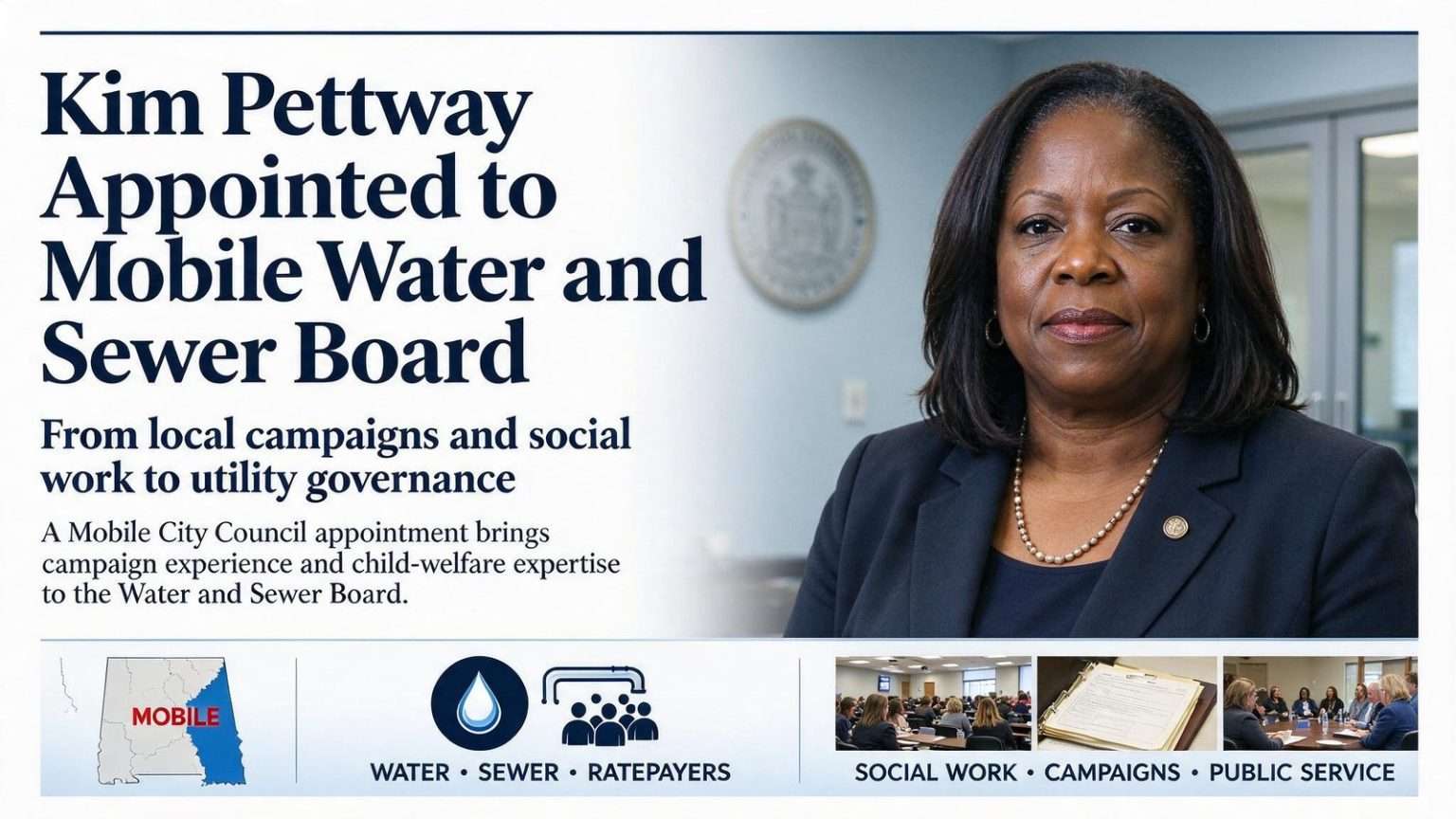
Kim Pettway, who had been active locally in Democratic political campaigns, was appointed to the Board of Water and Sewer Commissioners of the City of Mobile, stepping into a seat left vacant by the death of a longtime community figure. The appointment moved Pettway from behind-the-scenes campaign work into formal public service on the board that governs one of Mobile’s most essential utilities.
Pettway filled the vacancy created by the recent passing of the Rev. Wesley James, whose death left a number of voids in the community. James had been a fixture in Mobile civic and religious life, and filling his unexpired term meant stepping into a role shaped by years of his institutional knowledge. She was nominated by District 3 City Councilman Jermaine Burrell and appointed by a vote of the Mobile City Council.
Pettway would serve the remainder of James’s unexpired term, which was set to end Feb. 2, 2014. That timeline gave her several years on the board — long enough to influence policy and rate decisions, but with the seat eventually returning to the appointment process, where the council of the day would decide who held it next.
A Background in Local Campaigns
Pettway came to the appointment with a notable record in local politics. She had served as campaign manager for Burrell in his hard-fought 2009 victory over veteran City Councilman Clinton Johnson, a race that unseated one of the longest-serving members of the council and reshaped the District 3 seat that Burrell still held when he made the nomination.
She also played prominent roles locally in the Obama campaign and in Herman Thomas’s unsuccessful bid to unseat state Sen. Vivian Figures. Those campaigns placed Pettway in the middle of the Democratic organizing network that spanned city and county races, from municipal council contests to legislative and presidential campaigns, and built the relationships that made her a natural choice when Burrell needed a nominee for the water board. Working both a presidential operation and a hard-fought local legislative race in the same stretch gave her experience with campaigns of very different scale — one driven by national field structure, the other by door-knocking and personal networks in a single Mobile district.
During the 2008 presidential election, she chaired the Mobile chapter of Generation Obama, an effort that targeted young adults and professionals between the ages of 25 and 40. The group was part of a national push to organize younger voters into the campaign’s field operation, and its Mobile chapter gave local professionals their first structured entry point into presidential politics in a generation. Chairing the chapter meant building an organization from scratch — recruiting volunteers, hosting events, and turning enthusiasm into the voter contact that campaigns ultimately depend on.
That campaign experience placed her within the network of Democratic organizers who had become active in Mobile politics in recent cycles, and her nomination by Burrell reflected the working relationship the two had built during his council run. Campaign managers see every side of a candidate’s operation, from fundraising and scheduling to the block-by-block work of turnout, and the trust built in that environment tends to carry into governing relationships afterward.
A Professional in Social Work
Beyond her political activity, Pettway brought a professional background rooted in social services and higher education. She was employed at the University of South Alabama as a social work instructor, training the next generation of practitioners in a field the Gulf Coast leans on heavily, particularly in the years since Hurricane Katrina exposed how much demand falls on social service agencies after a disaster.
She held a bachelor’s degree in psychology from the University of Montevallo, along with a master’s in criminal justice and a Master of Social Work from the University of Alabama. The combination of degrees — psychology, criminal justice, and clinical social work — spanned the behavioral, legal, and human-services sides of public welfare, an unusually broad academic base for a local board appointee.
Before joining the university, she had worked for 10 years with the Mobile County Department of Human Resources in its Child Welfare Division. Front-line child welfare work in a county the size of Mobile means caseloads involving the county’s most vulnerable families, and ten years in that division gave Pettway direct experience with the agencies, courts, and community organizations that support children across the area.
That combination of academic training and front-line experience in child welfare gave her a public-service résumé that extended well beyond the campaign trail. It also distinguished her from the business and engineering backgrounds that have traditionally dominated utility boards, bringing a social-services perspective to a body whose decisions reach every household in the city.
What the Board Actually Governs
The Board of Water and Sewer Commissioners oversees one of the city’s most essential utilities, and appointments to it carry practical weight for ratepayers and for the management of Mobile’s water and sewer systems. The utility’s reach extends beyond the city limits through service agreements with surrounding communities, making the board’s decisions a concern for much of Mobile County rather than the city alone.
Water and sewer governance involves some of the most expensive infrastructure a city maintains. Treatment plants, pumping stations, and hundreds of miles of pipe age continuously, and the board is responsible for balancing the rates customers pay against the capital spending required to keep the system reliable and compliant with environmental regulations. When sewer-system upgrades are mandated by federal clean-water requirements, as they have been in cities across Alabama, it is the board that must chart the financing.
Board service also demands an understanding of how utility decisions ripple through the community. Rates fall hardest on fixed-income households, service extensions shape where development can happen, and the system’s long-term health affects everything from fire protection to the water quality of Mobile Bay. A commissioner with Pettway’s social work background sees those ripple effects from the customer’s side of the equation.
Her years inside the Mobile County DHR child welfare system also gave her working knowledge of how government agencies actually function — budgets, caseloads, compliance audits, and the gap between policy on paper and practice in the field. Former social workers and public administrators frequently serve on municipal boards precisely because that operational literacy transfers, and it is the kind of experience that rarely appears in campaign biographies but shows up in how a commissioner reads a budget line or questions a contract.
Pettway’s selection also underscored the role the City Council plays in shaping the boards and commissions that govern local infrastructure. Mobile’s council appoints members to a range of bodies that operate at arm’s length from the council itself, and those appointments — rarely the subject of campaign debates — often determine more about daily life in the city than the ordinances the council passes directly.
From Campaigns to a Board Seat
With Burrell’s nomination and the council’s vote, she moved from behind-the-scenes campaign work into a formal public position, taking on responsibility for a utility that touches every household and business in the city. The transition is a common one in Mobile politics, where council allies are frequently elevated to the boards that run the city’s independent authorities, but it requires a different kind of work — quieter, more technical, and conducted largely out of public view.
By stepping into the seat once held by the Rev. Wesley James, Pettway assumed a term that would run for several more years, giving her a sustained voice in the governance of Mobile’s water and sewer operations. The late commissioner’s tenure had given the board continuity, and the council’s choice of a younger appointee with a fresh professional background shifted the board’s composition at a moment when utilities across the state were confronting aging infrastructure and rising environmental compliance costs.
The appointment marked a new chapter in a public-service career that had already spanned child welfare, higher education and grassroots political organizing across the city. Few Mobile board appointments of that cycle combined those three strands — direct human services, academic training, and campaign-level political experience — and the water board gave Pettway a venue where all three had practical application, from ratepayer advocacy to the long-term stewardship of a utility the city depends on every day.
For District 3, the appointment also carried symbolic weight. Burrell’s district includes neighborhoods whose residents feel utility rate increases directly, and a commissioner drawn from the community’s own organizing network gave those neighborhoods a familiar advocate on a board whose meetings rarely make headlines.
Whether the term ran to its February 2014 expiration or the appointee served longer, the selection was Burrell’s first significant mark on the city’s infrastructure governance since taking office, and it set a precedent for how the first-term councilman would use his appointment power in the years that followed.