Monroe County Hunting Lodge Sells as Whole Foods Eyes Mobile
A Mobile family paid $2.35 million for a 1,400-acre hunting lodge near Frisco City, while Whole Foods listed Mobile as a future store site and a Foley strip center changed hands.
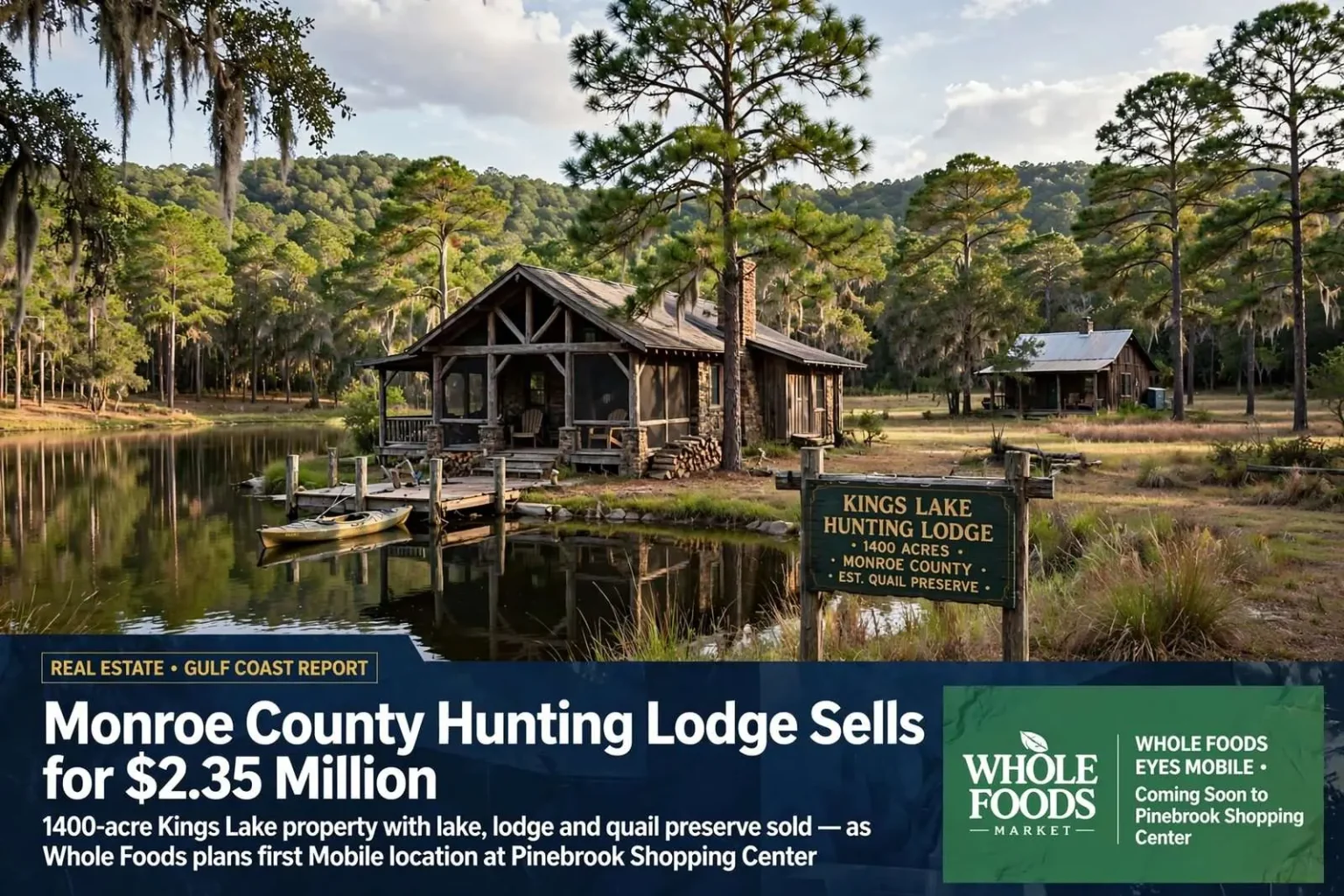
A Mobile family paid $2.35 million for the 1,400-acre Kings Lake Hunting Lodge in Monroe County, just south of Frisco City, according to Calvin Weaver Jr. of Praytor Realty in Mobile, who represented the buyers. The property includes a seven-acre lake, a camp house, a bunk house and a quail preserve. Tommy Gleason of Gleason & Roberds Commercial Real Estate worked for the sellers. The sale is one of the largest recreational-land transactions in the region in recent memory, and it reflects the enduring demand for mature sporting properties within driving distance of Mobile.
Monroe County, sprawling across pine hills and creek bottoms north of the Mobile Bay area, has long been a destination for hunters and land investors from South Alabama. Tracts of this size with developed amenities — a stocked lake, lodging and an established quail program — rarely reach the open market, and brokers said interest typically comes from families seeking a compound for generations of use rather than from developers. The 1,400-acre scale puts the property among the larger private holdings available anywhere in the coastal plain.
Recreational land values across south Alabama have climbed steadily over the past two decades as timberland buyers, conservation buyers and hunting interests compete for finite acreage. A property combining timber income potential with a finished hunting operation commands a premium over raw land, which helps explain a price that works out to roughly $1,700 per acre for a fully improved sporting retreat. Buyers in this segment typically weigh road frontage, water access, timber mix and existing improvements before committing to a seven-figure purchase, and Kings Lake offered all of the above.
Retail and Office Deals
Local investors paid $650,000 for a bank-owned strip center at 2650 S. McKenzie St., across from the Tanger Outlet in Foley. Tenants in the 7,200-square-foot center include Sprint, Republic Finance and a nail salon. David Milstead of Milstead & Associates represented the seller, and Sharon Wright of White-Spunner Realty worked for the buyers. Bank-owned sales of this kind often price below replacement cost, and the center’s position across from one of the busiest retail destinations in Baldwin County made it a natural target for local investors hunting stable income.
The Foley corridor along Highway 98 and McKenzie Street has become one of the Gulf Coast’s retail powerhouses, anchored by the Tanger Outlets and surrounded by restaurants, services and national chains that draw shoppers from across the region. Small strip centers in the shadow of that traffic benefit from the spillover, and leased centers with national tenants in place offer the predictable cash flow investors prize.
In Gulf Shores, a local investor paid $260,000 for the 2,500-square-foot former Smart N Sassy store on Gulf Shores Parkway, according to David Swiger of Swiger & Company Realtors. The investor also bought two adjacent lots for $75,000 and planned to develop a restaurant on the combined half-block site. Gulf Shores Parkway is the city’s commercial spine, running from the Intracoastal bridge toward the beach, and parcels with that exposure have appreciated sharply as the city’s visitor economy expands.
Assembling multiple parcels into a single development site is a common playbook along Gulf Shores Parkway, where older freestanding buildings sit on lots that are more valuable together than apart. A restaurant on a half-block site near the heart of the city would join a dining scene that has grown with the resort economy, and buyers willing to accumulate land gradually often end up controlling corner locations that never come to market in one piece.
Investors paid $220,000 for a 4,300-square-foot office building at 755 Downtowner Loop West in Mobile, according to Angela McArthur of Prudential Cooper & Co.’s commercial division, who represented the sellers, the Quackenbush Family Partnership. Keith Vaughn of KV Properties worked for the buyer. The Downtowner Loop sits in the commercial district near Mobile’s midtown hospitals and offices, an area where smaller office buildings serve professional tenants who want proximity to the city’s medical and business corridors without downtown parking costs.
Separately, CrossCountry Mortgage Inc., an Ohio-based lender, leased 1,000 square feet at 2090 S. Schillinger Road in west Mobile and planned to open in June, McArthur said. West Mobile along the Schillinger Road corridor has been among the city’s fastest-growing residential areas for years, and mortgage lenders, title offices and realty companies have followed the rooftops west. A new branch office positions the lender in the middle of the neighborhoods generating the region’s home purchase activity.
Office leasing activity in Mobile’s suburban corridors has held steadier than in many markets because the city’s professional services economy — law, medicine, banking, insurance and real estate — continues to expand with the port and industrial base. Small-footprint leases like CrossCountry’s are the building blocks of that growth, filling strip centers and small office buildings along the arterials where customers actually travel.
New Leadership for Area Realtors
The Mobile Area Association of Realtors named William Haithcock, chief executive of the Harrisonburg/Rockingham Association of Realtors in Harrisonburg, Virginia, as its new executive director, according to the association’s board. Haithcock was chosen from a field of 34 applicants nationwide to succeed longtime director Jeff Newman, who planned to retire July 31 after 33 years in the post.
The Mobile Area Association of Realtors serves hundreds of members across Mobile and Baldwin counties, providing multiple listing services, professional standards enforcement, ethics training and advocacy on property rights issues before local governments. Its executive director runs the organization’s day-to-day operations, from the MLS database that underpins every transaction in the market to the lobbying presence that keeps the industry’s voice heard at city and county hall.
Recruiting from outside the market is a common move for associations the size of Mobile’s, and Haithcock’s experience leading another association gave the board a candidate familiar with the job’s full scope. Following a 33-year tenure, though, means stepping into an organization shaped by one leader’s long stewardship, and members said the transition would focus on continuity of services while modernizing the association’s tools and communications for a new generation of agents.
At Long Last, Whole Foods
Perhaps the most anticipated news for many Mobile shoppers came from the Whole Foods Market website, which listed Mobile as a future store site. Realtors said the natural and organic grocer, which operated more than 340 stores worldwide, was expected to open in Pinebrook Shopping Center at Airport Boulevard and McGregor Avenue. The listing ended years of speculation about when the Austin, Texas-based chain would enter the Mobile market, a question that had circulated locally since Whole Foods expanded aggressively through the Southeast.
Pinebrook sits at the heart of Mobile’s premier retail corridor, where Airport Boulevard meets McGregor Avenue amid a concentration of upscale shopping and dining that serves west Mobile and Spring Hill. A Whole Foods anchor would place the city alongside markets like Birmingham, Pensacola and New Orleans that had already landed the grocer, and local real estate watchers expected the store to lift traffic for neighboring tenants while validating the corridor’s drawing power.
Natural and organic grocers choose markets using demographic screens — household income, education levels, and existing spending on organic food — and Mobile’s inclusion on the company’s future-sites list suggested the market finally crossed those thresholds. For shoppers, the practical impact is a full-service natural foods supermarket with an extensive prepared foods section, expanded organic produce and specialty items that conventional grocery chains in the city stock only lightly.
A Busy Week Across the Region
From a sprawling Monroe County quail preserve to a long-awaited grocery chain, the week’s transactions reflected the wide range of activity across the region’s real estate market. In a single stretch of days, the market produced a seven-figure land sale in a rural county, bank-owned retail in Foley, beach-town redevelopment in Gulf Shores, suburban office trades in Mobile, a new corporate tenant in west Mobile and a leadership change atop the industry’s local trade association.
That breadth is characteristic of the Gulf Coast market, where tourism-driven Baldwin County and port-driven Mobile County generate parallel but distinct demand. Rural land, suburban office, beach retail and national grocery expansion rarely move in lockstep, and a week that shows strength across all of them signals a market with more than one engine. Brokers involved in the week’s deals said the common thread was confidence — buyers paying for income streams and locations they expect to hold value, and sellers finding the prices they were waiting for. Financing availability, they added, remained the variable to watch as the market moved through the year.
For residents, the practical meaning shows up gradually: a restaurant rising on Gulf Shores Parkway, a lender opening its doors on Schillinger Road, a new director answering the phone at the Realtors association and, eventually, organic produce on Airport Boulevard. Real estate news becomes community change one closing at a time.