
Lay’s Smiles Survey Ranks Alabama Among the Nation’s Most Joyful States
Lay's first Smiles Survey ranks Alabama among the nation's most joyful states, crediting the friendly people, with nominations open.
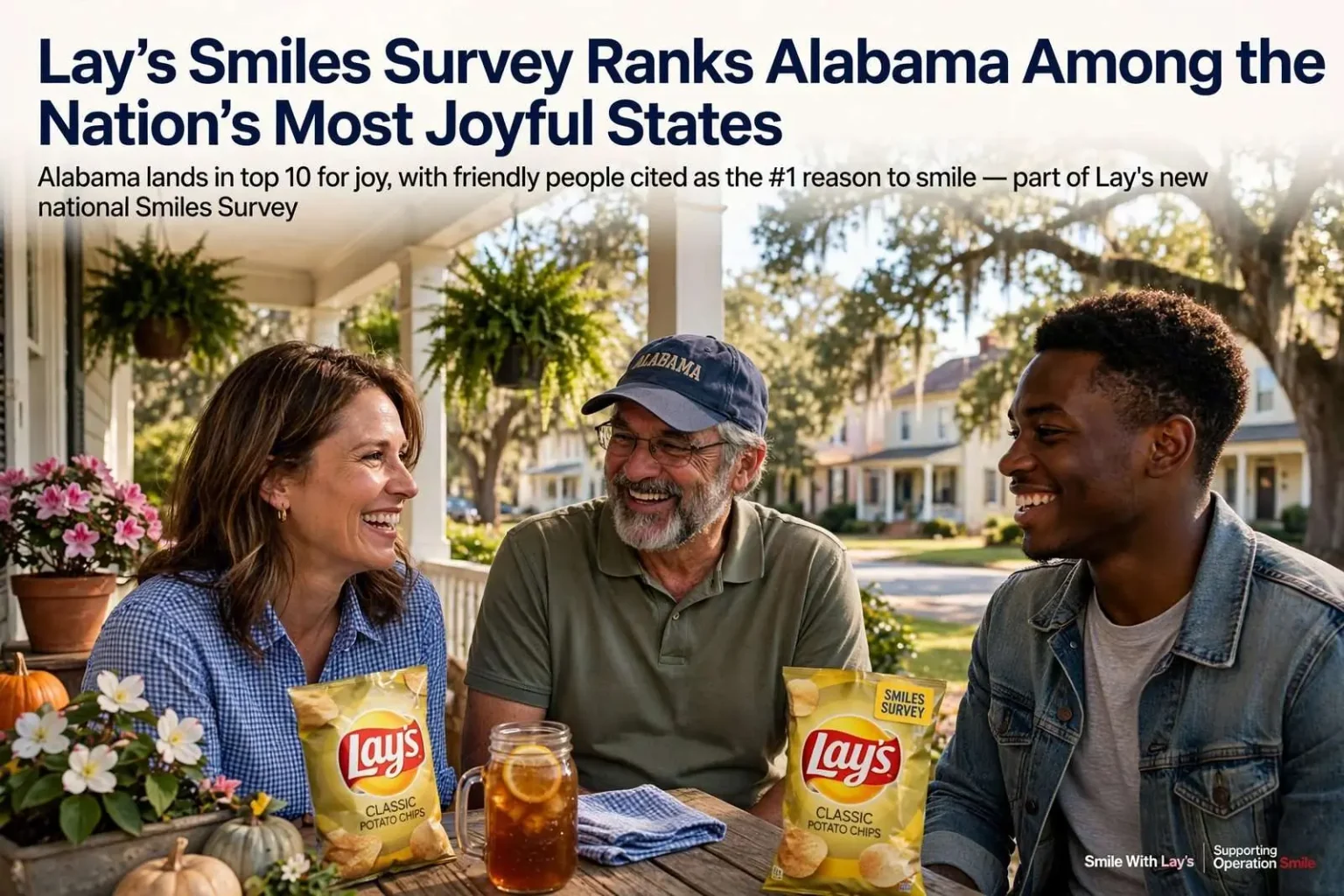
Alabama has landed a spot in the top 10 most joyful states in the country, according to Lay’s first Smiles Survey — and the reason will surprise no one who has spent time in the Heart of Dixie. According to the findings, the number one reason to smile in Alabama is the friendly people.
The ranking gives the state a national spotlight in a campaign that set out to measure something no economic statistic quite captures: where Americans report actually being happy. For a state more often discussed in national media for its football rivalries and industrial recruitment wins, a top-10 finish on a joy index built from everyday smiles offers a different kind of recognition — one that residents tend to attribute to the way neighbors treat each other on porches, in church pews, and in checkout lines.
The survey set out to map the happiest corners of the country. While 66 percent of Americans overall consider themselves happy, New York reported the highest level of joy, followed by Georgia, Mississippi, Florida, Texas, Michigan, Arkansas, Connecticut, Alabama and Indiana.
The list carries a few surprises for casual observers. New York’s finish at the top runs against the state’s reputation for hurried, impersonal big-city living, though the finding is a reminder that the Empire State includes far more than Manhattan — upstate towns, Hudson Valley communities, and Long Island suburbs all contributed to the state’s numbers. Alabama, meanwhile, shares the top 10 with both of its Deep South neighbors: Georgia and Mississippi, with Florida close behind, giving the Southeast a strong bloc in the rankings and suggesting that something regional is at work in how residents answer questions about joy.
What Makes Alabamians Smile
According to the findings, the number one reason to smile in Alabama is the friendly people. That answer will ring true to anyone who has moved to the state from elsewhere and found strangers offering directions before being asked, or church casseroles arriving after a family hardship, or conversations started in line at a high school football game. Southern hospitality is often cited as a slogan, but the survey’s respondents treated it as a daily, lived experience.
The state’s everyday texture supports that reputation. Small towns across the Black Belt, the Tennessee Valley, the Wiregrass, and the Gulf Coast still operate on first-name familiarity, and even Alabama’s largest metros — Birmingham, Huntsville, Mobile, and Montgomery — maintain reputations for approachability that newcomers regularly note. Community institutions that draw neighbors together, from Friday night football to farmer’s markets to worship services, give residents repeated, low-stakes chances to connect with the people around them.
Alabamians also have plenty of the small pleasures that survey respondents elsewhere tied to smiling: springtime azaleas and dogwoods, porch-sitting weather that stretches from March into November, and a food tradition — barbecue, fried catfish, peach cobbler, and Gulf seafood — that residents defend with genuine pride. None of those appear on a balance sheet, but they show up plainly in how people describe their daily lives.
From Survey to Smiling Bags
The brand behind the chips is also turning the campaign toward good deeds: Lay’s is looking for local people to star on millions of its bags as part of the Smile With Lay’s competition. Anyone who knows someone who goes out of their way to make others smile can nominate them, with winners receiving a starring role in the new campaign benefiting Operation Smile, a medical nonprofit that has provided hundreds of thousands of free surgeries for children born with cleft lip, cleft palate or other facial differences.
The competition’s structure is simple by design. Rather than searching for photogenic contest entrants, the brand asks people to look around their own communities for the ones who make joy contagious — the volunteer coach, the cafeteria worker who greets every child by name, the neighbor who checks on elderly residents during heat waves. Nominations become the campaign’s raw material, and the winning stories move from local legend to national packaging, printed on bags that reach millions of households.
The tie to Operation Smile gives the campaign a charitable backbone that goes beyond marketing. The nonprofit works internationally and in the United States to provide free surgeries that repair cleft lips and palates, conditions that affect a child’s ability to eat, speak, and, in many places, attend school without stigma. Because the surgeries are relatively short but transformative, donated dollars convert directly into changed lives — one of the reasons brands partner with the organization for large-scale cause campaigns. A campaign built on smiles, fundraising for surgeries that literally restore them, is the kind of alignment that consumer brands and nonprofits both prize.
Nominations can be submitted online, giving Alabamians a chance to put the state’s reputation for friendliness on a bag of chips while supporting a cause that provides surgeries where they are needed most. For the state’s many recognized hometown helpers — and for the friends, families, and coworkers who know them — the entry process is a low-effort opportunity to shine a national light on everyday Alabama kindness.
How the Ranking Fits the Region
Placing Alabama, Georgia, Mississippi, and Florida together in the top 10 makes the Southeast one of the best-represented regions in the survey, and the pattern lines up with other happiness research that has repeatedly found strong community ties among the biggest drivers of self-reported well-being. Social connection — the frequency and warmth of everyday interactions — consistently outranks income in the research literature on life satisfaction, and that is precisely the dimension where Southern communities tend to score well.
The survey also arrives as Alabama works to reshape its national image in economic terms, with automotive and aerospace plants, shipbuilding on the Gulf Coast, and a growing technology sector in Huntsville drawing newcomers from other states. Those arrivals often become the state’s quickest converts to its friendliness reputation, and their word-of-mouth recommendations have become part of the state’s recruiting pitch for both employers and workers.
For residents, the ranking’s practical takeaway is modest but pleasant: the thing outsiders most want to know about a place is whether people are happy there, and Alabama can now answer with a nationally recognized brand’s data point, backed by the state’s own experience. The Smiles Survey will not change infrastructure budgets or school rankings, but it documents something Alabamians have long insisted on — that the state’s most valuable export, after steel and soybeans and spacecraft, might be its welcome.
A Closer Look at the Numbers
The survey’s finding that 66 percent of Americans overall consider themselves happy sets the baseline against which every state result should be read. With two-thirds of the country describing itself as happy, a top-10 placement like Alabama’s means the state’s respondents were among the most positive in the nation — a meaningful distinction in a field of fifty, where the spread between the most joyful and least joyful states was enough for the survey to build an entire ranked list around.
The composition of the top 10 also rewards a second reading. Three of the four Deep South states made the list, along with Texas, giving the Gulf Coast corridor a continuous band of joy from the Sabine to the Atlantic. The Midwest contributed Michigan and Arkansas, while the Northeast’s Connecticut and the Midwest’s Indiana rounded out the group, a reminder that friendliness and satisfaction are not the exclusive property of any one region — even if the Southeast’s showing was hard to miss.
It is worth remembering what a brand survey is and is not. The Smiles Survey is a marketing exercise with a charitable component, not a peer-reviewed academic study, and its methodology is lighter than what researchers at universities or the Gallup organization would apply. But the campaign’s findings track closely enough with more rigorous measures of Southern contentment that Alabamians can take the result as confirmation rather than flattery.
Operation Smile and the Power of a Grin
The campaign’s charitable partner gives the effort substance beyond rankings and nostalgia. Operation Smile has grown from a small family-led medical mission founded in the early 1980s into one of the world’s most active surgical charities, coordinating volunteer medical professionals and local partner hospitals to reach children whose families could never afford the procedure on their own. Hundreds of thousands of free surgeries later, the organization’s model — train local providers, equip partner facilities, and follow patients long-term — has made cleft care a realistic prospect in communities where it once was not.
The connection between the campaign’s theme and its cause is more than wordplay. Children born with cleft lip or cleft palate often face feeding difficulties in infancy, speech challenges in early childhood, and social isolation as they grow. A surgery lasting an hour or two can change the entire arc of a young life, which is why the phrase behind the campaign — giving a child a reason to smile — lands as literal rather than sentimental.
For Alabamians considering a nomination, the competition’s online submission process lowers the barrier to participation to a few minutes’ effort. The nominee does not need to hold a title or run an organization; the campaign’s premise is that ordinary people performing small, consistent acts of kindness are the ones who deserve the spotlight. Given the state’s survey-topping reason to smile — its friendly people — Alabama should find no shortage of candidates whose everyday warmth merits a place on millions of bags and a contribution to surgeries that put lasting smiles on children’s faces.


