Left-Lane Bill Clears Alabama House, and Baldwin County Drivers Are Paying Attention
The Alabama House passed the Anti-Road Rage Act, letting police ticket left-lane lingerers — a change Baldwin County Bayway drivers will notice.
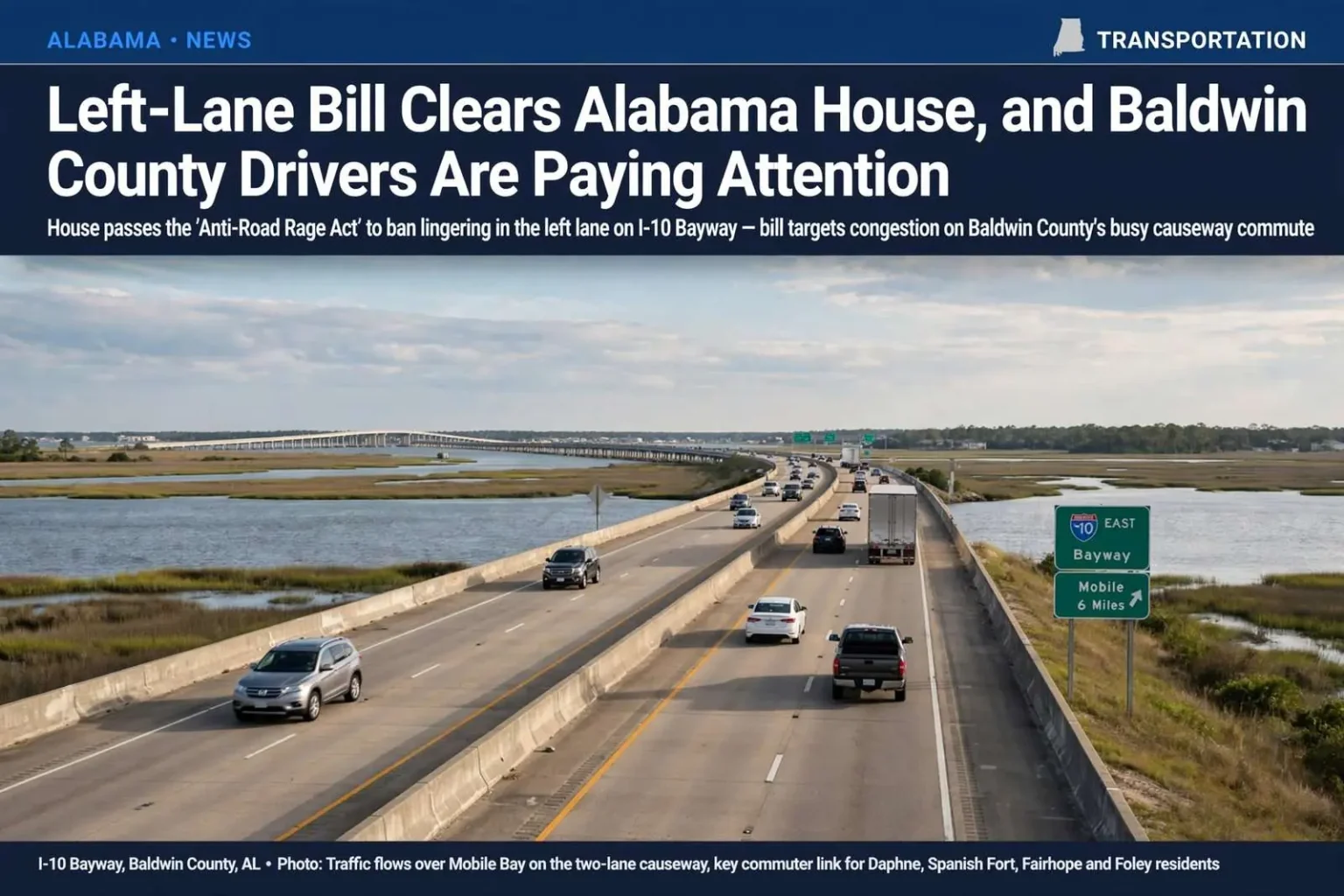
The Alabama House of Representatives has passed a measure that would allow police to ticket drivers who linger in the left lane of an interstate without passing anyone, and the proposal is drawing close attention in Baldwin County, where thousands of motorists rely on the left lanes of Interstate 10 every day. Under the bill, dubbed the Anti-Road Rage Act, a driver could be cited for traveling more than a mile and a half in the leftmost lane without overtaking another vehicle. Supporters describe the measure as a common-sense housekeeping rule for highway travel: the left lane is for passing, and drivers who settle into it and stay there create the bottlenecks and confrontations the legislation is meant to prevent.
The legislation was introduced by Rep. Phillip Pettus, a former Alabama state trooper whose years in patrol work shaped his view of how highway conflicts begin. Pettus has framed the bill as a way to reduce the kind of highway confrontations that start when faster traffic stacks up behind a slower vehicle in the passing lane. From a trooper’s perspective, those moments — a line of cars flashing headlights, tailgating, weaving to get around a stationary blocker — are often the opening act of road rage incidents, sideswipe crashes, and dangerous passing maneuvers on the shoulder. A clear, enforceable rule about left-lane use, he argues, gives officers a tool to defuse those situations before they escalate.
Why the left lane matters on the Bayway
The proposal resonates strongly in Baldwin County, where a large share of daily commuters use the Bayway stretch of Interstate 10. That section of interstate, which carries traffic across Mobile Bay on a low-lying causeway, has only two lanes in each direction, leaving little room to maneuver when a vehicle settles into the left lane and stays there. With trucks, commuters, and beach-bound travelers all sharing the same narrow ribbon of pavement, a single slow-moving vehicle in the passing lane can turn a routine crossing into a rolling traffic jam with no practical way around it.
The geography makes the problem sharper than it might be on a wider highway. The Bayway is the primary link between the Eastern Shore and Mobile, and drivers who live in communities such as Daphne, Spanish Fort, Fairhope, and Foley and work in Mobile have few realistic alternatives for their daily commute. A driver boxed in behind a left-lane camper on that stretch cannot simply change routes; the choice is to wait, to pass on the right, or to take risks. Transportation planners have studied widening the crossing for years, but a construction project on that scale is a long-term answer, while a left-lane enforcement law would be an immediate behavioral one.
Baldwin County’s rapid residential growth adds to the daily pressure on the corridor. New subdivisions across the county continue to push more vehicles onto I-10, and the population balance between the two sides of Mobile Bay has shifted steadily toward the Eastern Shore. More cars mean more encounters between faster and slower traffic, and more opportunities for the friction that the Anti-Road Rage Act is designed to reduce. Local drivers who make the crossing twice a day know the pattern well: a modest slowdown in the left lane can cascade backward for miles during peak hours.
How the bill would work
Under the legislation, the violation is defined simply. A driver traveling more than a mile and a half in the leftmost lane of an interstate without overtaking another vehicle could be cited by a law enforcement officer. The distance threshold is meant to distinguish between normal driving — briefly moving left to pass, then returning to the right — and the extended occupation of the passing lane that frustrates the drivers behind. Exceptions for emergencies, heavy traffic, and planned lane closures are the kind of details that are typically sorted out as a bill moves through the legislative process.
Alabama is not breaking new ground with the concept. A large majority of states already have some form of keep-right or left-lane restriction on the books, and several have run public awareness campaigns urging drivers to “move over or get a ticket.” Safety researchers have long noted that differences in vehicle speeds, not speed itself, contribute heavily to highway conflicts. When a slower vehicle occupies the lane intended for passing, the speed differential between lanes widens, and the maneuvers drivers make to compensate — sudden lane changes, aggressive passing, brake-checking — are precisely the behaviors linked to multi-vehicle crashes.
From bill passage to law
The House’s passage is an important step, but the bill still requires further action in the Legislature before it could become law. A measure must clear the second chamber, and if that chamber amends the bill in any way, the two versions must be reconciled before final passage. Only then would the measure head to the governor’s desk for a signature. That process gives legislators time to hear from constituents, law enforcement agencies, and highway safety advocates about how the rule should be written and enforced, and it means the final shape of the law could differ in detail from what the House approved.
If enacted, enforcement would fall to state troopers and local police departments with jurisdiction over interstate segments. The Mobile County and Baldwin County portions of I-10, along with I-65 and I-165, would fall under the new rule, and officers would make individual judgments about when a driver has clearly crossed the threshold from ordinary driving into a citable violation. Advocates of the bill note that similar laws elsewhere are enforced inconsistently but still change driver behavior over time, largely through public familiarity with the rule itself.
For commercial traffic, the change could be significant. The Port City’s port facilities, the aircraft manufacturing operations in Mobile, and the distribution centers spread across Baldwin County all put heavy truck traffic on I-10, and large trucks have their own rules about lane use. A left-lane law aimed at all drivers would add another layer to the expectations placed on professional drivers and on the four-wheel traffic that shares the road with them. Trucking companies and safety groups have generally supported keep-right laws because they reduce unpredictable lane changes around large vehicles.
What drivers should take from the debate
Even before any law takes effect, the attention the bill has received serves as a reminder of the etiquette that safety experts recommend on multi-lane highways: use the left lane to pass, then return to the right; match the general flow of traffic; and avoid using the passing lane as a cruising lane, regardless of how fast you are traveling. The argument that “I’m already going the speed limit” is a common defense of left-lane cruising, but supporters of the legislation note that the law does not make individual drivers the arbiters of the speeds of others, and that self-appointed pace-keeping is exactly what generates the confrontations Pettus described.
For Baldwin County residents, the bill’s progress through the Statehouse is worth following for a second reason as well: it signals legislative attention to the corridor’s problems at a time when the region is pressing for broader solutions to I-10 congestion, from capacity projects to better incident management. A left-lane law would not add a lane to the Bayway, but advocates argue it would add capacity at essentially no cost, by making better use of the pavement that already exists.
Drivers who want to weigh in on the legislation can contact their state representative and senator, whose contact information is available through the Alabama Legislature’s website. As the bill moves to its next stage, the experience of the commuters who cross the Bayway every day — the ones who most directly live with the consequences of left-lane congestion — will likely remain a central part of the argument on both sides.
The House has done its part. Whether the Anti-Road Rage Act becomes law will now be decided in the remaining steps of the legislative process, and whether it changes daily life on I-10 will be decided one commute at a time by the drivers who use it.
The road ahead for the measure
Legislative watchers note that traffic safety bills with broad public appeal often move quickly once they clear their chamber of origin, but nothing is final until the process is complete. The bill’s supporters in the House made the case that the measure costs the state nothing, requires no new infrastructure, and addresses a hazard that constituents raise with their representatives regularly. Opponents and skeptics, where they exist, tend to raise questions about enforcement discretion and whether citations should carry points against a license or be treated as a lesser offense — questions that can shape the bill’s final text.
Either way, the conversation the bill has sparked is already doing some of the work its sponsor intended. Every news story and constituent email about left-lane etiquette reaches drivers who may think twice the next time they set the cruise control in the far-left lane with no one to pass. For the commuters who cross the Bayway twice a day, that change in habit — if it takes hold — would be a welcome improvement on a corridor where every lane counts.