
Lightning-Struck Gas and Water Lines Force Repairs on Irvington’s Taylor Road
Spire crews repaired gas and water lines struck by lightning near Taylor Road in Irvington, briefly blocking residents from leaving.
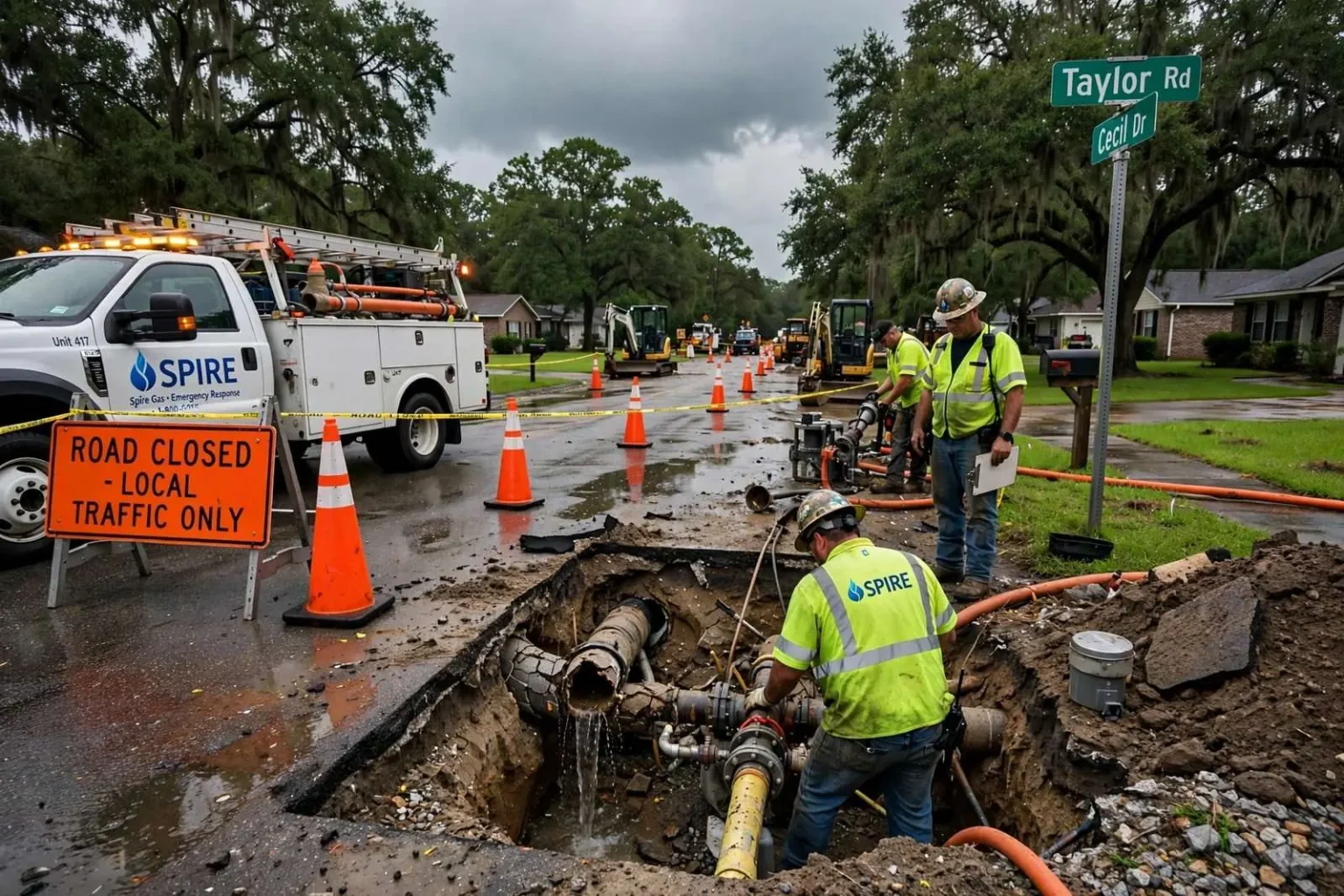
Spire utility crews spent Wednesday afternoon repairing gas and water lines in Irvington after a lightning strike damaged buried infrastructure along Taylor Road near Cecil Drive, according to the company. The utility said both a water line and a gas line were struck during the storm, forcing crews to secure the site before any repairs could begin.
According to Spire, crews first worked to shut off the flow of gas before making repairs, a standard safety step whenever a natural gas line is compromised. The company expected the work to be finished by late afternoon and said the area was safe once the lines were restored.
Residents briefly blocked in
The work prompted a temporary roadblock along the affected stretch of Taylor Road. Some residents reported that the road was blocked off while crews worked, leaving them unable to leave their homes for a time. Repair work of this kind typically requires closing a section of roadway so that excavation equipment and crews have room to operate safely around buried lines, and utility workers generally ask residents to remain clear of the trench while the damage is being located and fixed.
No injuries were reported in connection with the incident. The affected stretch sits in a residential part of the Mobile County community south of Mobile. Irvington is an unincorporated area of homes, churches and rural parcels along U.S. 90 and the roads that branch off it, sitting between Theodore and St. Elmo on the inland side of the communities that line the western shore of Mobile Bay. Storms that sweep in off the Gulf on a summer afternoon routinely pass through the area, and utility crews in the region are accustomed to responding to weather damage during the long June-through-September storm season.
When lightning finds buried lines
Lightning is usually thought of as a threat to power lines, trees and home electronics, but buried utilities can be damaged as well. A strike to the ground or to above-ground equipment such as meters, regulator stations or service poles can send current through the soil and into underground pipe, cracking or weakening it at vulnerable points. When gas and water lines share the same right-of-way beneath a residential street, as they often do, a single strike can affect both systems at once.
Damage to a gas line is treated as an immediate safety priority because escaping natural gas can accumulate in the soil, in storm drains or inside nearby structures and ignite. Crews isolate the damaged section by closing valves upstream and downstream of the break before any excavation begins, then vent and test the area as they work. Water line damage is typically repaired afterward, since the primary risks there are service outages, street flooding and undermining of the road bed itself.
The repair sequence
A job like Wednesday’s follows a familiar sequence. Crews confirm the damage and isolate the lines, locate the exact break, excavate down to the pipe, replace the affected section, pressure-test the repair and backfill the trench before the roadway can be reopened and traffic allowed through. When two utilities are damaged at the same spot, gas and water crews often work the same trench in sequence, and the road department may be called in afterward to patch the pavement. That coordination is part of why a single lightning strike can turn into a multi-hour repair operation on an otherwise ordinary afternoon.
Spire’s role on the Gulf Coast
Spire is the natural gas utility serving much of the Mobile area, including unincorporated Mobile County communities such as Irvington. The company maintains a network of distribution mains and smaller service lines beneath streets throughout the region, along with the meters and regulator equipment that connect individual homes to the system. Utility crews respond around the clock to reported leaks, damage from construction activity, weather-related failures and incidents like Wednesday’s strike.
For customers on the affected street, a repair of this kind usually means a temporary interruption of gas service. After the line is fixed, crews restore service house by house, relighting appliances and checking meters before moving to the next address. Water service follows a similar pattern, though a water repair may also require a precautionary advisory until the line is flushed and pressure is confirmed. Residents along Taylor Road saw that full cycle play out over the course of a single afternoon.
A reminder about Gulf Coast storms
The incident serves as a reminder that summer thunderstorms along the Gulf Coast can do more than knock out power. South Alabama sees some of the most frequent lightning activity in the country during the height of summer, with storms building over the bay and the Gulf nearly every afternoon and pushing inland through Mobile County. Most strikes cause little more than flickering lights or a tripped breaker, but a direct hit on utility infrastructure can crack buried lines, damage transformers and trigger the kind of neighborhood repair operation that played out on Taylor Road.
Utility officials routinely urge residents to report the signs of a gas leak — an odor often compared to rotten eggs, hissing near a meter, or dead vegetation in an otherwise green yard — and to report discolored water, bubbling in the street or a sudden drop in water pressure that can indicate an underground break. The guidance is consistent: leave the area, keep others away and call the utility from a safe distance rather than investigating the source directly. Ignition sources, including anything with an open flame or an electric spark, should stay off until the utility has cleared the scene.
What the incident means for residents
For the households near Cecil Drive, the afternoon was an inconvenience rather than a danger: crews isolated the damage quickly, no one was hurt, and the area was pronounced safe before the work wrapped up. But the episode illustrates how quickly a routine storm can turn into a neighborhood event, and why utility crews ask for patience and distance when trucks and excavators appear on a residential street.
State law also requires anyone planning to dig near buried utilities to notify the Alabama One Call system first so that lines can be marked before excavation — a step that protects residents doing yard work just as much as it protects the crews who maintain the infrastructure. For storm-related damage like Wednesday’s, the response begins the moment the strike is reported and ends only when the system has been tested and the street returned to normal.
Storm season and the grid beneath the streets
Across Mobile County, thousands of miles of gas, water and sewer lines run beneath residential streets, most of them out of sight and out of mind until something goes wrong. Summer is the busiest season for weather-related damage. Afternoon thunderstorms bring repeated lightning, saturated ground swells and then shifts as it dries, and falling trees and limbs tear at service lines during the stronger storms that move through ahead of frontal boundaries. Utility dispatchers in the Mobile area plan for a surge of calls on stormy afternoons, and repair crews stage equipment accordingly.
Unincorporated communities like Irvington present their own logistical realities. Homes there are spread along a mix of state highways, county roads and neighborhood streets such as Taylor Road, and utilities maintain lines across a wide rural-suburban footprint with fewer crew stations than a dense city core. When a strike or a washout takes out a line in one of these communities, residents may wait longer for a crew to arrive simply because of the distances involved — another reason early reporting of suspected damage matters.
Safe until the work was done
Spire said the area was safe once repairs were complete, and the company expected the job to wrap up by late afternoon. For the residents who were briefly blocked in along Taylor Road near Cecil Drive, the disruption was short-lived. By the company’s account, the system did what it is designed to do: isolate the hazard, repair it and restore service without harm to anyone nearby. No injuries were reported, and neither the utility nor emergency officials described any evacuations or extended closures beyond the work zone itself.
That outcome is not automatic. A gas line strike carries real risk if the damage goes unreported or if the escaping gas finds an ignition source before crews arrive. The difference between a routine repair job and a serious incident often comes down to how quickly the damage is recognized and how carefully the area around it is kept clear. In this case, residents flagged the roadblock, the utility responded within the afternoon, and the repairs were finished the same day they began.
A practical lesson for the season ahead
The episode stands as a practical lesson for the rest of the Gulf Coast storm season. Lightning is frequent, utilities run everywhere beneath the surface, and a single strike can interrupt gas and water service to a street in an instant. Households that know how to recognize the smell of a gas leak, that keep the utility’s emergency number handy and that stay out of marked work zones make those multi-hour repairs uneventful — which is exactly how Wednesday’s operation on Taylor Road ended.
For now, traffic on Taylor Road is back to normal and service is restored, but the next afternoon storm is rarely far off in south Mobile County. The same ground that absorbed Wednesday’s strike will be struck again somewhere else before the summer is out, and somewhere else in the region a crew will spend an afternoon doing what Spire’s crews did on Taylor Road: shutting off the flow of gas, digging down to the damage, and putting the neighborhood back the way it was.


