Little Feat Brings 45th Anniversary ‘Waiting for Columbus’ Tour to Mobile’s Saenger Theatre
Little Feat brings its 45th anniversary "Waiting for Columbus" tour to Mobile's Saenger Theatre, with founding member Bill Payne discussing new jams, songwriting collaborations and reissues.
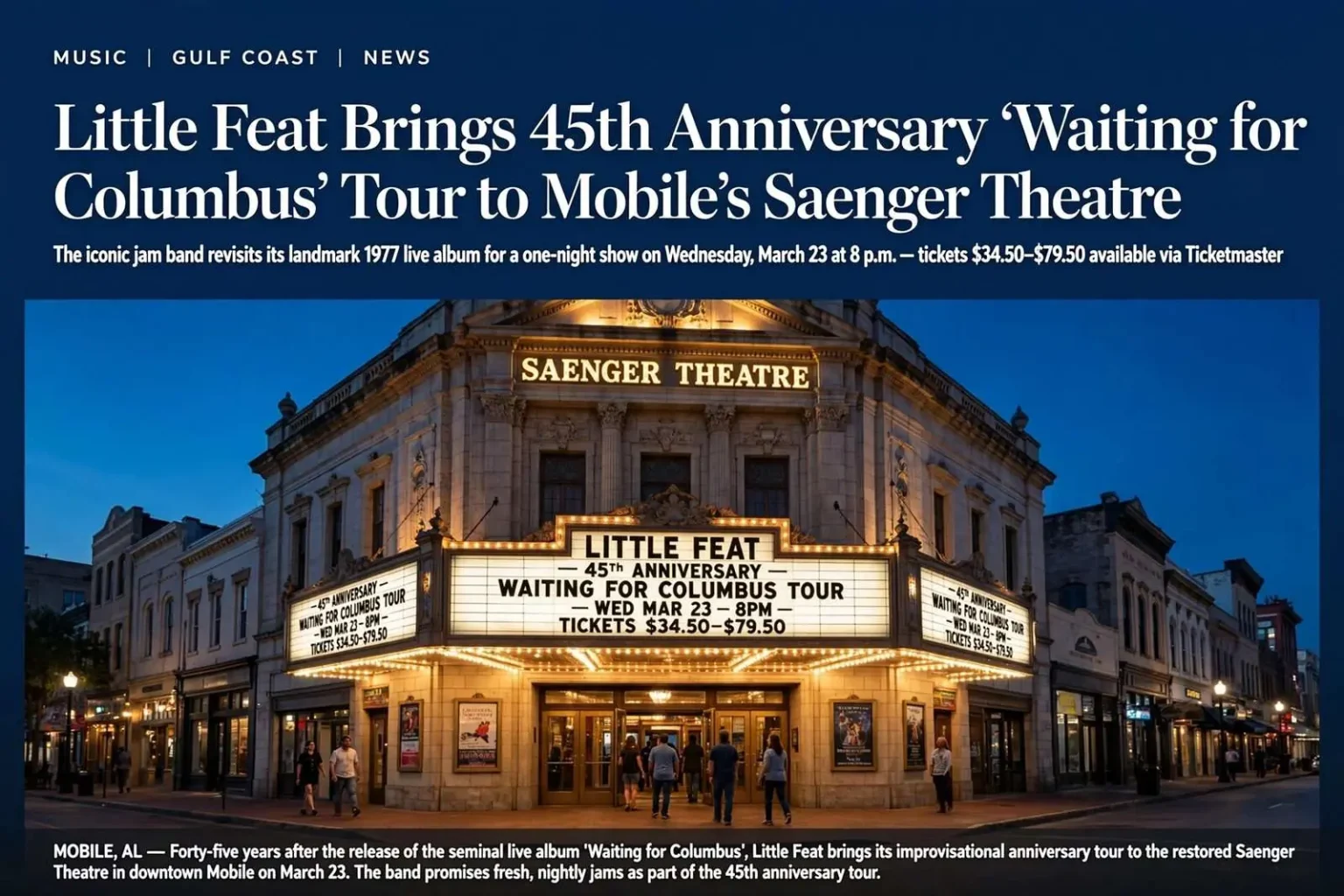
Forty-five years after Little Feat released its landmark live album “Waiting for Columbus,” the influential jam band is bringing an anniversary tour built around that record to downtown Mobile. The band is scheduled to play the Saenger Theatre on Wednesday, March 23, at 8 p.m., with tickets ranging from $34.50 to $79.50 through Ticketmaster. For a band that has spent five decades building a reputation on improvisation, the tour is less a nostalgia exercise than a rolling laboratory, and Payne promises that no two nights on the run will sound quite the same.
The Saenger Theatre is a fitting stage for the occasion. Opened in 1929 as a grand movie palace on Joachim Street in the heart of downtown Mobile, the venue fell on hard times in the decades after the advent of television and suburban theaters, closed for a stretch in the late 1970s, and was meticulously restored at the turn of the millennium. Today it serves as one of the Gulf Coast’s premier concert halls, hosting touring acts, Broadway productions and symphony performances, and its restored atmospheric interior gives anniversary tours of classic bands a sense of ceremony that arena dates rarely match.
“Waiting for Columbus” was recorded over seven shows and helped set the template for how a live jam band album could sound, influencing generations of touring acts that followed. The double LP captured Little Feat at a commercial and creative peak, weaving together songs from across the band’s studio catalog with extended, guest-filled jams that turned songs like “Dixie Chicken” and “Willin’” into vehicle-sized showcases. Critics have long ranked it among the greatest live rock records ever made, and its influence can be heard in the way countless bands since have documented their own late-night, improvisational selves.
Little Feat’s stop at the Saenger will give Mobile audiences a chance to hear those songs reworked with the improvisational energy the band has built its reputation on. Founding member and pianist Bill Payne discussed the tour, the band’s songwriting process and what audiences can expect from the Mobile show in a recent interview. Payne, who co-founded the band in Los Angeles in 1969, remains the group’s musical anchor, its keyboardist and one of its principal writers, and he has watched the band’s audience shift and renew itself across five decades of touring.
Not a note-for-note tribute
Payne said the band began preparing for the anniversary tour somewhat organically, since many of the “Waiting for Columbus” songs were already staples of Little Feat’s live sets. That familiarity cuts both ways: it makes the songs easy to assemble for a tour, but it also raises the risk that a run built around familiar material could feel like a victory lap. Payne and his bandmates approached the question deliberately rather than by default, he said, talking through how to honor the record without entombing it.
A run of shows last November billed as “Little Feat by Request” actually pushed the band to explore material outside that core catalog, which Payne said made the return to the “Waiting for Columbus” songs feel fresh rather than repetitive. Playing songs chosen by fans forced the band to reach into deep album cuts and to work material they had not performed regularly in years, sharpening their arrangements and loosening their approach before the anniversary material took center stage.
“We’re not here to replicate it,” Payne said of the original album. “Some do these live albums note for note. We’re not doing that. It wouldn’t be Little Feat if we did.”
The distinction matters to a band whose identity has always been built on the idea that a song is a starting point rather than a destination. Little Feat’s sound — a blend of rock, blues, country, R&B and the second-line funk of nearby New Orleans — was constructed to be rearranged, and Payne treats the band’s recorded history as a body of material that stays alive precisely because it is never finished.
Different jams every night
Instead, Payne said the band plans to build a different set of jams into the songs each night, sometimes bringing in guest musicians or featuring the group’s horn section in different ways from show to show. The horn section gives the anniversary material a new texture: the brass arrangements add weight to tunes that on the original album relied on the interplay of guitars and keyboards, and rotating guests keep the band’s nightly conversation unpredictable.
He said the band may even try acoustic arrangements of some songs later in the tour, an experiment that would strip the material back to its rhythmic and melodic bones. For a catalog that spans shuffle boogie, country ballads and roadhouse funk, the acoustic versions are a way of testing which songs hold up when the amplified scaffolding comes down — and Payne has long been candid that Little Feat’s writing survives such tests better than most.
The band also plans to leave room in the encore to pull from the extended version of “Waiting for Columbus” or reach for other fan favorites like “Let It Roll” or “Long Distance Love.” The extended edition of the live album, expanded in reissue form with additional performances from the same run of shows, holds material the original LP left off, and Payne sees the encore as the natural place to reward listeners who know that history.
“I want to keep it fresh,” Payne said. “We’re all going to keep open the encore section… We’ll have a free zone there to see what we want to do.”
That “free zone” is where the band’s instincts take over. On any given night it may mean a long instrumental detour, a guest sitting in, or a song pulled from four decades of records that has nothing to do with the anniversary catalog at all. The band treats the encore not as a wind-down but as the loosest part of the show, and Payne said the plan is to keep it that way through the entire tour.
Songs built to last
Payne credited the staying power of the “Waiting for Columbus” catalog to songwriting that doesn’t feel tied to a specific era. The band’s founders and longtime writers wrote about highways, bayou country, truck stops and late-night longing in language that avoided the slang and production fashions of any single decade, and that restraint is part of why the songs have carried across generational audiences without translation.
He pointed to the track “Dixie Chicken” as an example of a song that could have been written recently rather than decades ago. The tune, with its New Orleans-inflected groove and its sing-along refrain, has become a standard that younger bands still cover, and Payne hears its durability in the way new listeners discover it without any sense that it is a museum piece.
“I think the songs themselves are timeless in that they don’t necessarily represent a period of time,” Payne said. “It’s not like a hit song that somebody recorded where someone would say, ‘It’s cool, but it sounds dated.’ I think it holds true on most of these songs.”
Asked about his favorite night among the seven shows that became the original album, Payne said 45 years had made that impossible to pin down, though he recalled strong performances at Lisner Auditorium in Washington, D.C., where much of the material was recorded. The shows were taped in the winter and early months of 1977, with a handful of dates also cut in London, and the band’s live peak during that stretch gave producer George Massenburg an abundance of strong performances to assemble.
He also described the band’s reception in London during that era, including a memorable encounter with Rolling Stones guitarist Keith Richards, who told him the two bands were “all from the same cloth.” The remark stuck with Payne as confirmation of what the band had long suspected: that Little Feat’s blend of American roots idioms and jamming instinct had kin across the Atlantic among the British players who had absorbed the same blues and country traditions.
Payne described Little Feat’s overall approach to its catalog as similar to a jazz band’s mentality: record a song, then feel free to revisit and rearrange it months or years later rather than treating the original recording as the only correct version. In practice, that means the “Waiting for Columbus” anniversary tour is less a restoration project than the latest remix in a 50-year process of revision, and Payne insists the band will keep revising long after this run of dates ends.
New music and reissues in the works
Beyond the anniversary tour, Payne said Little Feat’s catalog is getting fresh attention from Warner Brothers, which is reissuing several of the band’s albums, including “Waiting for Columbus” itself. The reissue campaign arrives at a moment when catalog music from the 1970s is finding new audiences through streaming, and it gives the anniversary tour a commercial backbone to match its artistic one.
Payne also discussed an active stretch of songwriting collaborations. He has written 20 songs with lyricist Robert Hunter, four of which appeared on Little Feat’s 2012 album “Rooster Rag,” with 16 more still unreleased. Hunter, best known as the lyricist behind the Grateful Dead’s songbook, brought a literary sensibility that Payne found a natural match for Little Feat’s narrative streak, and the two maintained the partnership until Hunter’s death.
He has also been writing with Pulitzer Prize-winning poet Paul Muldoon, who recently edited a collection of Paul McCartney’s lyrics, as well as producer and musician John Leventhal, who is married to singer-songwriter Rosanne Cash. Payne said the range of collaborators — a formalist Irish poet, a Nashville producer with deep country and Americana credentials — reflects the band’s habit of writing in different rooms with different ears rather than closing itself off.
Payne said he has also written two songs with Charlie Starr of the Southern rock band Blackberry Smoke, with Starr, Cash and Leventhal all set to appear alongside Little Feat in a PBS special. The television taping will gather several generations of American roots musicians around the band’s catalog, and Payne frames it as another extension of the same impulse that drives the anniversary tour: the music works best when it is shared, rearranged and passed along.
Payne credited the band’s management team, Nashville-based Vector Management, led by Ken Levitan with day-to-day support from Brian Penix, for helping keep Little Feat’s career moving forward. A band approaching its sixth decade of touring needs logistical muscle as much as musical inspiration, he noted, and the stability behind the scenes has let the players concentrate on the work.
“It’s being musicians and reaching an audience,” Payne said. “How do you do that on your own? You need people knocking on the doors, having them answered and then being able to walk into the next room.”
The Mobile date falls in the middle of that sustained effort — a theater show in a Gulf Coast city the band has played before, built around the record that most completely documented what the band does. Little Feat’s “Waiting for Columbus” anniversary tour stops at the Saenger Theatre, 6 S. Joachim St. in downtown Mobile, on Wednesday, March 23, at 8 p.m. Tickets are available through Ticketmaster.