Loaded Handgun Recovered Inside Monroeville Elementary After Student Hid It on Campus
Monroe County schools say a loaded handgun brought to Monroeville Elementary was recovered a day later after the student admitted hiding it inside the.
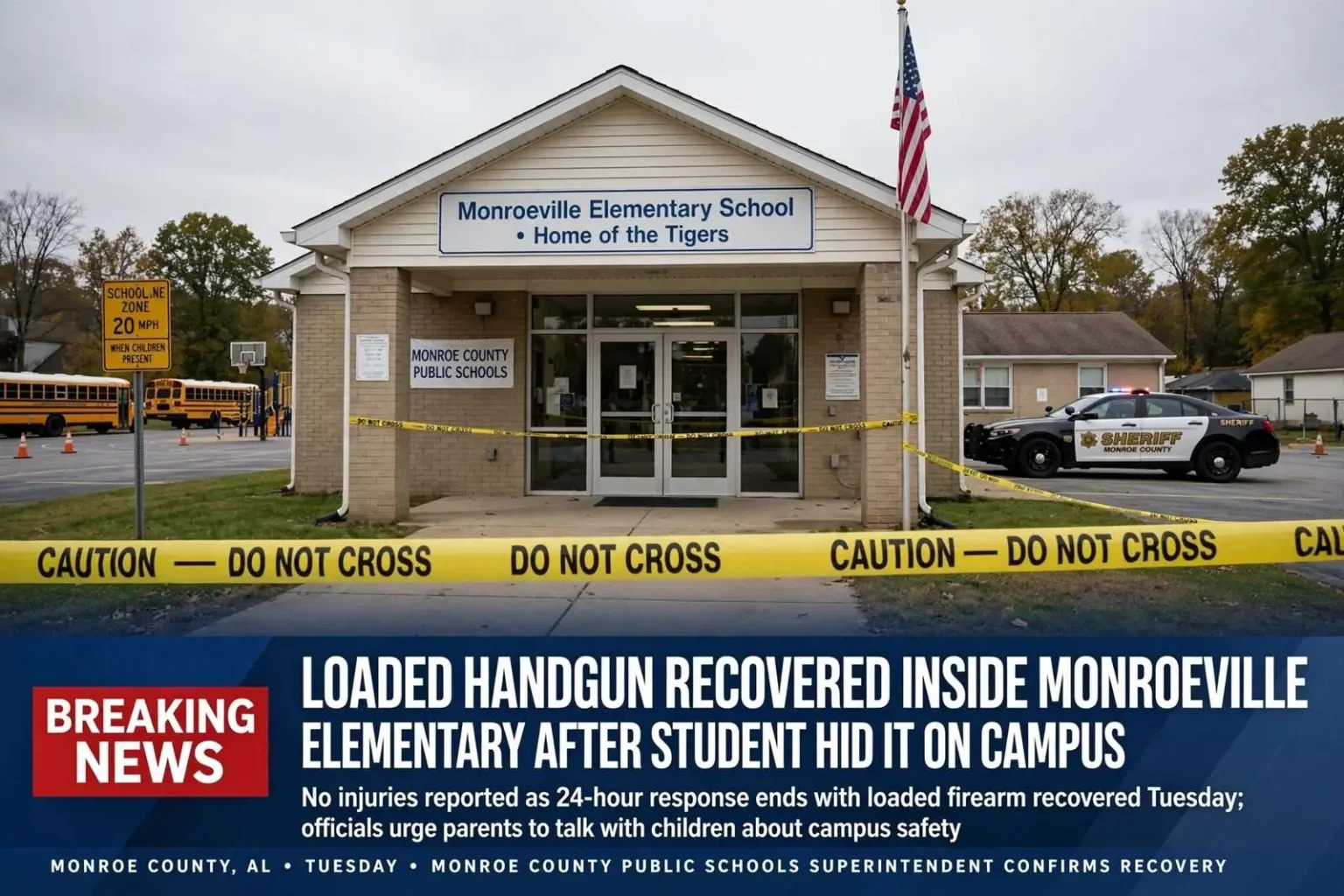
A loaded handgun brought onto the campus of Monroeville Elementary School was recovered the following day after the student who carried it in admitted to family members that the weapon was still hidden inside the building, according to Monroe County Public Schools Superintendent Greg Shehan. Shehan said the gun was brought to school on a Monday and found on Tuesday.
The case unfolded over roughly 24 hours and ended without injuries, but it delivered a jolt to a school community where such discoveries are mercifully rare. Elementary campuses are not the settings most people associate with weapon incidents, and the recovery of a loaded firearm inside a building serving young children raises the kind of questions — how it happened, what happens next — that districts answer through both investigation and communication.
Shehan moved quickly to put the district’s account on the record, issuing a statement to parents that traced the sequence from the first report to the recovery of the weapon. That speed matters in a school crisis: accurate, prompt information from the superintendent’s office is the best antidote to the rumors that race through a small community when news of a gun on campus spreads.
How the Weapon Was Found
According to the superintendent’s account, the sequence began when a parent contacted school officials to report that a student had shown their child a pistol on campus while the children were walking to a bus. “The administration immediately pulled video and witnessed the incident,” Shehan said in a statement issued to parents. “The student was brought to the office immediately and searched. No weapon was found.”
The steps that followed reflect the standard playbook Alabama schools follow when a weapon is reported. Administrators secured video evidence, took the accused student out of the classroom and searched that student immediately, and brought law enforcement into the case while notifying the student’s parent — parallel actions designed to establish facts quickly without tipping off or endangering anyone else in the building.
Shehan said the student initially told school officials the weapon had already been taken back home. That account changed after the family was unable to locate the gun. “The student confessed to the family that the weapon was hidden in the school,” Shehan said. “Administration immediately went to the location in the school and found the loaded weapon.”
The recovery closed the immediate danger. A loaded firearm had spent a night inside an elementary school, unseen by the adults responsible for the building — a fact that underscores how easily a small weapon can move through a campus, and how much the eventual recovery depended on the honesty of a child in the student’s own household.
District Urges Parents to Talk with Children
The superintendent said the incident underscores why students need to report weapons on campus rather than stay quiet. District officials are asking parents to talk directly with their children about campus safety and about telling an adult when they see or hear about a weapon at school. Parents whose children hear of a weapon on a campus are urged to contact both law enforcement and school administration immediately.
The district’s message puts families at the center of prevention. In this case, the chain that ended with the recovery of a loaded gun ran through a parent — first in the report that something had been seen, then in the family conversation that produced the weapon’s location. Officials want that pattern repeated: children who know to tell an adult, and adults who know to call the school and law enforcement rather than assume the problem will resolve itself.
Safety experts make a practical point to parents who raise the subject at home. Conversations about weapons work best when they are calm and specific — what a weapon looks like, why bringing one to school endangers everyone in the building, and exactly whom to tell if a student sees or hears about one. Children who understand that reporting protects their friends, not just themselves, are more likely to come forward despite the social pressures that keep students quiet.
The Law and the Aftermath
Bringing a weapon onto an Alabama school campus carries serious consequences under state law, which prohibits firearms in school buildings and on school grounds, with narrow exceptions that do not apply to a student carrying a handgun for any reason. Violations can expose adults to felony prosecution, and cases involving minors move through the juvenile justice system, where proceedings and outcomes are confidential by design.
The district has not released details about any discipline in the case. No injuries were reported in connection with the incident.
The decision to withhold disciplinary details is standard practice for Alabama districts, which are constrained by federal student privacy law from discussing individual students’ records. What the district can share — that a weapon was recovered, that no one was hurt, that parents should talk with their children — is what it shared, leaving the question of consequences to the confidential processes that govern both the school system and the courts.
Monroeville’s School Community
Monroeville, the Monroe County seat best known as the hometown of writers Harper Lee and Truman Capote, anchors a rural school district where the elementary campus serves as a daily gathering point for much of the community. In towns of this size, a weapon incident at the elementary school is felt personally — the children involved are neighbors’ children, and the administrators handling the case are people parents know by name.
That intimacy cuts both ways. It gives districts like Monroe County a communication advantage: a superintendent’s statement reaches parents quickly and is taken at face value in a way that larger urban districts struggle to achieve. It also means the incident’s effects linger in a community where the same families will share classrooms, ballfields and church pews for years, making the district’s emphasis on calm, factual communication all the more important.
What Schools Ask of Everyone
The episode’s lesson, as the district framed it, belongs to every adult in the community. Weapons that reach school campuses overwhelmingly come from homes, and the first line of defense is secure storage — firearms locked and unloaded where children cannot reach them. National surveys have consistently found that a substantial share of school weapon incidents trace to guns taken from family or household sources, which is why districts across Alabama pair their campus-security messaging with reminders to parents about safe storage at home.
The second line of defense is reporting. Students are frequently the first to know when a weapon is headed to school, and districts invest in telling them that reporting is not tattling but protection. In Monroeville’s case, both defenses held — a parent reported what a child had seen, and a family pursued the truth when the gun could not be found at home.
The district has not announced policy changes in the wake of the recovery, and officials continue to direct parents with questions or concerns to school administrators. For a school community that got through a frightening 24 hours without harm, the superintendent’s closing counsel remains the operative one: talk with your children, and when you hear of a weapon on any campus, call law enforcement and the school — immediately.
Inside the School Response
The district’s handling of the incident illustrates the sequence school administrators across Alabama train on. When the first report arrived, administrators did not wait to verify it through the student alone; they pulled campus video and witnessed the incident themselves. That step transformed a child’s account into documented evidence and justified the immediate search that followed, all within the same school day.
The initial search coming up empty is the detail that most reveals how difficult these cases are. A student searched immediately after being seen with a weapon may truthfully have nothing on them — the weapon may already be stashed in a bathroom, a backpack drop point or a classroom corner. Schools therefore treat a negative search as the beginning of an investigation rather than its conclusion, which is exactly what happened here, with law enforcement involved and the family looped in from the start.
The family’s role in the resolution deserves the emphasis the superintendent gave it. When the gun could not be found at home, the adults kept asking rather than accepting the first answer, and the student’s confession to family led administrators directly to the hiding place. Had that conversation not happened, a loaded weapon would have remained hidden in an elementary school indefinitely, a danger to every curious child who might eventually find it.
The Broader Safety Net
Monroe County’s schools, like districts across the state, operate within a layered safety framework: campus visitors are screened, exterior doors are controlled, video systems cover hallways and entrances, and staff train on threat response. Yet no camera system replaces the human network that actually caught this case — a parent who heard something, reported it, and followed through until the weapon was found.
The district’s request to parents asks them to occupy that same role going forward. Contacting both law enforcement and school administration immediately, as the district urged, protects against the two failure modes in these situations: assuming someone else has reported it, and waiting to see whether the problem resolves itself. In weapon cases, hours matter — a weapon reported and recovered the same day is a crisis contained, while one that sits overnight is a standing danger, as this incident demonstrated.
Administrators will conduct their own review of the episode, as districts customarily do after a weapon recovery, examining how the gun entered the building and whether any procedure can be tightened. The findings of such reviews typically stay internal, but their effects show up in the small procedural changes — added checks, adjusted supervision, refreshed training — that make the next report a little less likely.