Looking Back at the Sharpest Elbows and Oddest Moments of the 2022 Alabama Primary
A look back at the sharper edges of Mobile and Baldwin counties' 2022 primary season, from a robocall controversy in the Mobile County district attorney's race to an eyebrow-raising ad in a Baldwin County Commission contest.
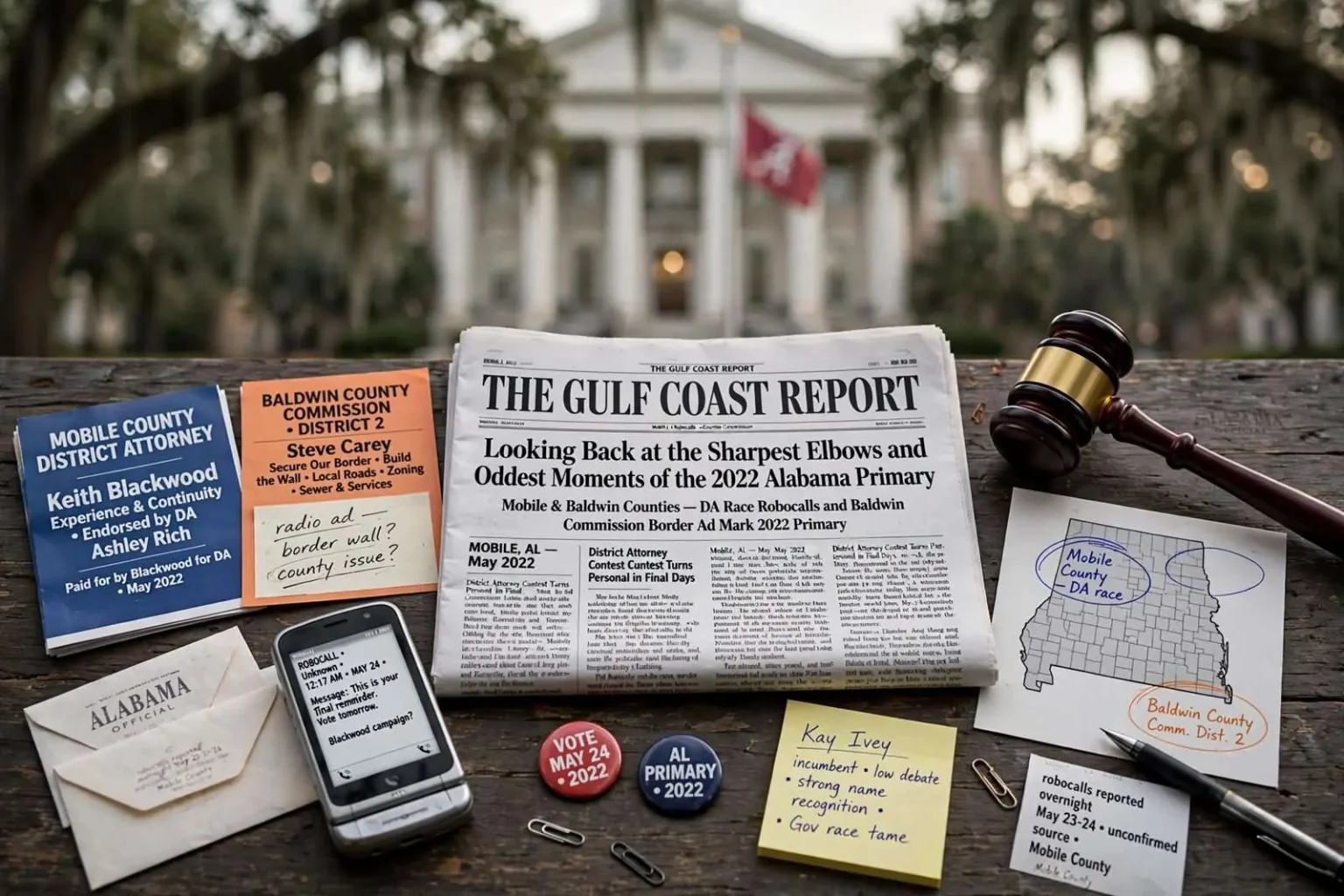
Alabama’s 2022 primary season delivered plenty of the usual noise — mailers, robocalls and television ads repeating the same handful of buzzwords — but it also produced a handful of local storylines in Mobile and Baldwin counties that stood out from the pack, particularly a bitter fight for Mobile County district attorney and an unusual moment in a Baldwin County Commission race.
By most accounts, the statewide campaign season was relatively tame compared with past cycles, when candidates in local judicial races have traded much sharper personal attacks. This year’s contests stayed largely on message, built around a familiar set of Republican primary talking points that dominated advertising across the Gulf Coast, including border security, references to former President Donald Trump, claims of conservative credentials and criticism of the Biden administration’s policies.
The restraint at the top of the ticket had its own logic. With a popular incumbent governor and a U.S. Senate seat where the front-runner’s strength discouraged serious challenges, the campaigns that did spend heavily aimed their fire outward rather than sideways, and the tone filtered down. In past cycles, Mobile-area judicial and legislative primaries had produced flyer wars over divorce records and old client files; in 2022, most down-ballot contests in the two counties stayed within the bounds of the standard issues.
The district attorney race turned personal at the wire
Still, the race for Mobile County district attorney generated real friction. Candidates Keith Blackwood and Buzz Jordan ran to succeed longtime District Attorney Ashley Rich, and the contest grew tense in its final days after a wave of robocalls hit phones across Mobile County overnight between May 23 and May 24, just ahead of Election Day. The calls were reportedly attributed to Blackwood’s campaign, a claim his camp denied. Blackwood in turn blamed Jordan, while Jordan said he had nothing to do with the calls and accused his opponent of spreading misinformation about him.
Neither campaign publicly identified who was actually behind the calls, and it remains unclear whether the episode had much impact on the outcome. Much of the race instead turned on how voters felt about the current district attorney’s tenure, with Blackwood leaning heavily on Rich’s endorsement as evidence of continuity in the office and Jordan positioning himself as a change candidate amid concerns some voters raised about repeat offenders cycling through the local justice system.
Rich’s endorsement was the race’s defining asset. After three terms prosecuting in the state’s second-largest county, the departing district attorney carried both a network of donors and a public record that made her blessing worth more than any television buy, particularly in a low-turnout primary where the voters paying closest attention were the party’s most reliable regulars. Jordan’s task was to argue that a record of continuity was itself the problem, a harder sell in a county where prosecutors had not been the target of the reform wave reshaping offices in larger cities.
Throughout the campaign, Blackwood and Jordan rarely referred to each other by name in public comments, instead using terms like “my opponent” or “my opposition” — a detail that became something of a talking point among local political observers following the race closely. The verbal dodge, repeated at forum after forum, became the race’s unofficial running joke, and by the final weeks supporters on both sides were reporting the count like sportscasters. It also said something real: both men would have to work in the same legal community after the election, whatever the result.
The governor’s race stayed on brand
In the governor’s race, incumbent Kay Ivey, a Wilcox County native, continued to lean into a folksy, plainspoken Southern style that has become a hallmark of her public appearances, even as she limited her exposure to debates and detailed policy discussions with the press. Ivey has built a political brand around personality and familiarity with rural Alabama voters, an approach that has proven durable in a state where retail politics and cultural touchstones often carry as much weight as policy specifics.
The strategy reflected the mathematics of incumbency in Alabama. A governor seeking renomination with strong name recognition and no scandal-driven opposition gains little from debate stages that can only create risk, and Ivey’s campaign treated unscripted exposure accordingly. Her opponents — a field of lesser-known Republicans and a handful of Democrats who would face the winner in the fall — lacked the money to change the terms of the race, and the primary unfolded largely as a formality ahead of an expected easy general election.
Brooks and the price of a lost endorsement
Alabama’s U.S. Senate primary also drew significant local attention, with Congressman Mo Brooks navigating a bumpy campaign after losing a high-profile endorsement earlier in the race. Brooks was forced to rebuild support through more traditional campaigning after the setback, a shift that underscored how much the modern Alabama Republican primary landscape can hinge on a single endorsement.
The reversal was a study in how quickly a primary can change shape. An endorsement from a former president had once positioned Brooks as the establishment-beating outsider of the field; when it was withdrawn, the congressman found himself running as a conventional candidate in a field that had been built around the assumption he was not one. In a state where a president’s endorsement has repeatedly decided Senate primaries, the lesson for future candidates was blunt: outside validation is an asset that can be repossessed, and a campaign that cannot survive without it may not survive with its loss.
A Baldwin race that sounded like a border debate
Down the ballot, a Baldwin County Commission District 2 race featured a moment that raised eyebrows among voters focused on local governance. One radio advertisement for candidate Steve Carey touted his support for a border wall, prompting questions from residents about why a county commission contest — a role focused on local roads, zoning and county services — would center on federal immigration policy rather than issues specific to Baldwin County.
The ad was a compressed example of nationalized local politics. Baldwin County, the state’s fastest-growing county, had real commission-level issues to argue: the Eastern Shore’s traffic, sewer capacity along the Highway 181 corridor, and the strain that decades of growth had put on county government. A border wall, whatever a candidate’s views, is not within a county commission’s power, and the backlash among attentive voters suggested a limit to how far national messaging could travel down the ballot — even in Alabama’s most reliably Republican county.
What comes after the primary
With the primary now behind them, Mobile and Baldwin county voters are bracing for a runoff period in several statewide races before the November general election, when attention will shift from campaign mailers back to the practical business of local government heading into the second half of the year.
Runoffs reshape local campaigns as much as statewide ones. A candidate who finished second by a few hundred votes gets a second chance with a smaller, better-defined electorate, and the message that worked in a five-way race rarely survives translation to a two-person final. For the district attorney nominees, the weeks before the general election would determine whether the robocall mystery of May became a footnote or a chapter — and for Baldwin’s commission candidates, whether the next four years of road and sewer debates would be shaped by a race that had spent its airtime on a wall a thousand miles away.
The robocall episode itself deserves a place in the region’s campaign lore. Overnight calls timed to the last 48 hours of a race are a well-worn trick of the trade precisely because they are nearly untraceable in real time: the vendor is contracted through intermediaries, the attribution is planted in the call’s own script, and by the time a campaign denies involvement, the Election Day news cycle has already carried the story. Alabama’s attorney general has pursued robocall-related election complaints in the past, but enforcement rarely catches up with a race decided by a Tuesday night — which is why operatives keep reaching for the tool.
What made the district attorney contest distinctive was the office it involved. The Mobile County District Attorney’s docket — thousands of felony cases a year, spanning everything from capital murder to the area’s persistent opioid and fentanyl trafficking — touches more residents’ lives than most statewide offices, and both candidates had spent careers inside it. Blackwood, a career prosecutor in Rich’s office, ran as the heir to a shop whose conviction rates and victim services programs he defended; Jordan, a veteran defense attorney and former prosecutor, argued that decades of the same management had left repeat offenders cycling through the system while cases backed up. Voters were choosing not a platform but a working style, which is why the race’s personal friction stood out against an otherwise quiet ballot.
For the region’s political watchers, the 2022 cycle offered a modest reassurance. The state’s primaries have produced genuinely vicious local races in recent memory — judicial contests in the Mobile area once set the standard for scorched-earth mail — and a cycle in which the sharpest moments were a mystery robocall and a misaimed radio ad counts, by Alabama standards, as comparatively genteel. The runoff period would test whether that restraint held once the field thinned.