Louisiana blues guitarist Tab Benoit brings ‘Fever for the Bayou’ sound to Soul Kitchen
Louisiana blues guitarist Tab Benoit makes his Soul Kitchen debut Saturday, Dec. 5, bringing his signature Acadian blues sound and his Voice of the Wetlands environmental advocacy to downtown Mobile.
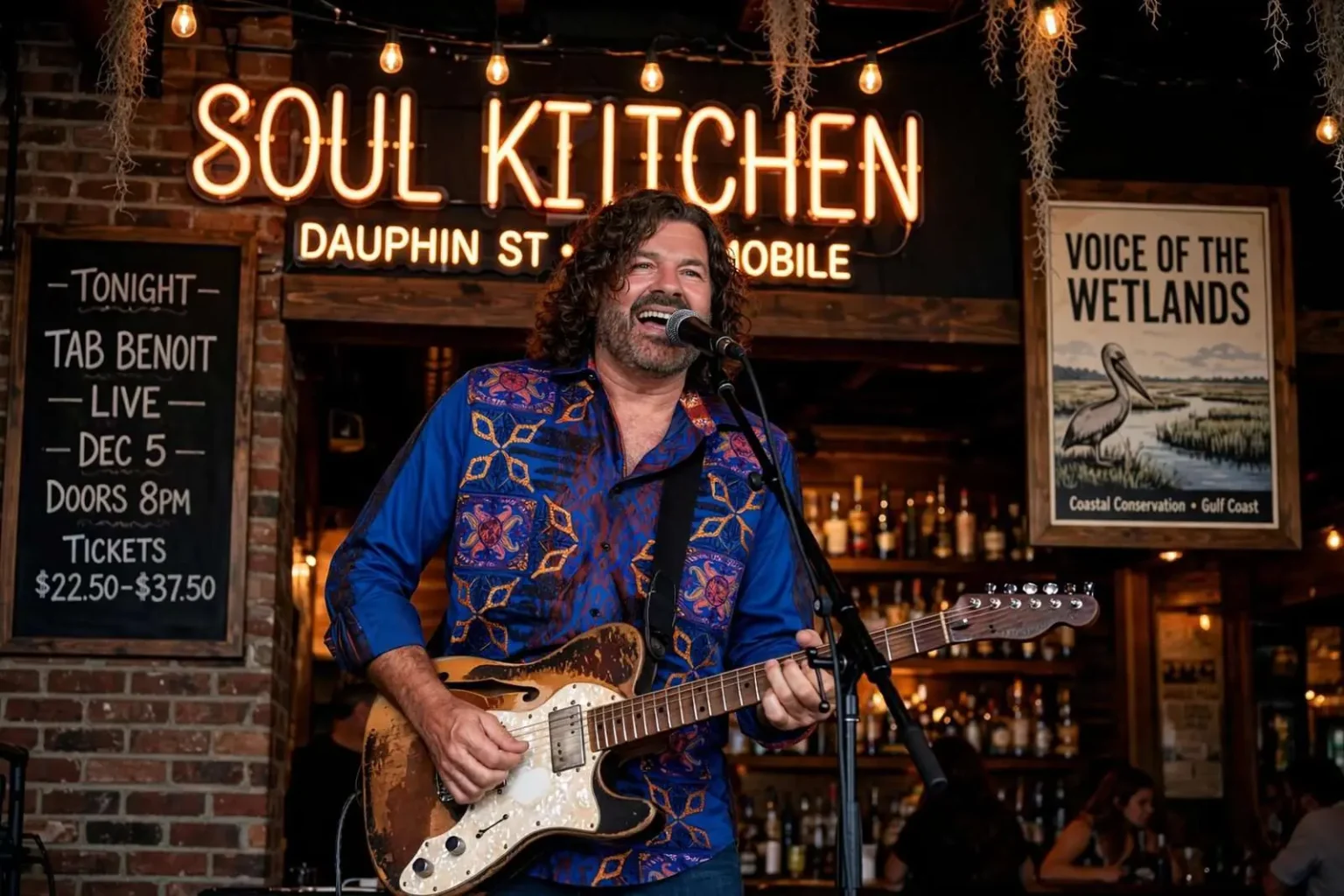
Soul Kitchen in downtown Mobile will host one of its most notable bookings since reopening from pandemic-related closures when Louisiana blues guitarist Tab Benoit takes the stage Saturday, Dec. 5, marking his debut performance at the Dauphin Street venue. Doors open at 8 p.m., with tickets ranging from $22.50 to $37.50 available through the venue’s website or by phone at 866-777-8932.
For a room still finding its footing after months of dark nights and reduced crowds, landing an artist of Benoit’s standing is a statement. Soul Kitchen has long been a fixture of the Dauphin Street entertainment district, the strip of bars, restaurants and music rooms that forms the heart of downtown Mobile’s nightlife, and its calendar since reopening has been filled largely with regional acts. A nationally recognized blues headliner signals that the venue — and the downtown scene around it — believes the audience is ready to come back.
Benoit has spent nearly three decades building a reputation as one of the most distinctive voices in modern blues, blending Delta and Chicago blues traditions with the swampy, soulful textures of his native Louisiana bayou country. That sound, often described as Acadian or swamp blues, first reached wide audiences with his 1993 debut album, “Nice and Warm,” and has continued to evolve across a catalog that includes his well-known track “Fever for the Bayou,” a song many fans consider the clearest distillation of his musical identity.
A sound rooted in the bayou
Swamp blues occupies a particular place in American music. It grew up in south Louisiana, somewhere between the sparse, haunted Delta style to the west and the horn-driven rhythm and blues of New Orleans to the east, and it carries the rhythms of a landscape where water is never far away. Benoit’s version of it is stripped down and direct: a big, dry guitar tone, a steady groove and a voice that sounds like it was built in the humid air of the bayou country south of New Orleans.
That geography matters to how he plays. Benoit came up in the small towns of Terrebonne Parish, an area of shrimp docks, drawbridges and slow-moving bayous where Cajun culture and blues traditions run deep, and his music has always reflected that world rather than the polished blues of Chicago’s electric era. Reviewers and fans alike have pointed to the way his arrangements leave space — letting a single bent note or a drum shuffle carry a song where other players would stack on layers.
When he arrives in Mobile, audiences can expect a high-energy set built around Benoit’s guitar-driven arrangements and Louisiana-inflected soul, the kind of performance that has made him a fixture on blues festival stages across the country for close to thirty years.
An advocate for Louisiana’s coast
Beyond the stage, Benoit has spent years channeling his platform toward environmental advocacy along the Gulf Coast. He founded Voice of the Wetlands, an organization dedicated to raising awareness about the erosion and degradation of Louisiana’s coastal wetlands. The group’s signature event, the annual Voice of the Wetlands Festival, brings together Benoit and a rotating cast of fellow musicians for performances that double as fundraising and awareness efforts for wetlands restoration.
The cause is not abstract for anyone who lives on the northern Gulf Coast. Louisiana’s coastal marshes serve as a buffer that slows hurricanes before they reach populated areas, and they act as a nursery for the shrimp, crabs and finfish that support commercial fleets on both sides of the Mississippi state line. As those wetlands wash away, the loss is felt not just in Louisiana’s fishing villages but in the seafood houses and harbors of coastal Alabama, where the health of the northern Gulf ecosystem is a shared concern.
Benoit’s advocacy has made him something of an ambassador for the region’s environmental struggles, and his concerts frequently double as informal classrooms, with the guitarist talking between songs about what is happening to the coast he grew up on. For Mobile audiences, that mix of music and message has become part of what a Tab Benoit show is.
A year without stages
Like most touring musicians, Benoit spent much of the past year navigating a live music industry upended by the pandemic. In early November, he appeared alongside blues-rock artist Samantha Fish at Nashville’s historic Ryman Auditorium for a three-hour set performed in front of a limited, socially distanced crowd and streamed live to thousands of additional viewers watching from home.
The Ryman date became one of the templates for pandemic-era touring: a small, spaced-out live audience providing the energy of a real room, with a livestream extending the reach to fans who could not travel. Benoit and Fish, who have collaborated and toured together for years, used the format to stretch out musically in ways a standard club set rarely allows, trading guitars across a long night of blues and roots material.
The experiment also pointed to what artists and venues hope comes next. A livestream can carry a show to listeners hundreds of miles away, but neither the performers nor the clubs that depend on ticket sales can survive on it alone. The return of in-person shows in rooms like Soul Kitchen is the other half of the recovery, and bookings of Benoit’s caliber are a sign that promoters believe audiences will show up.
A long-awaited night on Dauphin Street
For Mobile blues fans, the Dec. 5 date carries a double appeal: it is Benoit’s first appearance at the venue, and it is one of the first chances since the pandemic began to see a major national touring act in an intimate downtown room. Clubs the size of Soul Kitchen are where blues music works best — close enough that the audience can watch a guitarist’s hands and feel the kick drum in the floor.
As with all shows in the pandemic era, attendees should check the venue’s current health and safety policies before arriving, since capacity limits and mask guidance have shifted from week to week across Alabama’s entertainment venues.
Tickets ranging from $22.50 to $37.50 are available through the venue’s website or by phone at 866-777-8932, and doors open at 8 p.m. For a downtown district that depends on live music to fill its sidewalks on weekend nights, a Saturday show by one of Louisiana’s best-known bluesmen is exactly the kind of night the reopening was waiting for.
Downtown Mobile’s entertainment district has been rebuilding its calendar in stages, and every weekend that a national act plays Dauphin Street sends business to the restaurants and bars around it. Music venues work as anchors for the surrounding blocks: a well-attended show fills nearby parking lots, keeps kitchen staffs busy before and after sets, and puts foot traffic back on sidewalks that went quiet during the closures. Downtown business groups have long pointed to that spillover effect as a reason live entertainment sits at the center of the district’s economy.
The Gulf Coast blues circuit that Benoit travels runs through a string of rooms like this one, from New Orleans across the Mississippi coast and into the Florida panhandle. Mobile sits close to the middle of that route, which is part of why the city has historically drawn more than its share of national touring acts for a metro area of its size. When touring routes allow a stop on the central Gulf Coast, Dauphin Street is often where the date lands, and audiences here have grown used to seeing major blues and roots artists in rooms of a few hundred seats.
Benoit’s catalog gives a blues audience plenty of ground to cover in a single night. Material stretching back to “Nice and Warm” has remained in his live repertoire alongside later work like “Fever for the Bayou,” and his concerts tend to move between full-band swamp blues and quieter passages where the guitar alone carries the room. Fans who caught the streaming dates got a preview of that range; a club show is where it lands with full force.
Voice of the Wetlands has also given Benoit’s Gulf Coast appearances a local resonance. The organization’s work has connected musicians, commercial fishermen and coastal researchers around a shared message about land loss, and its festival has become a gathering point for Louisiana artists who share those concerns. Coastal Alabama audiences, watching their own shoreline fight erosion and storm damage, have reasons of their own to listen when Benoit talks about the water.
For the venue, the booking is also a measure of where demand stands. Promoters across the region have spent the past year watching capacity limits, tour postponements and shifting public guidance reshape their business, and a Saturday-night headliner is a bet that Mobile’s audience is ready. Early ticket sales for comparable shows around the region have suggested that regular concertgoers are returning first, filling rooms that depend on them most.
As scheduled, the show falls on Saturday, Dec. 5, with doors opening at 8 p.m. at the Dauphin Street club. Tickets ranging from $22.50 to $37.50 remain available through the venue’s website or by phone at 866-777-8932, and anyone planning to attend should confirm the venue’s current entry policies when purchasing. For fans of Gulf Coast blues, it is a rare chance to hear the sound of the bayou country played by the man who grew up in it — and for downtown Mobile, it is the kind of night the reopening has been building toward.