
Lumber prices spike across Mobile, squeezing builders and homeowners
Lumber prices in Mobile have climbed to three or four times recent levels, adding an estimated $36,000 to the cost of a new home, local builders say.
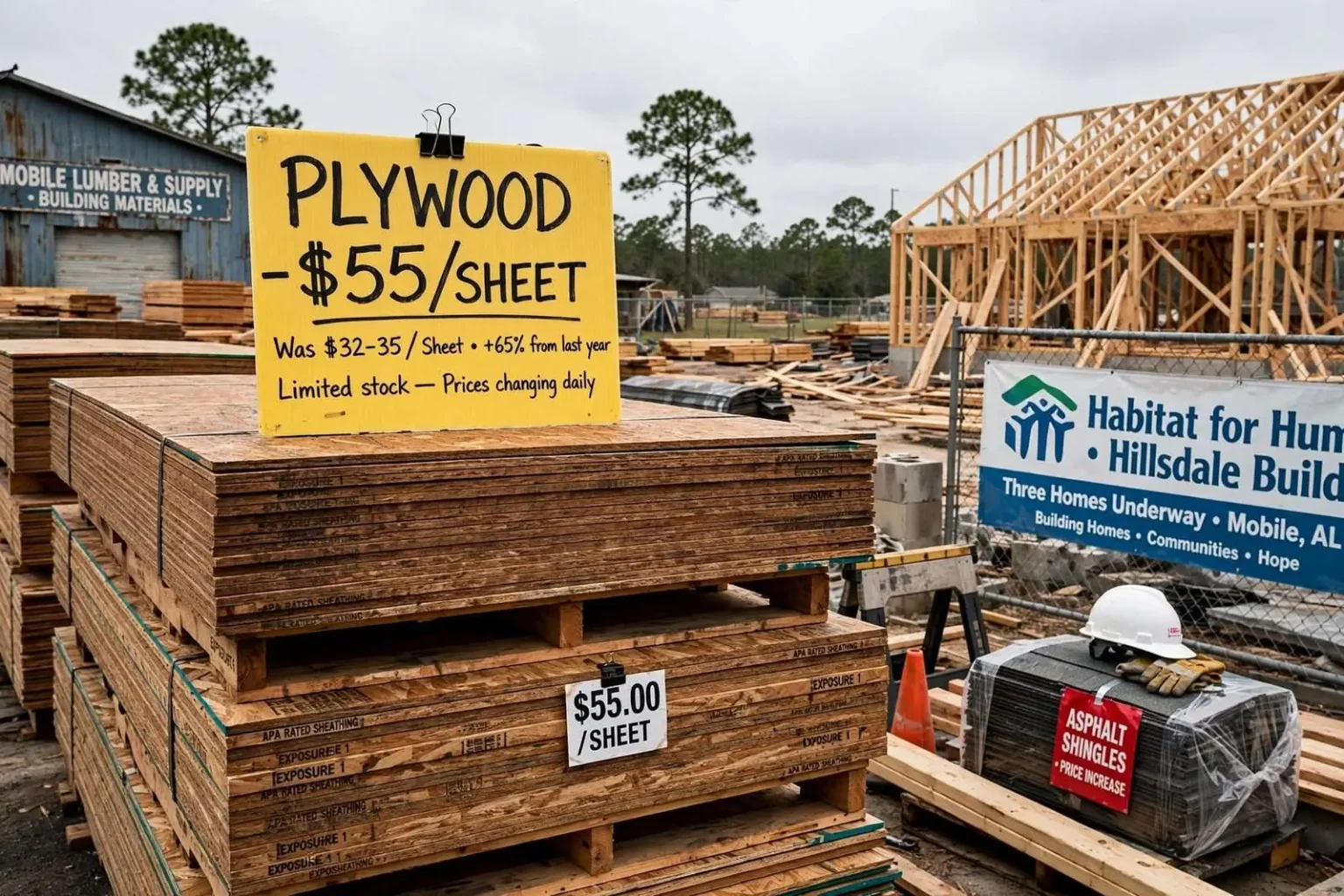
MOBILE, Ala. — Anyone who has visited a lumber yard or big-box store lately has likely felt the pinch of sharply higher wood prices, with some materials costing three or four times more than they did a year or two ago. The increases are being felt across the homebuilding industry in Mobile, from volunteer-driven charity builds to production framing crews, and the ripple effects are reaching anyone who has planned a repair, an addition or a new home along the Gulf Coast.
Courtney Rouse-Heinz, who works in home building with Habitat for Humanity, said the organization currently has three builds and several roofing projects underway, and delaying them because of cost is not a realistic option. A Habitat home under construction in Mobile’s Hillsdale neighborhood is costing the group about twice as much as a comparable home built last year, Rouse-Heinz said.
For a nonprofit that depends on donated funds, volunteer labor and community goodwill to put families into affordable homes, a doubling of construction cost is more than an accounting problem. It means fewer houses completed for the same budget, longer fundraising timelines, and families waiting longer for keys. Roofing projects add another layer of urgency: a roof that cannot wait for prices to fall is a roof that must be replaced at whatever the market charges, particularly when a damaged roof leaves a family exposed to the Gulf Coast’s frequent storms.
At the Lumber Yard
Carpenter Tony Causey, who has been watching plywood prices climb, said some plywood that recently arrived at his supplier was priced around $55, compared with roughly $32 or $35 in the past.
Plywood and oriented strand board are the structural backbone of most American homebuilding — they sheathe walls, roof decking and subfloors — so a jump of twenty dollars or more per sheet compounds quickly across a single house, which can require dozens of sheets before framing is complete. Carpenters and contractors who bid jobs weeks in advance have found themselves absorbing losses when materials arrive priced higher than their quotes assumed, and many have begun writing price-escalation clauses into contracts simply to survive the volatility.
The pain is not confined to job sites. Homeowners walking the aisles of a big-box store for a weekend deck repair or fence project have encountered the same sticker shock, and small repair contractors who quote fixed prices for customers face the same squeeze as production builders, without the volume discounts that cushion larger firms.
How the Prices Got Here
According to the National Association of Home Builders, lumber prices began rising as far back as 2018 but accelerated in 2020 as pandemic-related demand surged. The NAHB estimates the soaring prices have added about $36,000 to the cost of building a typical single-family home.
The pandemic turned the lumber market upside down in two ways at once. Mill operations slowed or idled early in 2020 as health precautions took hold, shrinking supply just as lockdowns triggered a do-it-yourself and home-improvement boom. At the same time, historically low mortgage rates set off a homebuilding and renovation rush, and nearly everyone — families fleeing cramped apartments, remote workers adding home offices, investors chasing new construction — was buying wood at the same moment. Futures markets, which had long treated lumber as a quiet commodity, swung violently as supply chains built for steady demand buckled under the spike.
Local Voices on the Squeeze
Today’s Homeowner host Danny Lipford said low interest rates are driving a wave of construction, even as contractors face challenges moving projects forward. He predicted prices could begin peaking and easing over the following months, though he cautioned the adjustment would be gradual.
Lipford, a Mobile-based remodeling expert whose nationally syndicated home improvement program has long made him one of the Gulf Coast’s most recognizable voices on construction, framed the dynamic the way many contractors describe it: demand is not the problem — money is cheap and everyone wants to build — but the cost and availability of materials keep pulling projects sideways. Bids expire faster, schedules stretch, and homeowners who budgeted a project a year earlier are discovering the same work now costs dramatically more.
His caution about the pace of any decline reflected how these markets actually unwind. Mills take months to restart and ramp up, inventories take time to refill, and builders who pre-ordered at high prices do not slash quotes overnight. Even when prices peak, they tend to drift down unevenly rather than return immediately to old levels, which is why industry economists generally counsel homeowners to plan for elevated costs even as the worst of the spike passes.
More Than Just Lumber
The run-up is not limited to lumber. Builders report that nearly every commodity used in construction, from shingles to bricks to concrete, has seen prices jump.
The broad-based inflation changed the math on every line of a construction budget. Asphalt-based shingles track oil prices, which had climbed sharply. Bricks and concrete carry energy-intensive manufacturing costs, and the freight that moves all of it — trucks, rail, and ships bringing imported goods into Gulf ports — grew more expensive as well. Contractors who could once substitute materials or re-engineer plans to shave costs found few alternatives left when everything rose together.
For the Mobile area, where new subdivisions continue to spread across the county and older housing stock requires constant repair, the consequences are practical and immediate. Higher construction costs feed directly into the price of new homes, appraisals, insurance replacement values and renovation quotes. First-time buyers stretch further to qualify for the same house, landlords pass costs into rents, and nonprofits like Habitat face the hardest math of all, since their mission depends on building affordably in exactly the market that has become least affordable.
The hope, for builders and homeowners alike, is that the forces driving prices upward eventually meet the forces pulling them back: increased mill production, moderating demand, and freight networks that return to normal. Until then, the region’s builders say they will keep adapting — repricing jobs, reordering early, and asking customers for patience — as they wait for the lumber market to give them room to breathe.
What It Means for Local Families
The squeeze arrives at a difficult moment for households across the region. Rent and home prices along the Gulf Coast have been climbing for years, and every additional dollar in construction cost works against the families least able to absorb it. A working family saving for a down payment watches the price of the same starter house rise faster than its savings; a homeowner with a storm-damaged roof faces a repair quote far above what neighbors paid a few years ago; and a young couple planning to build on family land must decide whether to start now at today’s prices or gamble on waiting out the market.
Contractors describe families making difficult trade-offs in response. Some downsize their plans, trimming square footage or finished space to keep a project within reach. Some defer the garage or the third bedroom to a future phase. Others proceed anyway, knowing that waiting carries its own risk — labor costs have been rising alongside materials, and there is no guarantee that either declines meaningfully in the near term. In a region where hurricanes can rewrite construction plans in a single September, delay is not always a safe option.
Charity builders like Habitat face a version of the problem with higher stakes. The organization’s model depends on fixed budgets, donated dollars and volunteer hours producing real homes, so when the cost of materials doubles, the choice is stark: raise more money, build fewer homes, or push families further down the waiting list. Local Habitat affiliates across the Gulf Coast have leaned on community fundraising, corporate material donations and ReStore sales to bridge the gap, but the math gets harder every time a sheet of plywood climbs another ten dollars.
Reading the Market Ahead
Industry analysts watching the cycle generally point to a familiar pattern: prices that spike on shortage and panic eventually retreat when production catches up, but rarely all the way back to where they began. Mills that restart bring supply online over months, not weeks. Builders who deferred projects eventually return to the market. And as financing costs or buyer fatigue cool demand, the pressure eases from both directions at once. The question for the Gulf Coast building community is timing — how long the adjustment takes, and how many projects get repriced or postponed before it arrives.
In the meantime, those in the trade offer practical advice for ordinary homeowners. Get multiple bids and ask contractors how long their pricing holds before signing. If a project can be phased, bid it as a whole now and build it in stages, locking in work as budget allows. Budget a contingency of ten to twenty percent rather than treating the first estimate as final. And be skeptical of any bid that seems dramatically lower than the others, since it may reflect materials costs the contractor has not yet updated.
None of that changes the underlying reality that Mobilians have watched unfold at their local lumber yards: the raw materials of building a home in America became dramatically more expensive in a short span of time, and communities like this one are still absorbing the shock. The volunteers in Hillsdale, the carpenter watching plywood quotes, and the contractor pacing a kitchen remodel are all living through the same market — one that, everyone hopes, has already begun to turn.


