Lundi Gras 2013: Infant Mystics, Cajun Bike Rides, and a Full Slate of Parades Hit Mobile and Fairhope
Lundi Gras 2013 brought a full day of Mardi Gras parades to Mobile and Fairhope, including the Infant Mystics and Mobilians on Bikes' first Courir de Mardi.
Lundi Gras — the Monday before Mardi Gras — brought a packed schedule of parades and festivities to Mobile and the Eastern Shore on February 11, 2013. From one of the city’s oldest mystic societies rolling through downtown to a Cajun-inspired costumed bike ride through Midtown, the day offered something for every flavor of carnival enthusiast. The full slate set the stage for Fat Tuesday the following day, when the city’s biggest parades would close out a carnival season that began weeks earlier and runs deeper in Mobile’s history than anywhere else in the country.
For Mobilians, Lundi Gras has long been more than an appetizer for Mardi Gras. The Monday schedule traditionally layers school-age parades, neighborhood processions and the first of the season’s major mystic society rides, giving families a full day of carnival that crowds can navigate on foot and longtime residents treat as the true opening of the final celebration. The 2013 calendar was one of the busiest Lundi Gras lineups in recent memory, spanning downtown Mobile, the city’s northern neighborhoods and downtown Fairhope across the bay.
The Infant Mystics Ride Again
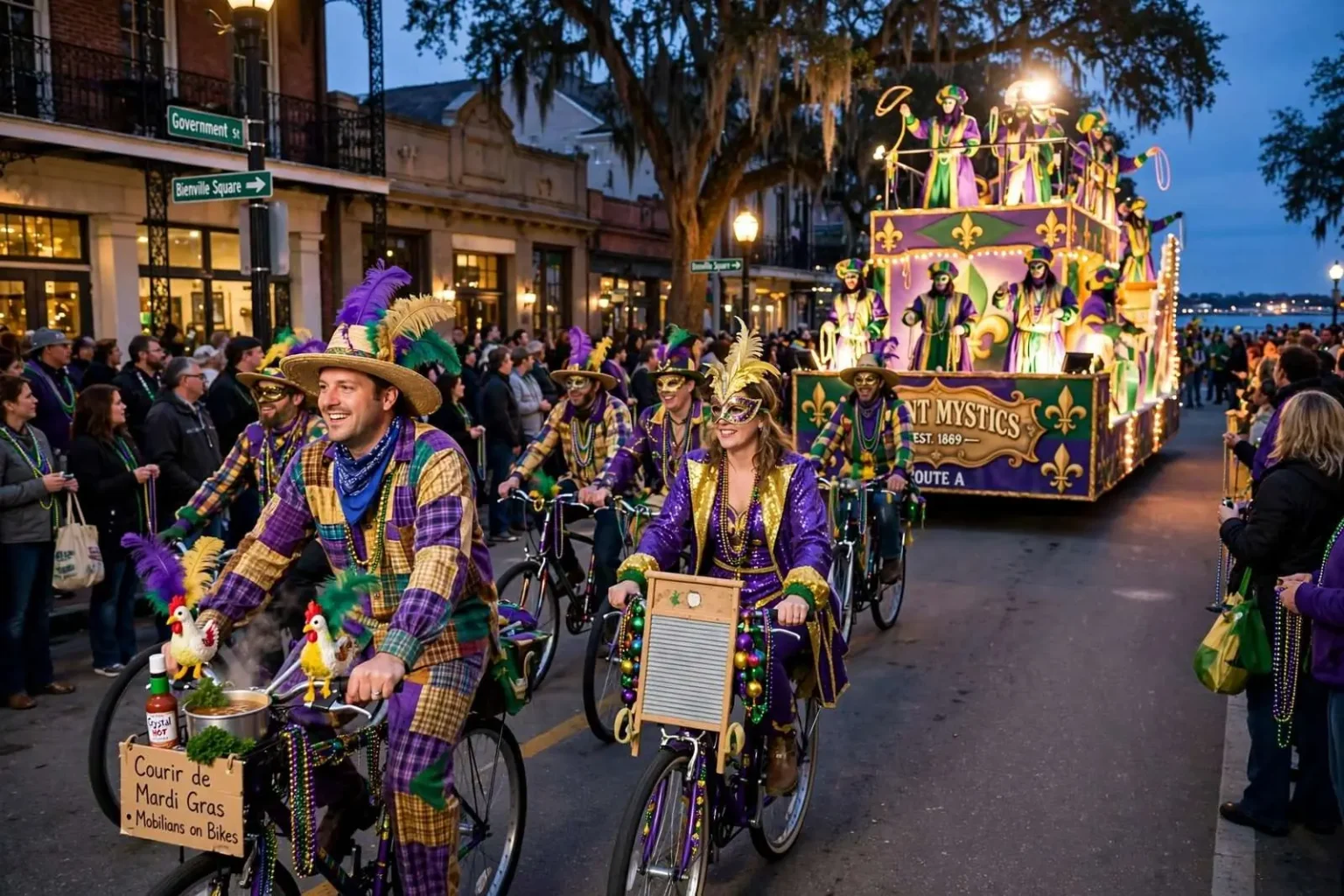
The Infant Mystics, one of Mobile’s most storied Mardi Gras organizations, took to their traditional Route A for their evening parade at 6:30 p.m. Founded in 1869, the society has long been known for its lavish masquerade balls and generous throws, and the 2013 ride carried on that tradition in grand fashion. An organization that has been parading since the years just after the Civil War occupies a special place in the city’s carnival hierarchy: the Infant Mystics rank among the oldest continuously operating mystic societies in a city that invented the American Mardi Gras tradition, with their emblem and throws among the most recognizable of the season.
Route A threads through downtown Mobile, carrying floats along the same corridors the city’s parades have traveled for generations, with sidewalk space at a premium along Government Street and the streets around Bienville Square. An evening slot on Lundi Gras gives the society’s parade the full carnival atmosphere — floodlit floats, marching bands, masked riders — while leaving Fat Tuesday’s daylight hours to the day’s larger processions.
The throws the society is known for carry their own economy of anticipation. Seasoned parade-goers along Route A know which floats carry the prized items — decorated cups, medallion beads, plush throws — and position themselves accordingly, a ritual as much a part of Mobile’s carnival as the parades themselves.
Mobilians on Bikes Launch Cajun-Style Courir de Mardi Gras
In a colorful new addition to the city’s carnival calendar, the cycling group Mobilians on Bikes held its first annual Courir de Mardi Gras — a bicycle-based take on the traditional Cajun Mardi Gras celebration. The costumed ride began at Murphy High School, where participants pedaled door to door through Midtown neighborhoods, “begging for lagniappe” at member homes along the route.
The courir is an import with deep roots. In rural southwest Louisiana, the traditional Cajun Mardi Gras sends costumed riders — the courir — from house to house on Fat Tuesday, begging ingredients for a communal gumbo through song, dance and theatrical mischief, capped by the famous chicken chase in which riders pursue a live chicken through fields and ditches. Bringing the tradition to Mobile on bicycles, a day early, gave the city’s carnival a taste of its cousin celebration to the west — and gave Midtown residents a parade that moved at the speed of a bicycle instead of a float.
The festivities included a Bayou Chicken Chase, in which costumed riders pursued a designated chicken runner through the streets of Midtown Mobile until the quarry was caught. The runner — a stand-in for the live chicken of the Louisiana tradition — turned the neighborhoods between Murphy High School and the ride’s finish into a rolling comedy chase, with riders in full costume pursuing the prize on two wheels while onlookers cheered from curbs and porches. The element of theatrical pursuit is the heart of any courir: the begging, the chase and the eventual feast are all staged as one continuous performance in which the audience is invited to laugh at the riders rather than merely watch them.
The ride concluded at the home of the group’s captain, where participants gathered for a Cajun-style gumbo party complete with zydeco music. The gumbo closed the circle on the courir’s logic — whatever is begged on the ride feeds the party at the end — and the zydeco soundtrack gave the Midtown gathering the accordion-and-rubboard flavor of the Louisiana prairie parishes where the tradition was born. For a first-year event, the formula landed: costumes, choreography, community and a hot pot of gumbo at the finish.
Mobilians on Bikes has built a following as one of the city’s most visible cycling groups, and the Courir de Mardi Gras gave the club a signature carnival event of its own. The ride’s route through Midtown also demonstrated how Mobile’s carnival has expanded beyond its downtown core in recent decades, with neighborhood celebrations and improvised traditions taking their place alongside the formal parades of the established mystic societies.
A Full Day of Parades
The rest of the day’s lineup kept the streets busy from noon onward. The Floral Parade rolled at noon along Route A, bringing the season’s school-age and civic-flavored pageantry through downtown, while the Prichard Parade stepped off at noon as well, carrying carnival across the city line into Mobile County’s northern neighbor. The two noon parades split the audience geographically and gave the day its family-friendly opening act, with school bands and community groups filling the streets before the evening’s mystic society rides.
The afternoon belonged to Route D, which hosted three parades in succession: the MLK Business and Civic Organization parade and the MLK Monday Mystic Adults parade, both at 3 p.m., followed by the Northside Merchants parade at 4 p.m. The MLK Avenue corridor’s parades have grown into one of the distinctive features of Mobile’s modern carnival — a celebration of the neighborhood’s own traditions, businesses and organizations, staged with full carnival pageantry. Back-to-back processions on the same route kept the crowds in place for hours, with the afternoon’s triple bill giving the northside neighborhoods a Lundi Gras schedule of their own.
Over in Fairhope, the Order of Mystic Magnolias paraded through downtown at 6:45 p.m., capping off a full day of celebrations across the region. The Magnolias are Fairhope’s own carnival society, and their Monday evening ride has become the Eastern Shore’s signature carnival event — drawing crowds from across Baldwin County to the streets around downtown Fairhope, where the parade’s route wraps through the small city’s tree-lined blocks before ending near the bluff overlooking Mobile Bay. The 6:45 start gave Eastern Shore families a carnival evening of their own without crossing the bay, and gave the day’s schedule a fitting geographic symmetry: Mobile’s traditions rolling on the western shore, Baldwin County’s on the eastern.
The spread of parades across the two shores on a single Monday illustrated how thoroughly carnival now blankets the region. A resident of Mobile could start the day at the Floral Parade at noon, spend the afternoon along Route D with the three northside parades, catch the Infant Mystics downtown at 6:30 and still be in Fairhope — across the bay — for the Mystic Magnolias shortly after. The Eastern Shore ride’s timing was arranged to let it complement rather than compete with the Infant Mystics, splitting the evening between the two communities.
Behind the day’s festivities sits the calendar itself. Lundi Gras 2013 fell on February 11, with Mardi Gras arriving the next day — February 12 — bringing the season’s climactic parades, the closure of downtown streets, and the masquerade balls that close the mystic societies’ year. The Monday lineup functions as the season’s dress rehearsal and its family day combined: shorter parades, afternoon time slots, neighborhood routes, and by 2013, new traditions like the courir ride adding variety to a calendar that stretches back generations.
Mobile’s claim as the birthplace of American Mardi Gras gives all of it a particular weight. The city’s first organized carnival celebration dates to 1703, predating New Orleans’ founding by more than a decade, and the mystic society system — masked balls, secret membership, themed parades and signature throws — was developed in Mobile before spreading across the Gulf Coast. By 2013 the tradition had grown to encompass more than five weeks of parades each season, with Lundi Gras and Mardi Gras forming the two-day crescendo at the end.
The Infant Mystics’ 2013 ride carried that history downtown; the Mobilians on Bikes courir carried its playful spirit through Midtown on two wheels for the first time; the northside parades carried it along the MLK corridor; and the Mystic Magnolias carried it across the bay. For the crowds that lined the routes on February 11, the day offered the full range of what the Gulf Coast’s carnival season has become — a centuries-old tradition, still adding new chapters, with one more day of celebration still to come.