M.O.O.R.E. Masquerade Ball Brings Original Music and Open-Door Spirit to Mobile Mardi Gras
The sixth annual M.O.O.R.E. Masquerade Ball returns to Azalea Manor Feb. 13-14, pairing original local music and projection-mapped visual art with an organizer pledge to welcome anyone who wants to attend.
Mobile’s Mardi Gras season is famous for its mystic societies, whose masked members roll through downtown streets each year tossing moon pies and trinkets from towering parade floats. Alongside the parades, those same societies host elaborate formal balls, invitation-only affairs long associated with exclusivity.
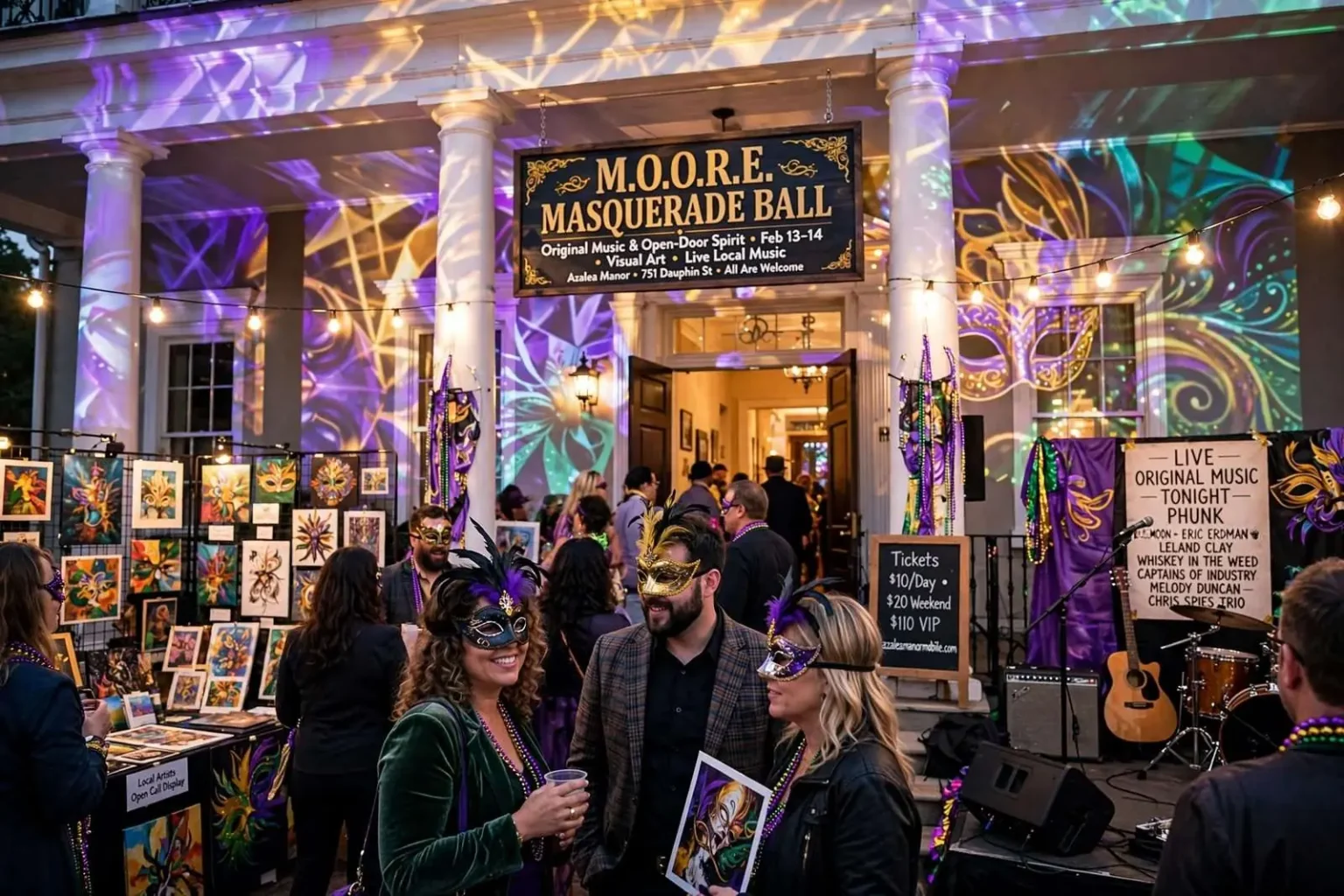
A trio of local music and arts professionals is offering an alternative this year with the sixth annual M.O.O.R.E. Masquerade Ball at Azalea Manor, a two-day event built around original local music, visual art and an open-door philosophy.
The event is the brainchild of Ryan Maness, Wes Isherwood and Aaron Rudzinsky, three fixtures of Mobile’s music and entertainment scene who say they created M.O.O.R.E. after noticing how selective some traditional Mardi Gras balls could be about who was welcome inside.
“The first ball that I went to, some friends of mine, who would typically not be allowed at the event, came with us,” Maness said. “I just saw the reaction on everybody’s face, and it felt like some kind of game, where they were keeping up appearances. Really, they only wanted certain people there. So, I felt like the M.O.O.R.E. could be something for everybody and anybody.”
The founders also wanted to fill what they saw as a gap in the traditional ball format: original music performed by the artists who wrote it, rather than cover bands playing crowd-pleasing standards. “One of the things these Mardi Gras balls also don’t have is original music,” Rudzinsky said. “You don’t see that. You see cover bands. People like to go see a band where they can sing along to every song. That’s all well and good, but Mobile has a rich music and art scene that must be celebrated as well. This fills that gap.”
All three organizers have deep roots in Mobile’s creative community. Maness is the bar manager at Soul Kitchen and also runs the monthly Elements hip-hop showcase there. Isherwood has worked production for touring acts including Kung Fu Mama and Dumpstaphunk, along with numerous venues and festivals. Rudzinsky is a videographer who produced the television show “Just Live Music.”
The three previously teamed up to launch the Deep South Music Festival, and organizing M.O.O.R.E. together, they said, grew naturally out of years of collaborating on projects meant to spotlight the local scene. “We’ve been working together for a long time,” Isherwood said. “We’ve all done various work both here and nationally, but we’ve always had this focus on our local scene and local community and trying to make something happen where we get the same people that we’ve worked with for 20 years now together in one place to all share the same feeling.”
Music remains the centerpiece of the ball, which has built a reputation for booking strong regional and local talent, including at least one act from outside the Southeast most years. This year’s lineup leans heavily on Mobile-based performers.
Phunk Blue Moon, a live-instrument hip-hop group known for capturing the spirit of Mardi Gras well past Ash Wednesday, returns as the event’s first repeat act. Eric Erdman is also scheduled to perform, bringing along collaborators from his recent album release show at Soul Kitchen.
Also on the bill is Whiskey in the Weed, a project featuring Zach DePolo, Ashlea Penquite and Jordan Kimsey. Singer-songwriter Leland Clay will bring his own brand of homemade, offbeat music, and the Captains of Industry — guitarist Corky Hughes, keyboardist Chris Spies and drummer John Milham — will take the stage, with Spies staying on afterward to perform with the Chris Spies Trio. Violinist Melody Duncan rounds out the musical lineup.
Beyond the music, organizers are planning a heavy dose of visual spectacle. Isherwood and Rudzinsky will use video projection mapping to wash the exterior and interior of Azalea Manor in shifting, light-driven imagery, a technique more commonly associated with modern concert productions than Mardi Gras balls. A range of local visual artists will also display work throughout the venue; organizers say the invitation to participate was open to any interested artist, not limited to those already connected to the group.
“It was an open invitation,” Maness said. “It’s not just artists that we know personally, it’s people who knew about the function and wanted to be a part of it, which goes back to us wanting to have everyone involved and participating.”
Ticket packages include a VIP option offering access to private restrooms, dedicated parking, bar deals and catering at Azalea Manor, with some VIP amenities tied in with Fat Tuesday.
The organizers have ambitions beyond this year’s event. Rudzinsky said he hopes M.O.O.R.E. can grow into Mobile’s premier Mardi Gras ball, while Maness wants to eventually add nationally touring acts to the lineup. The group has also talked about getting attendees involved in the “People’s Parade” held on Joe Cain Day.
For now, though, the focus is on this year’s event. “There will be a lot of randomness brought to the mix by the patrons and artists themselves,” Isherwood said. “Expect the unexpected.”
The sixth annual M.O.O.R.E. Masquerade Ball runs Feb. 13-14 starting at 4 p.m. both days at Azalea Manor, 751 Dauphin St. Tickets are $10 per day, $20 for the weekend or $110 for VIP access, available at Azalea Manor or online at azaleamanormobile.com.
About Mobile’s Mardi Gras Balls and Joe Cain Day
Mobile traces its Carnival celebrations to the early 1700s and calls itself the birthplace of Mardi Gras in the United States. Most of the season’s formal balls are hosted by mystic societies, and admission has traditionally required an invitation from a member.
Joe Cain Day, the Sunday before Fat Tuesday, honors Joseph Stillwell Cain. Shortly after the Civil War, he paraded through Mobile’s streets dressed as the fictional Chickasaw chief “Slacabamorinico,” helping revive Carnival in the city. The People’s Parade held that day is open to community groups rather than mystic societies.