Man Arrested After Overnight Shootout at Pensacola Apartment Complex
Deputies arrested Flenory Lee after an overnight shootout at Oakwood Terrace Apartments in Pensacola that shattered windows and struck a car.
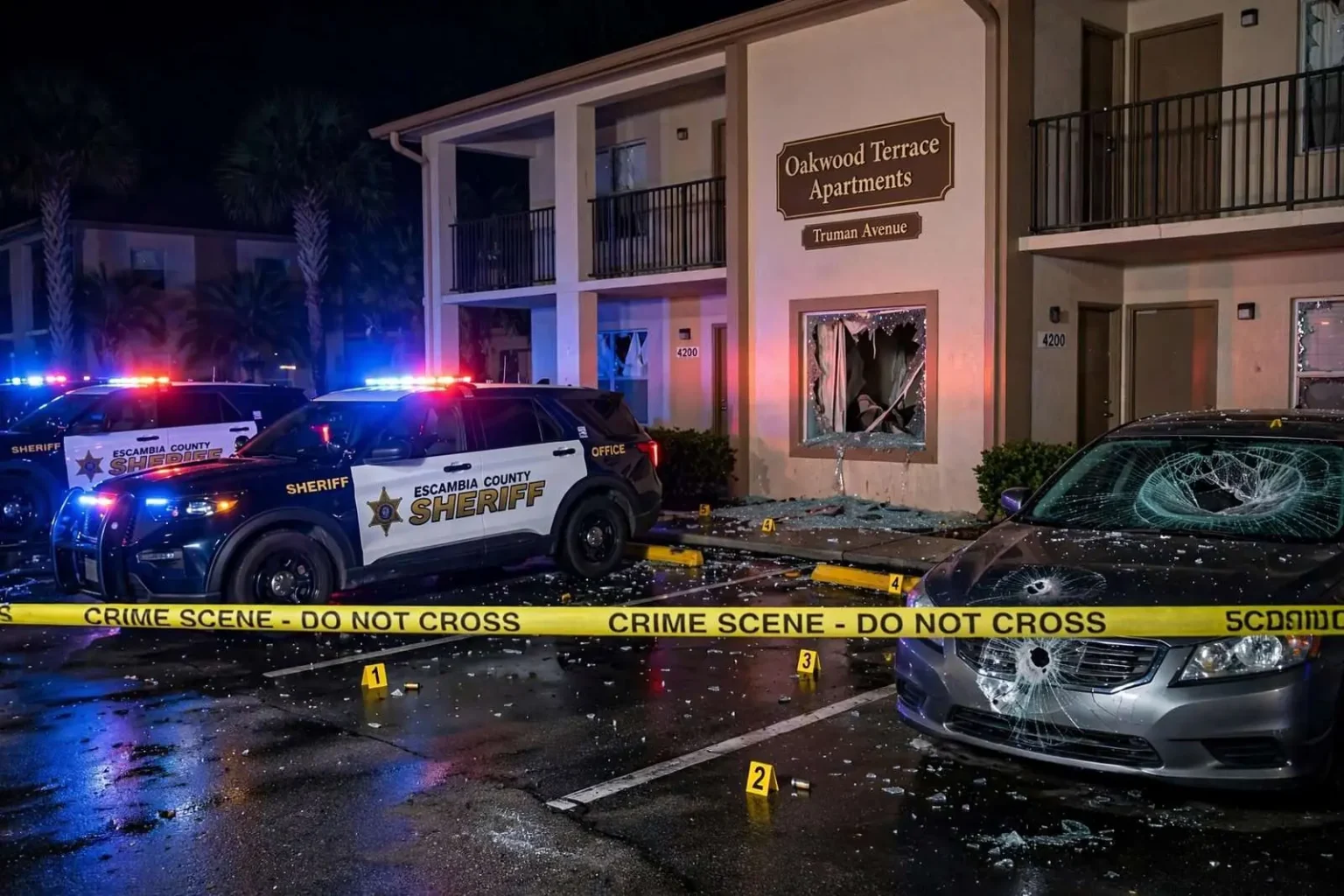
PENSACOLA, Fla. — An overnight gun battle at a Pensacola apartment complex has landed one man in jail after residents woke to the sound of gunfire outside their windows, and deputies are still searching for a second shooter who fled the scene.
Flenory Lee, 45, is accused of getting into a fight with another man and exchanging gunfire with him at the Oakwood Terrace Apartments on Truman Avenue, according to the Escambia County Sheriff’s Office. A deputy arriving on scene reported hearing multiple gunshots, putting an officer at the complex while the shooting was still underway or had just ended.
Witnesses described two shooters firing at each other following a fight, and investigators collected several shell casings from the area — the physical evidence that will help detectives reconstruct where each shooter stood and how many weapons were fired. The barrage caused real damage: one resident reported her bedroom window shot out, and another found a bullet hole in the windshield of a vehicle.
Deputies located Lee a short distance away walking along Massachusetts Avenue carrying a loaded gun, officials said. He was booked into the Escambia County Jail on $51,500 bond as the search for the second shooter continued.
What Deputies Found at the Scene
The details investigators work from in a case like this begin with the casings. Each shell casing recovered marks where a shot was fired, and a spread of casings across a parking lot or courtyard lets crime scene technicians map the positions of the shooters — how far apart they stood, whether they moved during the exchange, and how many rounds each weapon discharged. Paired with the accounts from witnesses who described two shooters firing at each other, the casings give detectives the skeleton of the shootout’s layout.
The property damage tells the other half of the story. A bedroom window shot out and a bullet hole in a windshield demonstrate that the rounds did not stay between the two men — the shots crossed living space and parked cars in a complex full of sleeping residents. Gunfire of that kind at a multifamily complex is exactly the scenario that turns a fight between two people into a neighborhood-wide hazard, and it is why the Sheriff’s Office response treated the case as a matter for serious charges rather than a mutual scuffle that escalated.
The deputy who arrived hearing multiple gunshots provided a critical midpoint in the timeline — official confirmation, on the record, of the shooting in progress. In cases built on witness accounts, that kind of law-enforcement corroboration of the gunfire itself anchors the reconstruction of when and how the exchange happened.
The Arrest Along Massachusetts Avenue
The speed of the arrest reflects the timing of the deputy’s arrival. Because the responding deputy was on scene while the gunfire was still audible, the search for the shooters began within minutes rather than after a delayed report, narrowing the window in which someone could leave the area on foot. Lee’s location a short distance away — still carrying the loaded gun — put him in custody before the complex had fully processed what had happened, and the second shooter’s flight is being investigated against the same compressed timeline.
Lee’s arrest came down to proximity and timing. Located a short distance from the complex on Massachusetts Avenue — a road that runs near the Truman Avenue corridor — he was still carrying a loaded gun when deputies found him. For investigators, a suspect located minutes after a shootout, in the immediate area, and armed with a firearm forms a circumstantial chain that begins with the flight from the scene; what prosecutors will need is the evidence — casings, witness identifications, and any forensic links — to connect Lee specifically to the shots fired at Oakwood Terrace.
That work is why the search for the second shooter matters so much to the case as a whole. Witnesses put two people at the exchange of gunfire, and an account that identifies both participants gives detectives a complete event to investigate rather than half of one. The Sheriff’s Office has not named the second shooter, and investigators have not said whether that person has been identified but not yet located, or remains unknown.
The loaded firearm recovered with Lee will itself be examined — for whether it was fired, how it compares to the casings at the scene, and whether its history includes other incidents. Ballistics comparisons of that kind are standard in shooting investigations and can confirm or eliminate a weapon’s role in an exchange within days of the recovery.
The Bond and the Charges to Come
Lee’s $51,500 bond reflects the stack of allegations a shooting case typically carries. Bond amounts in Florida are set by a schedule that assigns figures to each charge and enhances them for factors like the use of a firearm, and a total in this range generally indicates multiple counts rather than a single allegation — a structure consistent with an arrest that followed a shootout causing property damage across an apartment complex. The specific charges Lee faces were not detailed in the initial Sheriff’s Office account, which described the allegations and the booking total without enumerating every count.
Bond also assumes a practical role in a case still under investigation. A defendant released on bond remains under court supervision while detectives continue their work, and the months between arrest and prosecution are often when the complete picture — ballistics results, witness interviews, the second shooter’s identity — comes together. The bond figure is designed to be high enough to ensure the defendant’s appearance while the case matures.
Overnight Shootings and the Residents Who Live With Them
For the people who live at Oakwood Terrace, the episode turned an ordinary night into the kind of experience residents of apartment complexes describe with dread: waking to gunfire outside the window, taking cover, and emerging in the morning to find bullet holes in their own walls and vehicles. The damage in this case — a bedroom window and a vehicle windshield — struck property rather than people, but the margin was thin, and a shot that enters a bedroom crosses the line between property crime and a threat to life without anyone deciding it should.
Complexes along the Truman Avenue corridor sit in one of Pensacola’s dense residential areas, where apartment living puts neighbors in close proximity to whatever happens outside their doors. Community policing in these neighborhoods leans on exactly the cooperation seen here — witnesses who told deputies what they saw and heard. In shooting cases with no wounded victims, witness accounts are often the difference between an arrest and a case that stalls, which is why investigators consistently appeal for residents to come forward even days after an incident.
The Escambia County Sheriff’s Office has jurisdiction over the unincorporated stretches of the county and works the major crime response in areas around the city, and an overnight shootout with shots fired across a residential complex draws the agency’s full investigative apparatus: patrol deputies who secure the scene, crime scene technicians who process the casings, and detectives who carry the case forward.
What Comes Next
The case moves forward on two tracks at once: the prosecution of the man already in custody and the continuing hunt for the shooter still at large. Both depend on the same evidence set gathered from the complex overnight.
The search for the second shooter remains the open thread in the case. Until that person is identified and located, the account of the night’s events has one participant in custody and one at large, and investigators will continue working the witness descriptions and evidence collected at the scene to close that gap. Anyone with information about the shootout or the identity of the second shooter can contact the Sheriff’s Office or leave an anonymous tip through Crime Stoppers of the Panhandle region, which channels tips to investigators without requiring a name from the caller.
Lee, meanwhile, remains booked at the Escambia County Jail ahead of his first court appearances, where the full set of charges behind the $51,500 bond will be laid out and a trial timeline will begin to take shape. The loaded gun he was carrying, the shell casings from the complex, and the statements of the residents who heard the shootout will form the evidence prosecutors assemble in the weeks ahead.
For the Oakwood Terrace residents whose windows and windshields took the stray fire, the case’s progress matters for a simple reason: an arrest for the shooting is only half the outcome they are counting on, with the other half being the certainty that the people who fired across their homes at night have been held to account for all of it.