Man Fatally Shot on Felhorn Road; Police Say Self Defense Possible
A 28-year-old man died after an early-morning shooting on Felhorn Road East in Mobile; police say the case will go to a grand jury.
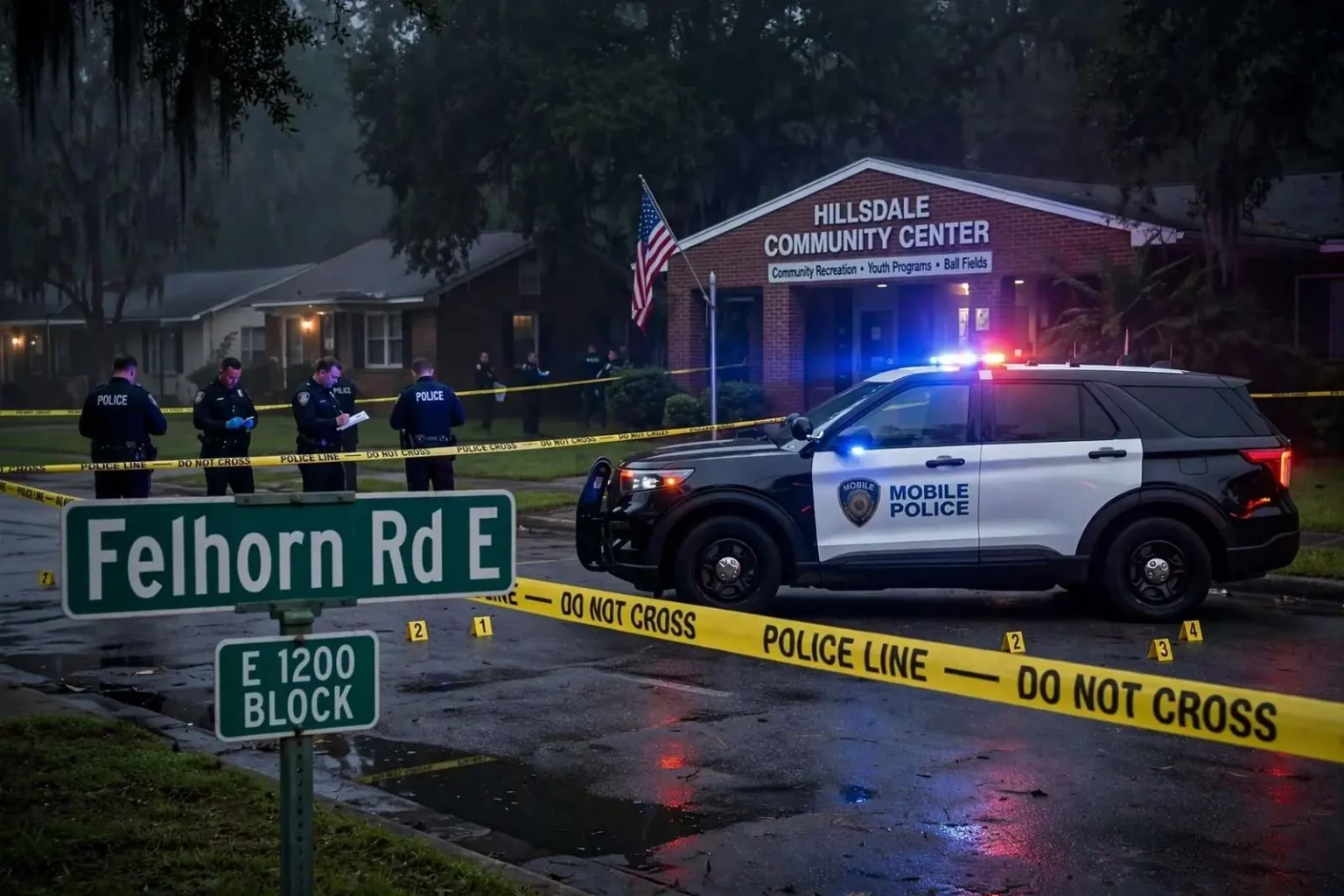
Mobile police are investigating after a 28-year-old man was shot and killed early Wednesday, August 24, in the Hillsdale area of Mobile. According to a release from the Mobile Police Department, officers responded around 1:07 a.m. to a report of shots fired at an address on Felhorn Road East near the Hillsdale Community Center. When they arrived, they found a 28-year-old man who reported that he had been shot. The victim was taken to a hospital for treatment but later died from his injuries, and an autopsy will be performed to determine the official cause of death.
What Police Found
The call came in as shots fired in a residential pocket of the Hillsdale neighborhood, an area of midtown-adjacent Mobile built around community landmarks like the Hillsdale Community Center and its ball fields. Officers arriving in the early morning hours found the wounded man still conscious enough to report that he had been shot, a detail that shaped the first phase of the investigation. Patrol officers secured the scene, and detectives took over to document evidence, canvass for witnesses, and piece together the sequence of events that ended with gunfire on Felhorn Road East.
In shootings that occur in the middle of the night, the first hours are critical. Investigators look for shell casings, damage to homes and vehicles, surveillance video from nearby residences and businesses, and anyone who heard an argument or saw people leaving the area before police arrived. Witnesses in residential neighborhoods are often reluctant to come forward, which is why the department paired its public appeal for information with an anonymous tip option that allows residents to share what they know without revealing their identity.
Officers secured the scene within minutes of arrival, holding the block while detectives were summoned. The wounded man was transported for emergency treatment, but his injuries proved fatal, turning a shots-fired call into a death investigation. The stretch of Felhorn Road East where it happened sits a short distance from the community center’s grounds, and by daylight, neighbors walking past the taped-off scene were already trading accounts of what they had heard in the night.
Possible Self Defense
In its release, the department said evidence gathered so far suggests the person who fired may have acted in self defense. “Based on evidence gathered, the subject may have acted in self defense,” the release stated. “Therefore, the case will be presented to a grand jury.” That language is significant: rather than an immediate arrest, investigators are routing the evidence to Mobile County’s grand jury, the body that decides whether criminal charges are warranted based on what prosecutors present to it.
Alabama law allows a person to use deadly physical force in self defense when they reasonably believe it is necessary to protect themselves against death or serious physical injury, and the state’s self defense statutes include protections for people who use force in places they have a right to be when faced with an imminent threat. But the decision is never made on the street the night of the shooting. Detectives gather the physical evidence, forensic results, and witness accounts, and prosecutors review that record before determining what goes to the grand jury. Presenting a case to the grand jury is the standard route when a death involves a possible claim of justifiable force.
How a Grand Jury Review Works
A grand jury in Alabama meets in secret and hears evidence presented by the district attorney’s office. Its members decide whether there is probable cause to indict — that is, whether the evidence supports formal criminal charges. The process is one-sided by design: the suspected shooter and the victim’s family do not argue their sides the way they would at trial. Witnesses may testify, but there is no defense presentation, and the target of the investigation has no right to appear. If the grand jury returns an indictment, the case moves to circuit court as a criminal prosecution. If it declines, the matter ends without charges, though prosecutors retain the option of revisiting a case if new evidence surfaces.
That route explains why the department has released so little detail. Police said no additional information would be released at this time to protect the integrity of the investigation, a standard practice in potential self defense cases where the grand jury’s decision could be influenced by facts aired publicly before the evidence is presented. Details such as who fired the shot, what led up to the confrontation, and whether anyone else was present are all part of the record detectives are building, and none of it becomes public until the process allows.
Fatal shootings that end with a possible self defense finding occupy an uncomfortable space for everyone involved. A family has lost a 28-year-old son, brother, or father, and no charging decision will change that. The person who fired, meanwhile, faces months of uncertainty and the possibility of charges even when the evidence ultimately supports their account. Investigators handle these cases knowing that both outcomes — an indictment or a no-bill from the grand jury — will land hard on one side or the other, and that accuracy in the early investigative work is what makes the eventual decision defensible.
The Hillsdale Neighborhood Context
Hillsdale is one of Mobile’s long-established residential neighborhoods, known locally for its community center and the youth programs that operate around it. Violent incidents in the area draw immediate attention from residents who live on streets like Felhorn Road East, where an early morning burst of gunfire shatters the sense of ordinary neighborhood life. Community organizations across Mobile have worked for years to pair neighborhood identity with services — after-school programs, recreation leagues, and mentoring — and centers like the one near the scene often serve as anchors for that work.
For families living near the scene, an unresolved fatal shooting brings practical concerns as well as grief. Residents typically notice increased patrol presence in the days after an incident, and detectives may return to canvass the same streets multiple times as witnesses think back on what they saw or heard. Police encourage anyone who later remembers details — a vehicle, a voice, a flash of movement around 1 a.m. that night — to call in the information even if it seems minor, because small observations often fill the gaps in a timeline built from fragmentary evidence.
Why the Autopsy Matters
The autopsy scheduled for the victim will do more than confirm that gunshot wounds caused his death. Forensic pathologists document the number and location of wounds, the range from which shots were fired, and the trajectory of each round, all of which helps investigators test competing accounts of the confrontation. Toxicology results, typically completed weeks later, become part of the same record. Together with the physical evidence from the scene, the autopsy findings form the medical backbone of the case that prosecutors will eventually place before the grand jury.
The interval between a shooting and a grand jury presentation can stretch for months, particularly when ballistics, forensic testing, and witness interviews are still being completed. Families of victims often describe that period as the hardest part, waiting for a system that moves deliberately while they grieve. Victim services staff with the police department and the district attorney’s office typically serve as the family’s point of contact during that time, relaying updates as the case progresses.
How to Provide Information
Anyone with information about the case is asked to call the Mobile Police Department at 251-208-7211 or submit an anonymous tip at mobilepd.org/crimetip. Anonymous tips are handled through the department’s existing tip channels, and information provided that way can be passed to investigators without a name attached. Department officials have repeatedly emphasized that even fragments of information — a description, a direction of travel, a name mentioned in passing — can be the piece that completes an investigative picture. Detectives working early morning shootings often reconstruct the scene from exactly these small contributions, since few residents witness the incident itself but many notice something in the minutes before or after.
The investigation into the Felhorn Road East shooting remains active, and the department has said its next public update will come as the case moves toward the grand jury. Until then, the account stands as the department released it: a 28-year-old man wounded in the Hillsdale area in the early hours of August 24, rushed to a hospital, and pronounced dead after his injuries proved fatal, with evidence pointing to the possibility that the person who fired the shots believed they were acting in self defense. Whether that belief holds up under the scrutiny of the grand jury will decide what happens next in one of Mobile’s most closely watched open cases.