
Man Hospitalized After Dog River Shooting; Arrest Made Within Hours
A 34-year-old man was critically hurt in a Dog River Drive shooting; Mobile police arrested 26-year-old Ladarrion Holcombe the same day.
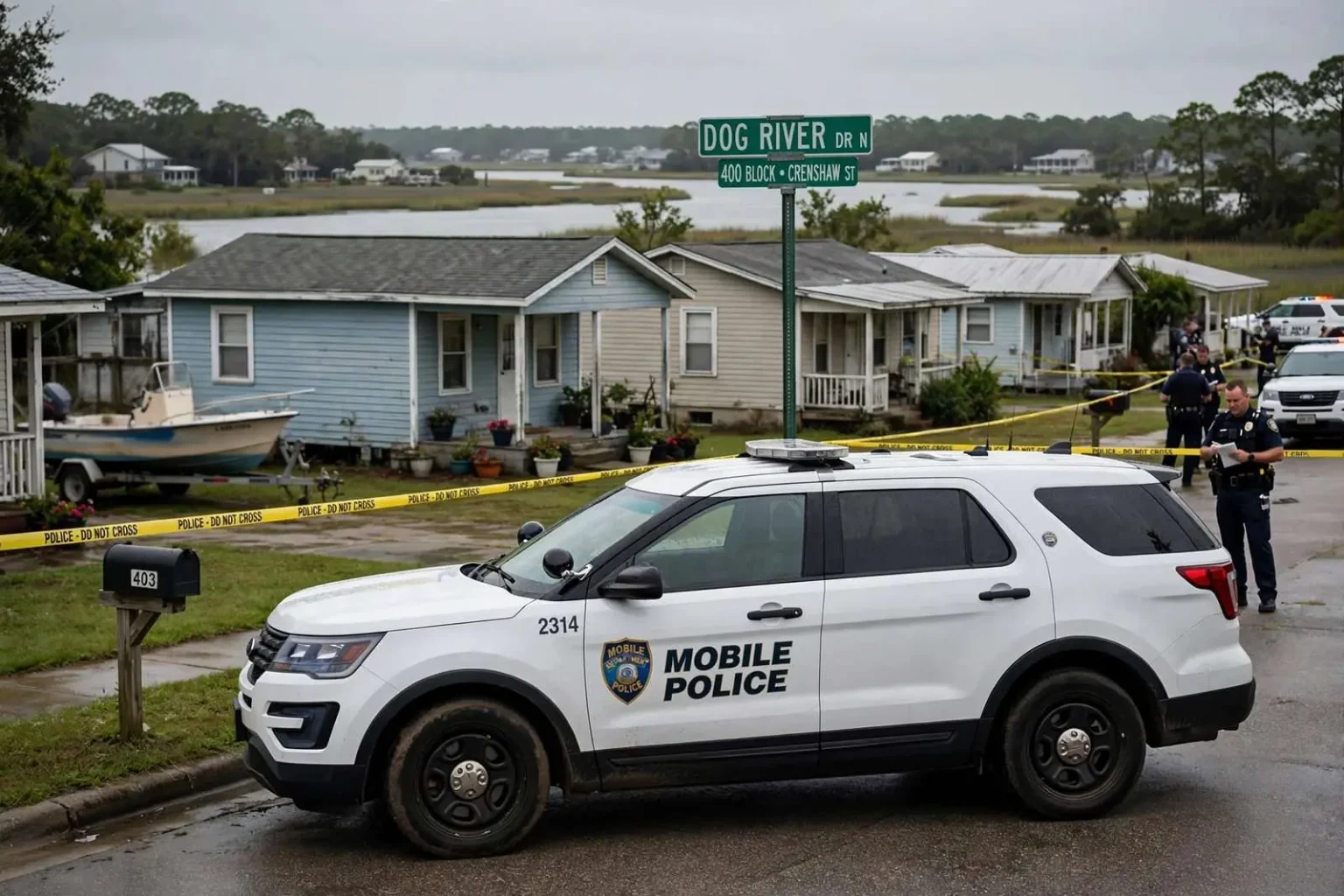
A 34-year-old man was hospitalized with life-threatening injuries after a shooting near Dog River on Tuesday afternoon, and Mobile police made an arrest in the case before the day was out. According to police, the man drove himself from Dog River Drive North to a home on the 400 block of Crenshaw Street after being shot, rather than waiting for help to find him.
Officers were called to that address at about 1:17 p.m., where Mobile Fire-Rescue medics treated him before he was taken to a hospital. By Tuesday evening, investigators had charged 26-year-old Ladarrion Holcombe with second-degree assault and discharging a gun into an occupied building in connection with the Dog River Drive shooting. The victim’s condition was not updated publicly, and police did not describe what led to the gunfire or how the shooter and victim knew each other, if at all.
An afternoon call in the Dog River area
The Dog River area sits in the southern reaches of Mobile, a neighborhood of waterfront homes, working-class streets and the creek and bayou network that feeds the river into Mobile Bay. It is the kind of residential district where a midday shooting sends a visible shock through the blocks around it, and where the sound of gunfire draws 911 calls even before anyone knows a victim. In this case the first officers arrived not at the shooting scene itself but at Crenshaw Street, where the wounded man had driven himself and where a caller had reported what they found.
Victims who move themselves after being shot present responders with a familiar set of challenges. The drive leaves a trail that investigators have to reconstruct, and the location where a victim lands may or may not be near where the gunfire occurred. Medics arriving on Crenshaw Street found a man with life-threatening injuries, and the treatment they began at the curb — controlling bleeding, stabilizing, packaging for transport — is the stage of trauma care that most influences whether a shooting victim survives. The hospital trauma center took over from there, with the patient’s condition described as life-threatening and left without further public updates.
The charges and what they mean
The charges filed against Holcombe by Tuesday evening reflect the two distinct harms alleged in the incident. Second-degree assault is the charge that corresponds to the shooting of the victim, carrying serious prison exposure for an attack that caused life-threatening injury. Discharging a gun into an occupied building is a separate offense that speaks to the danger the gunfire posed beyond the person struck, and it is the charge that reflects the fact that bullets fired in a residential area land somewhere, whether or not anyone else is hit.
An arrest within hours of a shooting is the product of fast, specific work. Patrol officers who responded to Crenshaw Street secured the scene and the victim’s account, while detectives traced the shooting back to Dog River Drive North, gathered witness statements and physical evidence, and located the suspect quickly enough to have charges prepared by evening. Speed matters in these cases for reasons beyond closure: witnesses’ memories are freshest in the first hours, and a swift arrest removes any question of retaliation while the neighborhood is still reacting to the news.
The questions that remain open
Police did not describe what led to the gunfire, and they did not say whether Holcombe and the victim knew each other, if at all. That silence is standard practice in an active case, where releasing details can compromise witness interviews, tip off anyone else involved and complicate prosecution. What the public record shows is the sequence that matters: a man shot near Dog River, a self-drive to Crenshaw Street, a 1:17 p.m. call for help, and an arrest the same day with two felony charges filed.
For the neighborhood, the unanswered questions are the part that lingers. Residents along Dog River Drive North and the surrounding streets want to know whether the shooting was connected to anything ongoing and whether the people involved were strangers to the area or part of it. Those answers tend to emerge in court filings rather than press releases, and in the meantime the arrest gives the blocks around the scene what they most want after a midday shooting, which is the knowledge that someone was held accountable before the sun went down.
How a shooting case moves from scene to charges
The path from a 1:17 p.m. call to evening charges runs through a sequence that Mobile police practice constantly. Patrol officers first secure the scene where the victim is found, keeping medics safe and preserving whatever the location can tell them. Detectives then split the work: one track goes to the victim, whose account, once he is able to give one, anchors the case; another goes to the scene on Dog River Drive North, where shell casings, damage to structures and physical evidence establish where the gunfire happened and how many shots were fired.
Witness canvassing follows the geography of the incident. In a neighborhood like the Dog River area, detectives go door to door along the streets involved, and they also collect doorbell and surveillance footage, which has become one of the most productive evidence sources in residential shooting cases. Businesses, home cameras and passing vehicles fill in a minute-by-minute picture that would have taken days to assemble a generation ago, and that footage is usually what allows investigators to identify a suspect and connect him to the scene quickly enough to file charges the same day.
What the charges carry
Second-degree assault in Alabama covers an assault that causes serious physical injury, and a conviction carries a prison sentence measured in years rather than months. The charge of discharging a firearm into an occupied building exists precisely for situations like residential gunfire: the law treats the act of firing into a home or building as a crime in itself, independent of who is struck, because every bullet fired into an occupied structure endangers everyone inside it. Together, the two charges capture both the harm done to the victim and the danger the shooting posed to the neighborhood.
The case now moves into the court system, where the charges will be reviewed by a magistrate, bond will be set, and the district attorney’s office will take over the prosecution. An arrest on the day of the offense gives prosecutors the strongest starting position, with evidence fresh, witnesses located and the suspect in custody, but the process from arrest to resolution runs for months, and the victim’s recovery will unfold on its own timeline alongside it.
Gunfire in residential Mobile
Incidents like this one land differently in a waterfront neighborhood than they do in the statistics that follow them. The Dog River area’s streets run along a beloved waterway where residents kayak, fish and dock their boats, and a midday shooting in that setting violates the expectations of a place people choose for its quiet. Community groups in Mobile have worked for years on the violence that touches the city’s neighborhoods, and each arrest like the one made Tuesday represents one piece of that larger effort, not a conclusion of it.
The charges of discharging a gun into an occupied building also serve as a public reminder that gunfire in a neighborhood is never a private matter between two people. Bullets that miss their intended target keep traveling, through walls and windows and into rooms where families are sitting. Alabama’s lawmakers wrote the occupied-building offense to say exactly that, and prosecutors in Mobile County have used it consistently in cases where gunfire crossed from a dispute into a threat against a whole household.
As of the latest public information, the victim remained hospitalized with life-threatening injuries, the suspect faced two felony charges, and the investigation into what led to the shooting continued. The neighborhood along Dog River got its answers faster than most: an arrest, charges and a case headed to court, all before the day ended.
What residents can do after a shooting nearby
When a shooting happens in a residential area, investigators depend on the people who live around it, and the first hours after the incident are when their information is worth the most. Anyone who heard the shots, saw a vehicle leaving quickly or has a camera that points toward the street can call Mobile police or leave an anonymous tip through the department’s tip lines, and even fragments — the time, the number of shots, the direction the vehicle went — help investigators build the timeline the case will rest on.
The same alertness protects the neighborhood in the days that follow. Residents noticing unfamiliar vehicles, damage to homes or cars they had not previously spotted are encouraged to report it rather than assume it is unrelated, since the full extent of an incident like Tuesday’s shooting often becomes clear only as people examine their property and share what they find. A charge of discharging a gun into an occupied building is proven, in many cases, with exactly that kind of neighborhood evidence: a hole in a wall, a fragment in a fence, a camera clip no one knew existed.
The victim’s recovery and the case ahead
The most important open question in the case is the condition of the 34-year-old man who drove himself to Crenshaw Street with life-threatening injuries. No update was given publicly, and trauma teams at Mobile’s hospitals treat gunshot wounds of that severity on timelines that can run from days to months, with setbacks and recoveries that families rarely describe publicly while care is ongoing. His survival is the measure against which the rest of the case will ultimately be read.
For Ladarrion Holcombe, the path forward runs through the courts, starting with an initial appearance and bond review and continuing through whatever motion practice, negotiations or trial follow. The charges as filed — second-degree assault and discharging a gun into an occupied building — will be tested against the evidence gathered on Tuesday afternoon and the days since, and the swiftness of the arrest will be among the reasons the case file is as complete as it is. In a neighborhood still processing the sound of midday gunfire, that file is the record of how the system responded, and the arrest before sunset was its first statement.


